Zak Romaszko
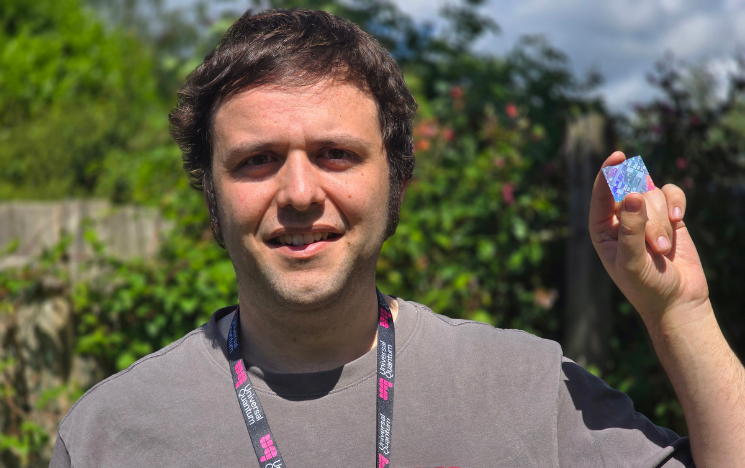
Zak (PhD Physics 2015) is Head of Quantum Chips at Universal Quantum, a world-leading team working to build quantum computers that will empower humanity to solve our most complex challenges.
Zak’s story
Zak started his journey at Sussex studying for his PhD within Winfried Hensinger’s IQT (Ion Quantum Technology) Group at the Sussex Centre for Quantum Technologies. Quantum Technologies is one of the University’s Centres of Excellence, drawing together world-leading experts and innovative approaches in quantum physics research to create transformational commercial products with the potential to change the way we live and work.
Following the completion of his PhD, Zak joined Universal Quantum, a spin-out company from the University of Sussex, as a Microfabrication Engineer. Universal Quantum develops scalable quantum computing technologies with applications across areas such as drug discovery, climate modelling, and advanced battery chemistry.
Zak specialises in ion-trap design and fabrication, with a particular focus on scalable and efficient methods for controlling large-scale quantum computing systems. His expertise spans the development of microfabricated quantum hardware and the engineering challenges associated with building practical, large-scale quantum machines.
What does a day in your role at Universal Quantum look like?
Incredibly varied! Some days, it is deep technical work in chip design, other days it will be freezing devices to cryogenic temperatures to see if they still behave as we expect or proposing new machines for different customers and projects.
Why did you choose to complete your PhD at Sussex and what motivated you to pursue a PhD specifically in ion trap quantum computing?
Winfried “Winni” Hensinger’s research. There’s a limited number of spaces to study quantum technology. When I started, the focus for quantum devices was limited in both scope and ambition. Winni challenged the status quo with a focus on scaling from the get-go. He's one of the first to push the idea that quantum computers need to be really powerful before they provide societal use and that was incredibly refreshing at the time.
What was the best thing about studying in Winfred Hensinger’s Ion Quantum Technology group?
I got to play (and break) a lot of cool things, and this learning was expected and welcomed. The learning was hands-on, in at the deep end, but there was also a support network to help you if needed. Also, there were so many other students in the research group who were an incredibly friendly and sociable bunch.
How did your first post-PhD role compare to your expectations?
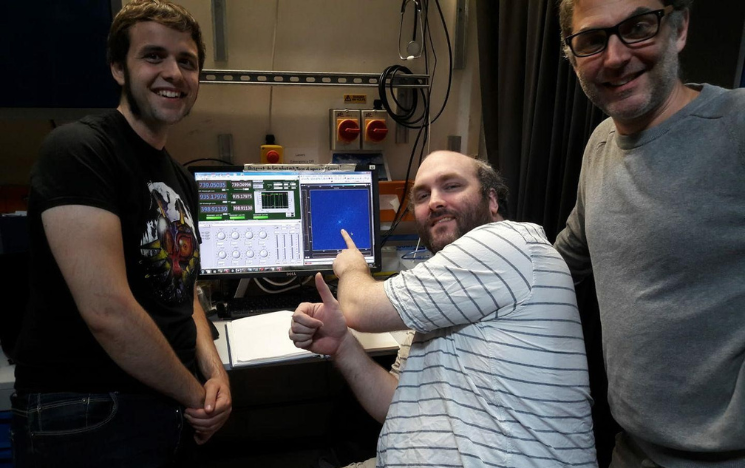
I was fortunate that towards the end of my PhD, Winni and Sebastian [Weidt] were starting up Universal Quantum which was a spin-out of the IQT research group. During my PhD we had always discussed that to scale these machines, the economics of it had to make sense.
I joined as the first employee alongside Iain Hunter (who was also in the research group), and it was very different to academia. We had to set up a whole bunch of operational activities because it was just us. We spent a lot of time talking with suppliers and hiring new people so that we could eventually get back to what we knew. Six years in, and we have 100+ people and we have a great operations team allowing me to think about quantum machines.
What were the biggest differences between academia and industry?
Academia has a freedom in research direction. My PhD started off with a focus on microfabrication of ion trap devices. Over time, that morphed heavily from the design of them to finally thinking how to scale the control of them. In industry, there’s a much more overarching common goal, that we’re all working together to meet. That doesn’t mean that you’re not jumping from project-to-project because I do that a lot still, but it does mean that I can’t go down every rabbit hole I’d like to.
Can you explain what quantum chips are to a complete beginner to quantum computing?
The operation of a quantum computer relies on quantum bits called “qubits”. Without going into detail, these allow us to solve problems much more efficiently than regular bits. The quantum chip acts as the boundary between the qubits and the classical computer controls that operate the quantum computer. For us, this is known as an ion trap. It’s a piece of silicon for example, which has a bunch of electrodes that are patterned onto the surface. When you apply oscillating voltages to these electrodes, it allows ions (a charged atom achieved by removing an electron) to be trapped which act as our qubit.
What excites you most about the future of the field?
We’re still not yet at useful quantum devices i.e. where they can help humanity achieve something they couldn’t have before. This moment is coming and we will have the potential to change the world for the better – think new materials, medicines etc.
What advice would you give to students who wish to pursue a career in quantum computing?
Try not to get too bogged down in one topic. It's really easy when you're in the thick of research to forget why you’re doing this. A holistic understanding can let you solve problems by fixing something else!
And finally, some quickfire questions:
If you were to describe Sussex in 3 words, what would they be?
Top notch research.
What inspires you the most?
Anyone who is passionate about something. If it wasn’t for passionate people, a lot of labours-of-love wouldn’t have worked out!
What do you do to relax?
Table tennis, video games and gardening (especially de-weeding).
Interviewed by Emily Crozier, Senior Research Project Officer, Sussex Centre for Quantum Technologies.