Cristina Loma Aragonés
Cristina (MSc Management of Information and Technology 2018) is a Bolivian entrepreneur and the Founder and CEO of MeridianPath.
Cristina’s story
Cristina began her journey at Sussex as a Chevening Scholar. Already an accomplished project manager with a passion for technology, she wanted to bridge the gap between technical innovation and the real needs of users. At Sussex she gained not only technical expertise but also a more human-centred perspective on technology.
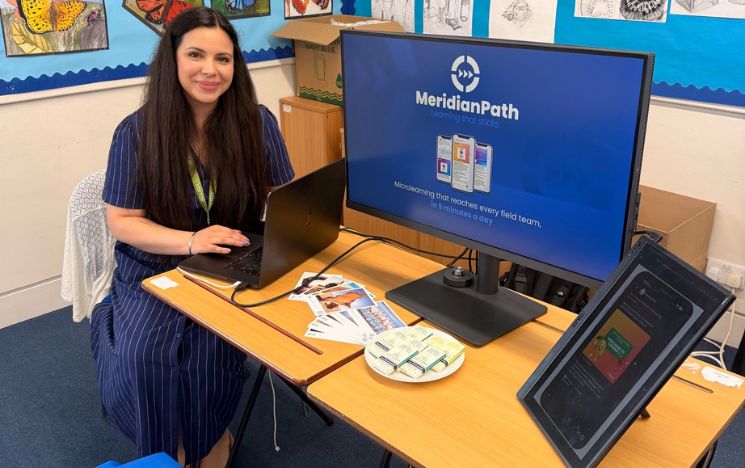
This people-focused approach became the foundation of MeridianPath, the microlearning startup she’s running from London. MeridianPath helps Latin American field workers turn disruption into a performance advantage through accessible, skills-based learning in the flow of work. The start-up was awarded gold in the Learning Technologies Awards 2026 in the Best Learning Technologies Project, Commercial Sector (UK) category for Bagó Pharmacy Academy.
What made you choose to study at Sussex?
Studying at Sussex was an inflection point in my professional career, allowing me to build a solid technical background. I was already working in government technology and capable of delivering projects, but I always felt that I could dive deeper into technical knowledge and a methodology for collecting evidence and understanding the people who would use the digital platforms. The course at Sussex addressed those precise gaps.
What was it like studying at Sussex as an international student?
The primary adjustment was academic rather than cultural. UK assessments require more independent argument and evidence, and less repetition of what was taught in class. I managed this transition well because I had access to academic papers and knowledge that were unavailable to me at home, alongside on-campus housing, expert professors and exceptionally talented classmates from around the world.
There were many additional opportunities outside the daily academic routine, such as the Sussex Innovation Centre, where I was a finalist at the StartUp Sussex Awards; university competitions; and coding courses like Code First Girls. These were where I first tested my own ideas.

How did your course in MSc Management of Information and Technology influence your career?
I arrived from a management background and graduated capable of working on the technical side. I discovered many new things; for instance, I engaged with a technology entirely novel to me while using Natural Language Processing (NLP) for my dissertation to conduct a sentiment analysis of privacy policies. Additionally, the human-computer interaction and user research modules gave me the frameworks and methods I still rely on, testing assumptions before building. At MeridianPath, we begin with fieldwork rather than a feature list, sitting behind a pharmacy counter in La Paz or travelling with a loan officer to a rural community. Sussex is where I learned that this counts as real work, not a nice extra.
Tell us about your company, MeridianPath.
At MeridianPath, we deliver just-in-time training to field workers in regulated sectors, with supervisors and managers built into the loop so learning shows up in real results like sales, inventory or loan collections. These workers are personally accountable for the decisions they make, handle high volumes of information and knowledge, and rarely sit at a computer, meaning conventional corporate e-learning doesn’t reach them. Of our participants, 95% apply the practical lessons immediately.
This year, we ran a programme with a major pharmaceutical laboratory across nine Bolivian cities where, unusually, adherence rose with each course instead of dropping. That client is now scaling it to over 500 people, and we’re expanding into Ecuador.
“Start from a problem you’ve seen up close, because that knowledge and experience give you the instinct and critical thinking that can’t be easily replaced.” Cristina Loma Aragonés MSc Management of Information and Technology
Where did your interest in technology, AI and education come from?
Education came first. My parents, aunts and grandmother were all public school teachers in Bolivia, and I grew up watching them teach extremely well with almost no resources. Technology came through the early tech communities in my home country, where I was one of the first women involved, working on digital literacy, privacy and the national digital agenda. AI is the most recent layer. What connects all of it is agency. I’m interested in tools that widen what individuals can decide for themselves, rather than quietly deciding for them.
You were a Chevening Scholar and launched Transformando la Educación, a podcast featuring Latin American EdTech leaders. Why do you think this work is important?
It was a collaboration between Chevening alumni funded through the Chevening Alumni Programme Fund, and the aim was to place Latin American women leaders in education in front of a regional audience. Knowledge in the region was completely siloed by country, so the value was in getting practitioners from Argentina, Peru, Paraguay and Bolivia into the same conversation, between them, they had already solved most of the problems the others were facing.

What is your favourite place on campus?
The path from the library back to Northfield, where I lived in campus accommodation. I came from a city with few green spaces, so crossing paths with rabbits and foxes on my way back from studying was incredible. Having nature all around me brought me a sense of calm, even during the most stressful periods of exams and my dissertation. Being able to walk through nature was a great way to reset.
If you were to describe your time at Sussex with a song, what would it be?
Havana by Camila Cabello. It was everywhere that year and marked the moment Latin artists truly broke through internationally. It’s a song about leaving your heart somewhere else, written by someone who emigrated from Cuba as a child. That’s the immigrant experience exactly, being fully present in a new place and still carrying home with you.
You joined the online Global Mentoring Programme in 2024/2025 where you were mentored by a Sussex alumnus. What kind of things did your mentor help you with?
Adrian helped me on two levels: strategic thinking and practical application. As someone who’d been through several career changes himself and is now a Partner at EY, he was an invaluable role model for someone with a portfolio career like mine, pushing me to keep advancing rather than settle. On the tactical front, we sat down and reworked my LinkedIn profile, my CV and my business pitch line by line. I’d recently relocated to London, assuming my track record would translate on its own. It didn’t, and having someone of that calibre who knew this market tell me plainly what wasn’t landing saved me a great deal of time.
What advice would you give to young female entrepreneurs who are looking to get into the technology field?
Today more than ever, you can be a builder rather than only a consumer of technology. The tools have collapsed the distance between having an idea and having a working version of it, and you don’t need permission or a large team to start.
Beyond that:
- Start from a problem you’ve seen up close, because that knowledge and experience give you the instinct and critical thinking that can’t be easily replaced.
- Don’t wait to feel qualified, that feeling arrives long after you’ve begun.
- Gather evidence about what your product does. You’ll walk into rooms where people doubt you, and data settles that much faster than confidence.
Cristina is among thousands of inspiring alumni on Sussex Connect. Join now to seek mentoring and industry advice and get a head start on your career.