Women’s action learning groups
Read about how women in Rannu and Katinting play important roles in productive work such as fishers, seaweed farmers, traders and casual labourers, whilst also maintaining family life.
Energy in daily life
Women in Rannu and Katinting, two villages in a small island in South Sulawesi where we are engaged in action research on participation of women in renewable energy (POWERE), play important roles in productive work such as fishers, seaweed farmers, traders, casual labourers, and so forth, and at the same time take care of reproductive activities such as domestic work in their households.
In terms of the use of energy in daily life on the island, women are the ones who actively manage consumption at the household level. Several of them are able to handle the technicalities of the renewable energy equipment they use at their houses, including small solar chargers, batteries, cables, and inverters. For the households that still use communal non-renewable energy as the source of their electricity – a public diesel generator operating several hours a day – women take care of the payments of the fee for their household.
The knowledge, skills, and experience they gain from these activities as well the important meaning of electricity for the well-being of themselves and their families, make them ideal actors for co-designing, co-managing, and ensuring sustainable use of the community-based floating solar panels that POWERE will build in their villages.
However, many women in Rannu and Katinting face a variety of obstacles due to socio-cultural and economic factors, among others, that hinder them to utilise their potential to actively participate in and serve as leaders, committee members, or managers of community-based renewable energy initiatives.
Responding to this situation, POWERE launched community-based action learning groups for women in Rannu and Katinting in early December 2025.
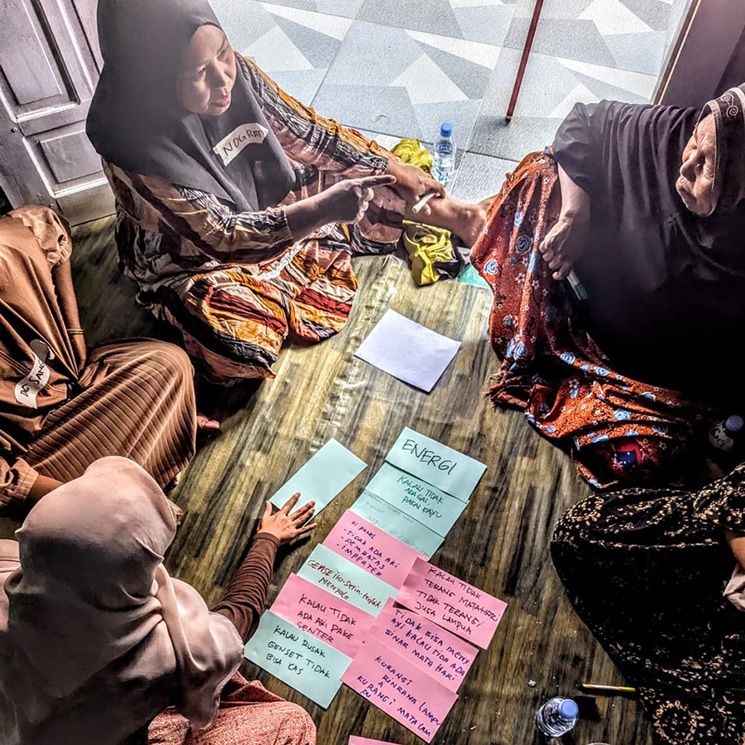
Women action learning group in Ranu Village
Action learning is a method and skill set for critical-creative reflection and collective action that builds a ‘dynamic capability’ for the women and the larger community, i.e. an adaptive and problem solving capability that can be extended to any issues faced by the women and/or their community.
Community-based action learning complements our action research approach. We are using the two together to strengthen critical awareness and capacity building of coastal rural women so that they are prepared to actively participate in the decision-making processes and even as the main drivers in the installation of the floating solar panel/FPV, its management and services to the wider community.
The design of POWERE’s action learning is equipped with certain modules that are developed with the principles of contextual critical education for adults. These modules are formulated to strengthen critical awareness and to build the capacity and skills the newly formed women's self-empowerment groups will need to co-design and manage the FPV on behalf of the community on an ongoing basis.
We facilitated the action learning group launch by eliciting a learning compact from the members confirming they wish to meet on a weekly basis and stipulating their own terms and principles of participation.
The action learning groups for women in Rannu as the larger village with around 1,074 inhabitants have about 25 women participating, and in Katinting as the smaller village with around 230 inhabitants about 15. While all engage in multiple livelihood activities, the majority of their income derives from seaweed farming. These participants represent diverse cross sections of the community in terms of wealth, status, and education.
In Rannu Village, participants include (using pseudonyms throughout) Daeng Rembulan, who works as a casual labourer in the low-paying task of tying seaweed, Daeng Noni, a female head of household who makes and sells traditional snacks, Daeng Tina, a play group teacher with a bachelor degree in early education whose lower-educated husband works as a fisher, and Daeng Nina, the wife of a wealthy punggawa (seaweed market intermediary) who is busy helping her husband with business.
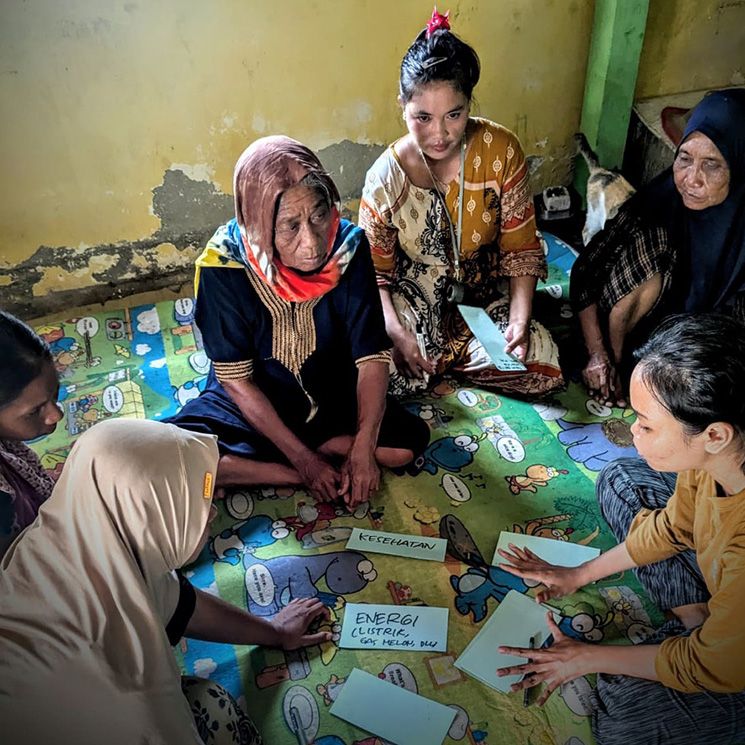
Women action learning group in Katinting Village
In Katinting Village, participants range from high school graduates such as Daeng Tika and Daeng Nina who manage their small seaweed farms, Daeng Nuni and Daeng Tuti, mother and daughter of a punggawa family who both struggle to write their names as they did not finish elementary school, Daeng Tina, a small petrol stall owner whose husband left her and her children in a situation of being unable to have a registered family card that hinders school entrance for her children and access to public health insurance, and Daeng Kaka, a fisher who only completed elementary school but has revealed a hidden talent for public speaking.
What the women are discovering through sharing, acting, and reflecting together in the action learning groups is that despite their differences, as women living life on a small island they have in common many unmet needs and that by acting together they can address these needs in ways that surpass the possibilities of any one individual.
At the second meeting of the women’s action learning group in Rannu Village, one participant stated that the action learning groups must continue because “we must learn together, think together, and act together to address our problems.”
The same positive energy and enthusiasm also appears in Katinting Village, where the women have started making informal discussions about the action learning meetings during their daily conversations. They are now excitedly discussing the name they gave to their group. Learning and acting together to address the problems, especially related to renewable energy, have started to become part of their hopes for a better future.
By Mia Siscawati, Bradley D. Parrish, Runavia Mulyasari, and Diah Irawaty