Boats galore
Learning more about the different boats and how they are used on the islands.
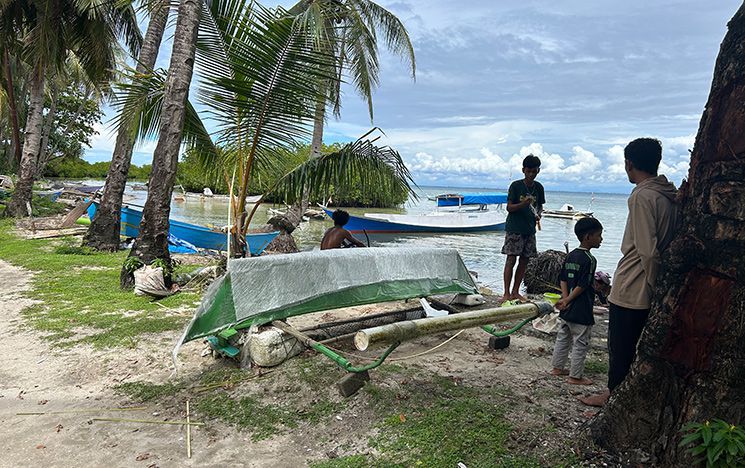
A lepa-lepa boat (without an engine) being repaired in Biyawasa in Indonesia.
All along the coast of Biyawasa, a kaleidoscope of different size, shapes and coloured boats are moored on the beach or near to the shore. There are ten boatmakers on the island. We talked to one of them, Abi, a fifty-year-old father of three daughters, to learn more about the boats while exploring potentials for solar-powered boats and women’s engagement with them.
Building boats
Educated to the third grade in elementary school, Abi started helping his father and uncle from the age of 15 in their boatbuilding business. This was in addition to the art of fishing, having developed a working knowledge of the boats in action. He recalled making sailboats with them up until 2000:
“In the olden days, we had kappala with sails. It was a different shape to the ones we make now. Then people started using jalloro with diesel. Those who had money wanted to use an engine to speed up their fishing and other travels. They also wanted more control of the waves and for the direction. When people used sail boats if they went to Makassar [the provincial capital on the mainland] it could take 2 days. With an engine it takes only 2 hours.”
Their boats were ordered across the islands of Tamparang, extending also to the mainland. Samarinda wood was imported from the forest island of Kalimantan for their construction.
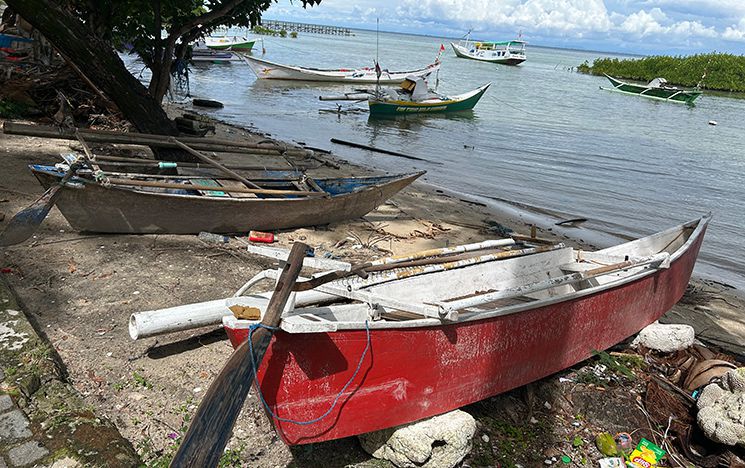
Lepa-lepa boats with and without an engine with larger jolloro boats in the distance.
Different types of boats
Abi showed us some of the boats he was repairing, as in the rainy West monsoon season (musim barat), orders for new boats dried up. He explained each one in depth:
“Jolloro is for long journeys and for large loads of fish. Its engine size varies from 30 to 300 PK [1 PK being equivalent to 1 horsepower]. It can be 16 metres long. The width is 3 metres usually. Sometimes people use a car engine (mesin) for this. It can cost around 200 million rupiah to buy [approximately £9,000].
Jollo-jolloro is a smaller boat for fishing and in Rannu it is used for seaweed farming. It uses a ketinting engine [using a pull cord to start the engine]. The engine size can vary from 10-24 PK, usually a Honda engine. Sometimes it can be 7, 9 or 13 PK. The boat can be 9 metres long and the width 1.5 metres long. It can cost 40 million.
There are 2 kinds of lepa-lepa – one with and one without an engine of about 7 or 13 PK. It’s the same engine as the jalloro as it provides speed. It can be 3 metres long and used mainly for catching squid. It can cost 7 million to buy. The one with wings (palewai) is without an engine. It costs 2 million.
Pete-pete is a bigger boat with an engine and wings. This engine can be 7 PK. It can be 5-7 metres long. It can cost 7 million as it has a similar engine where you pull to start.
A jalepa has a flat bottom so that it doesn’t go deep into the sea. We use it at low tide. It also uses a pulling rope for starting the engine. People use it for low tide work and travel such as seaweed farming and to repair the nets. The average size is 7 metres length. The engine is around 15 PK. With an engine it costs around 10 million. Without, around 7 million. It is different from a lepa-lepa as people can’t use that boat at low tide. It’s the same kind of engine but has different usage. The shape of the boats is different as well.
We also make a bigger jolloro as well. It is usually 14 metres long by 2.5 metres. It uses 2 engines--one is 300 PK and the other is 30 PK for extra speed.”
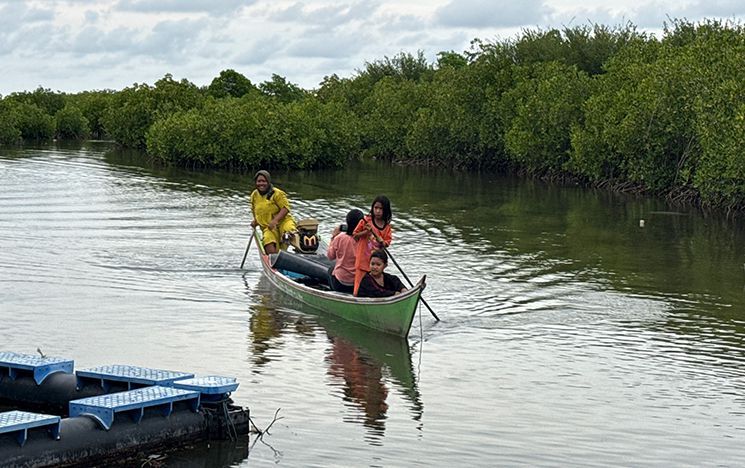
These descriptions may vary from village to village, person to person, but across the islands of Tamparang, all larger boats use diesel and the smaller ones use “benzene” (petrol). Even though it is a costlier fuel this is offset by the fact that the engine is cheaper than the one made for diesel. Occasionally, Abi had made a jolloro where the engine starts with a solar battery (aki). For instance, they had made a very large white jalloro boat for Hajji L in Rannu with solar-powered ignition for the engine.
Buying boat engines
Abi buys the engines in the provincial capital, Makassar. He tests the engine there and then before bringing it back to install it on the boat, and then tests it again with the customer. The engines might be manufactured by Honda, or “Matari” (Marelli or Mitsubishi), with Honda Mega being his favourite. They are all with a pull-cord start. While there are engines that start with push buttons, which might be easier to operate for some, they cost much more. He elaborated:
“The customer decides the engine, and that determines the cost of the boat. A new Honda engine can cost 4 million rupiah. A second-hand one can be half the price.”
Boats take up to three months to build
The average time to build a jalepa is about a month with support from his wife who may pare the sides of the boat. For the larger jolloro, it may take up to 3 months with support from 2-3 other men:
“Sometimes fisherman return from fishing at 8am. They can help with fixing and making the boats. Around 11 they stop and do their prayers and lunch. Then they can return in the afternoon for more work if it is available.”
Such work comes in very handy for other fishermen, especially during the months of January and February when it may be too stormy to go out and fish.
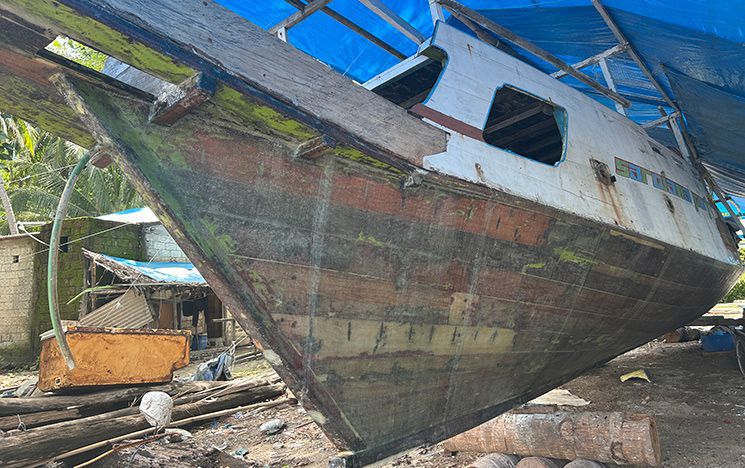
A jolloro boat being repaired during the rainy season in Biyawasa.
Using solar power for boats
When we discussed environmental issues, Abi was adamant that boats do not pollute, and that “it’s just smoke” that comes out of the engine when it starts. Like many others on the island, he had noted changes in the environment but had not heard of climate change. However, he had invested in a SuperSUN. solar power unit (combining battery, inverter and meter in one) that he had received from the village head, a distant cousin, which cost 1,200,000 IDR to install in 2025. He described the two 300-watt solar panels as “airplanes” (pesawat in Indonesian), probably because they look like aeroplane wings or the runway.
His preference for solar power (tenaga surya) is borne out of the fact that they do not need to pay monthly payments for the communal diesel generator. Before SuperSUN, they had a smaller solar panel to power four LED lamps and one television set, and charge two mobile phones and one flashlight each day. Ironically, solar is a word which in fact is used to describe diesel as a historical hangover when colonial powers introduced the fuel to Indonesia in the nineteenth century.
Abi’s interests in solar power extended to the boat in terms of solar panels being used to start the engine on a jolloro. However, he was not convinced that it could power a boat for long journeys but conceded that it could be used for near-shore activities as on a jalepa if the cost was not prohibitive.
Women's roles in operating and making boats
On women’s engagement with boats – apart from his wife’s contribution to the manufacture of the smaller vessels – he was also aware that a few women operated jalepa on the next island while tending to seaweed farms. He laughed while he told us a story about his seven-year-old daughter:
“Once my daughter steered the boat to Rannu (a half-hour journey over rolling waves to the next island). I sat next to her. But I want my daughter to be educated like you, so she will go to school. It looks like no one on my side of the family will continue the boat-making. My nephew might continue but he’s not as smart as me.”
Despite his ambitions for his daughter, he was not convinced that she could lead a successful boatmaking career. He did not explain why but it was an unspoken understanding that women do not do this kind of thing in a patriarchal society like in Biyawasa. If women are now beginning to sail boats in and around the islands of Tamparang, especially the jalepa for nearshore work, such views may well begin to change. The prospect of attaching sustainable electric motors to them is also a massive boon to both livelihood and the environment.
By Raminder Kaur and Della Arlinda Birawa.