Scoping the off-grid island of Tamparang
Our researchers visit several villages to find out more about electricity provision on remote off-grid islands in Sulawesi.
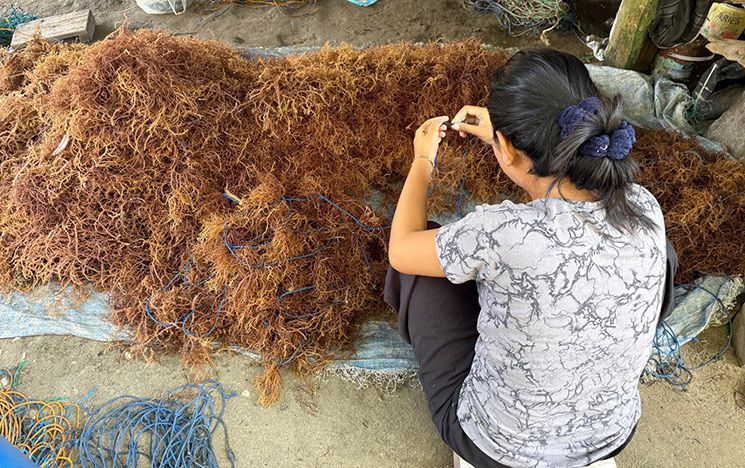
Woman in Katingting harvesting seaweed in Sulawesi. Photo by Raminder Kaur.
Tamparang
On a sunny yet breezy afternoon, our boat docked on Tamparang, a remote island in South Sulawesi. We were on a preliminary trip to potential research sites with CARE Indonesia representatives, Renee Picasso Manoppo and Muhammad Idhan, and postdoctoral researcher, Agung Iswadi, who also works for the renewable energy consultancy company Aquatera. We visited several villages, a summary of which we provide below with respect to electricity provisions, or lack thereof. The names of the island and villages visited are all pseudonyms.
Tagale
Village population 1,261 people, and about 300 households.
It has electricity provided by a solar power plant (PLTS) during the day; while at night, residents switch to diesel-run generators (PLTD). Both power sources are distributed from the sub-district capital of Tamparang. Residents’ electricity costs are subsidised so that household bills range from 100,000-200,000 IDR (Indonesian Rupiah) per month (approximately £5-£10).
Katinting
Village population 2,537, including 614 households with no electricity.
The two other sub-village neighbours of Katinting have electricity from a PLTS solar power plant, supported by the Ministry of Energy and Mineral Resources (ESDM). This solar power plant was once damaged, but the community managed to repair it and establish a self-managed system. Each household pays an average of 30,000 IDR for 600 kWh. The collected funds are used for maintenance and the operator's salary, which amounts to 1 million IDR per month. The operator, who previously worked at PLN (Indonesia's state electricity company), has the skills to handle repairs and maintain the electrical grid.
Most households in Katinting rely on battery-powered flashlights and kerosene lanterns, with only eight homes having installed small solar panels, which can power a few lights and charge mobile phones. A woman who had installed a small solar panel on her house stated that the ability to charge her mobile phone daily allows her to keep in touch with her relatives and to get information about the outer world. She hopes that Katinting will get better access to electricity so that she and other women in the village could have electrical household equipment that would reduce their time spent on domestic chores.
Katinting has recently received a solar panel grant from PLN for public facilities. The solar panels were installed in the village mosque and the local government office with a total capacity of 900 kWh. Under a voucher-based payment system, the community contributes an average of 50,000 IDR per month for electricity usage.
Learning about island life
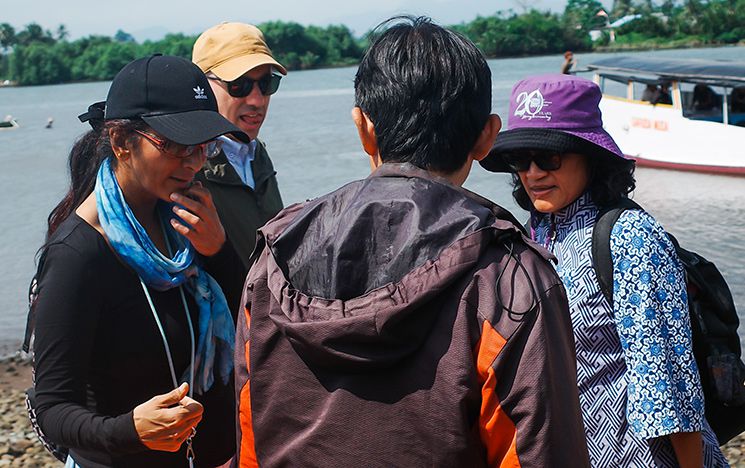
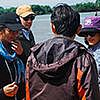
POWERE team meet with local residents in Tamparang island including Professor Raminder Kaur, Dr Mia Siscawati and Dra Bradley Parrish. Photo by Muhammad Zamzam Fauzanafi.
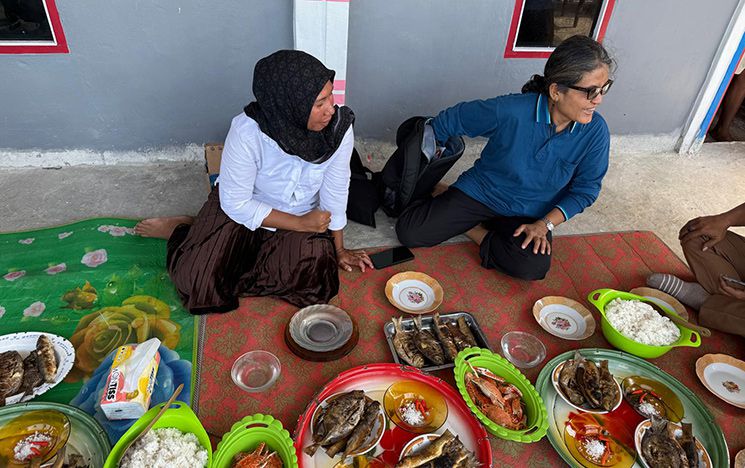
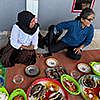
Sitting down to dine on fish and rice with residents in the off-grid village, Rannu, with Dr Mia Siscawati. Photo by Raminder Kaur.
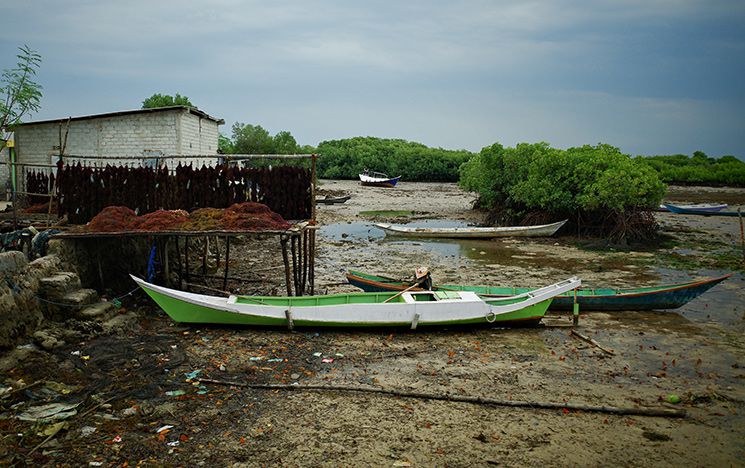
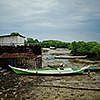
A small boat, jalepa, used for nearshore activities such as seaweed farming around the Sulawesi island of Tamparang. Photo by Muhammad Zamzam Fauzanafi.
Rannu
Village population 1,300 with 326 households.
Upon arriving in Rannu, we were greeted by the village head, uniformed department heads (KAUR), local police, and a group of enthusiastic women of all age ranges, some of whom are part of village governance institutions.
"The main issues here are electricity and water," explained the acting village head of Rannu. "We have a solar power plant (PLTS) and a seawater desalination unit—but both have been defunct for about three years now.”
The solar power system (PLTS) was enabled by a grant from the Ministry of Energy and Mineral Resources (ESDM), but critical flaws in its implementation led to its failure. There was no local capacity-building and no training was provided to villagers for maintenance or troubleshooting. This meant that the community was not able to tend to any technical issues when they arose. A dependency cycle was set up: top-down aid without community empowerment meant that the system collapsed within three years.
According to one of the village department heads (KAUR), another factor in the solar power system failing is because the batteries overheated—the battery storage room lacked air conditioning, causing excessive heat buildup. Furthermore, the village's generator set (genset) has also been broken for a month. “We're left in total darkness here,” lamented the village head.
About 10% of households have small solar panels, which they use to power a few lights and charge their mobile phones. Most village residents now buy rechargeable battery-powered flashlights, and rely on neighbours with solar panels to charge them.
Biyawasa
Village population 2,000, with no electricity.
Finally, members of our team visited Biyawasa on a smaller, nearby island that is part of the wider group of islands of Tamparang. The village once received a government-funded solar power plant but it has been non-functional for about five years, after its batteries exploded and caught fire. Some village residents blame the former village head, who controlled the solar plant management and appointed his son-in-law as the operator. “That was nepotism—the operator lacked technical skills but got the job because of family ties,” said a Biyawasa resident. The solar power system (PLTS) was effectively monopolised by the former village head because it was installed on his private land—a conflict of interest that led to the system’s collapse.
When the PLTS was operational, the system worked as follows: each household pays a monthly fee of 20,000 IDR (about £1) for a 300 kWh electricity supply. The management collects about 8 million IDR (£360) each month. From that, 2 million IDR is used for operational costs, like maintenance and staff salaries. This leaves the management with a surplus of 6 million IDR (£270). However, there is no further information on what happens to this leftover money.
Due to its proximity to the sub-district capital, Biyawasa residents could potentially negotiate electricity access from these installations, which has both a solar power plant (PLTS) and a diesel power plant (PLTD). The new village head attempted to transfer control of the solar power system to the village government, but the effort was flatly rejected, leaving the system defunct to this day.
By Muhammad Zamzam Fauzanafi, Mia Siscawati, Raminder Kaur and Bradley Parrish.