Livelihoods in Tamparang island
Learn more about seaweed farming and other livelihoods in remote villages.
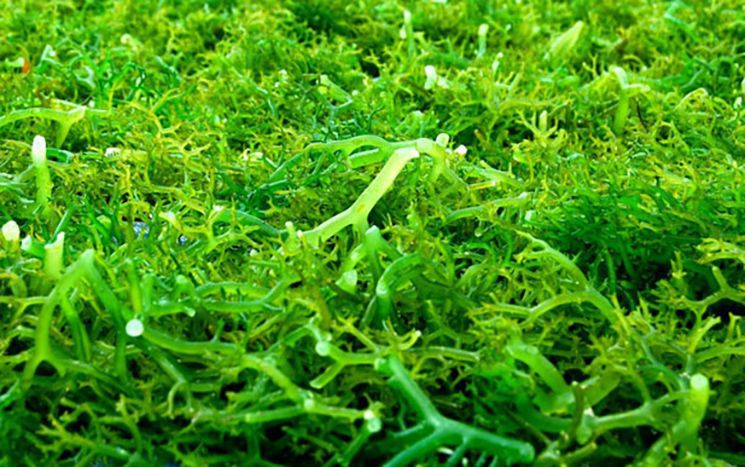
Eucheuma cottonii (commonly referred to as cottonii) seaweed in Tamparang Island.
Tagale
As with neighbouring villages, residents of Tagale on the off-grid Indonesian island of Tamparang (all pseudonyms) in Sulawesi cultivate a variety of seaweed – mainly Eucheuma cottonii (commonly referred to as cottonii) and Eucheuma spinosum (SP).
A typical seaweed farming family will have about 100 lines of seedlings (bentang) in the water that can produce 1 tonne of wet seaweed every 45 days or 7 kg wet seaweed, which is equivalent to 1 kg dry seaweed.
The post-harvest processing of seaweed in Tagale yields superior product quality compared to conventional rack-drying. The community appreciates that oven-drying could enhance seaweed quality by up to 75%. However, this potential improvement fails to generate economic returns because buyers will buy the seaweed for the same price regardless of seaweed quality and village provenance. Ovens are also expensive and energy-intensive.
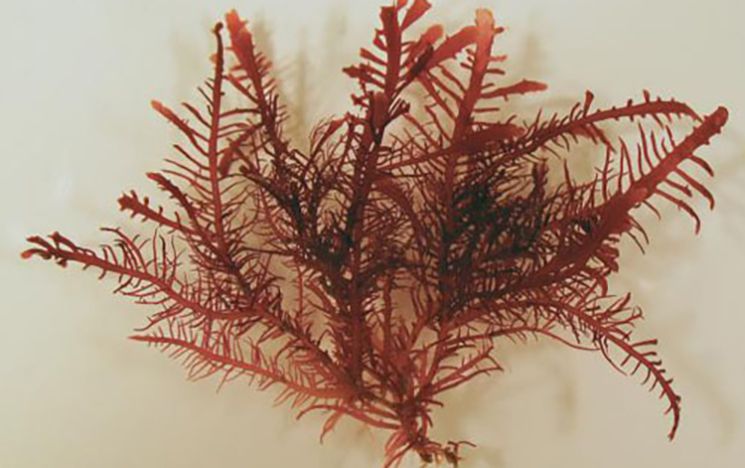
Eucheuma spinosum (SP) seaweed in Tamparang Island.
Women's and village enterprise roles in seaweed production
Women play important roles in seaweed farming, harvesting, and processing. In addition, Tagale has several women’s groups, which were set up with the support of a few NGOs (non-governmental organisations) that worked in this village. These groups include women supporting mangrove conservation, a women’s field school, and a group of women coastal farmers. As a result of women’s organising processes, the village has witnessed nascent entrepreneurial activities to diversify seaweed utilisation through enhanced food products. These include seaweed crackers (kerupuk), seaweed-based meatballs (bakso), seaweed jam (selai), and seaweed jelly (jeli). Such products are used for household consumption level, and no commercial distribution has to date been established.
The Tagale village-owned enterprise (Badan Usaha Milik Desa or BUMDes) operates with two business units: savings and loan/micro-credit (simpan-pinjam) and shrimp and milkfish (chanos chanos) aquaculture, which has ceased operations due to the mass mortality of stocks.
The BUMDes, along with six other village enterprises in Tamparang, has recently undergone comprehensive leadership restructuring following widespread enterprise failures. The restructured BUMDes in Tagale has secured substantial development funding through the following allocations: the total village funds obtained amounted to IDR 700 million (Indonesian Rupiah, approximately £31,600). The allocation for BUMDES was 20% (IDR 140 million). These funds fall under the funding classification: programme category for “Food Security”. Using these funds, they plan to establish a business: farming sea cucumbers (holothuroidea) in floating cages (karamba).
Katinting
Nearly all households in Katinting village cultivate seaweed, primarily of the cottoni and SP varieties. Each household manages 50 to 100 cultivation lines, with seedlings sourced from a mainland village. The women are actively involved, particularly in the tasks of tying and sun-drying the seaweed. For each bundle they prepare, they earn a wage of 3,000 IDR. They sell the dried seaweed to punggawa (middlemen or go-betweens) under the same system. They usually borrow money from the punggawa to fund their seaweed farming operations, typically of around 10-15 million IDR. The village head also acts as a punggawa, purchasing seaweed from local farmers and selling it to distributors in Makassar.
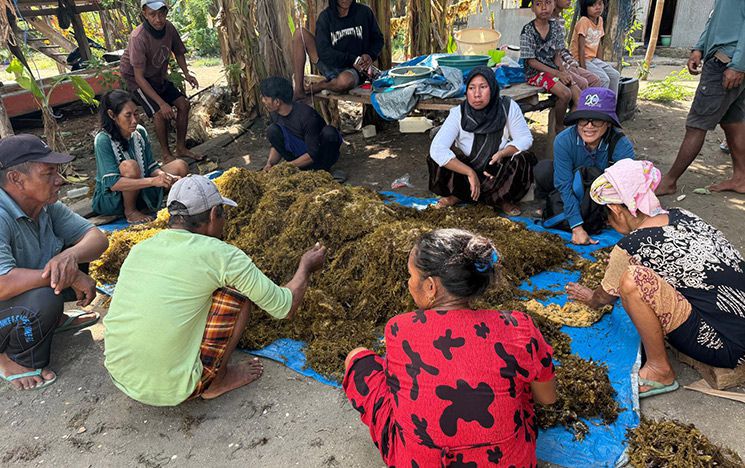
Women harvesting seaweed in Katingting village in a remote Sulawesi island. Photo by Raminder Kaur.
Global markets and the collapse of seaweed prices
Currently, the price of seaweed has plummeted from 42,000 to 14,000 IDR per kilogram. According to researchers from the Brackish Water Aquaculture Center (Balai Perikanan Budidaya Air Payau) in Takalar, this price collapse is caused by Chinese-owned companies monopolising seaweed distribution and production. The scheme works as follows: in the initial years, these companies bought up all available seaweed from farmers (via middlemen) to stockpile their inventory. This artificially drove up demand and kept prices of seaweed high (e.g. 42,000 IDR/kg). Once stockpiles were full, demand for seaweed plummeted, and prices crashed (now 14,000 IDR/kg).
Like other villages, the Katinting BUMDes has recently been revitalised with a new management team and is currently in the process of obtaining formal legal status. Planned core business is for seaweed trade and buying directly from farmers at fair prices to stabilise market fluctuations. The BUMDes received an injection of 160 million IDR in funding, sourced from 20% of the village's annual budget (800 million IDR), allocated under ‘food security’ provisions. When asked if the BUMDes could expand into electricity management, the village head agreed: "We’ve actually been considering becoming the electricity provider."
Rannu
The primary livelihood of the residents of Rannu village is also seaweed farming, with supplemental income from fishing and crab harvesting. They claim that Rannu has the largest seaweed farming area in Tamparang. According to local memory, seaweed farming was introduced to the village in the 1980s by migrants from Bali. Since that period, village residents feel that there has been no significant change in how seaweed is cultivated or managed. The only notable change in their seaweed processing has been the adoption of a hanging-drying method alongside traditional rack-drying (para-para). This new technique yields drier, finer-quality seaweed. The current price of seaweed has collapsed dramatically, dropping from around 40,000 IDR/kg in 2018 to just 14,000 IDR/kg for SP and 10,000 IDR/kg for cottonii today.
Rannu has recently revitalised its BUMDes, with its newly appointed chairman – a local junior high school teacher – attending our meeting when we were scoping the island The BUMDes received an injection of approximately 140 million IDR (20% of the village fund allocation from the government) to launch two business units – a rice trading store (jual-beli beras) and a fishery supplies shop (toko alat perikanan). One of the BUMDes' management members is a woman – a significant step toward inclusive governance in Rewataya. She works closely with several other women who are village government officers in Rannu.
The primary livelihoods of the community in Biyawasa village are rainfed agriculture (lowland which is suitable with semi-aquatic environment like Biyawasa village) and fruit farming, particularly of watermelons and melons. Secondary livelihoods include shrimp and milkfish aquaculture. Only a few people cultivate seaweed, since they have less suitable areas for seaweed cultivation around their village. With sufficient electricity, there may be scope to produce land-cultivated seaweed lettuce, Ulva, in the future.
By Muhammad Zamzam Fauzanafi, Mia Siscawati, Raminder Kaur and Bradley Parrish.