Go-betweens
Find out more about the seaweed market, and the middlemen who buy seaweed on a remote island to sell it on the mainland.
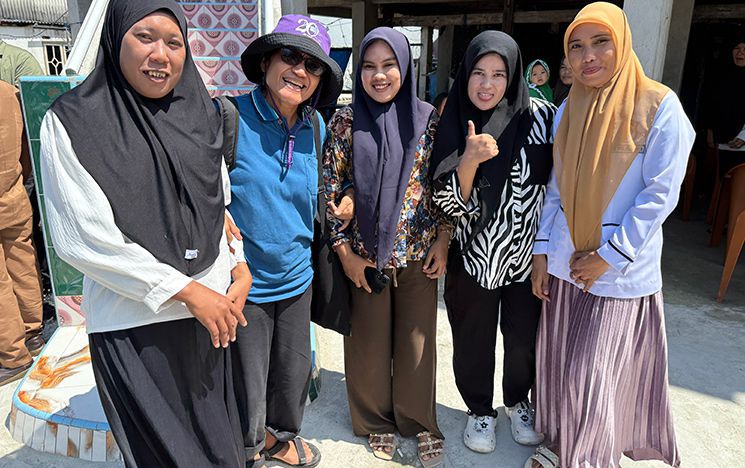
Women with Dr Mia Siscawati in a remote off-grid Sulawesi island. Photo by Raminder Kaur.
Punggawa
All dried seaweed products in the Sulawesi off-grid island of Tamparang (pseudonym) are channeled through traditional go-betweens or middlemen known as punggawa. Now a well-defined intermediary system, punggawa sell the aggregated product to a processing company based in the main island’s capital, Makassar. Processed seaweed is then transported from Makassar to the national capital, Jakarta, where it is distributed to international markets.
Punggawa differ markedly from the typical "middleman" found in many agricultural sectors. Unlike external actors who often operate with limited accountability and primarily extract value from rural producers, punggawa are embedded in their respective communities. They are deeply integrated into the island’s social and economic systems. Because of such close connections, seaweed farmers have developed trust in them. They know that the punggawa will buy their harvest regularly, and in return, the punggawa get exclusive access to seaweed from their area. This setup works well: it saves time, reduces uncertainty, and keeps the business relationship running smoothly without the need for formal contracts.
Punggawa buys seaweed directly from the farmers, and are flexible as to the condition of the product—whether it be still wet, semi-dried, or fully dried. This helps farmers avoid rejection or waste and minimises risk.
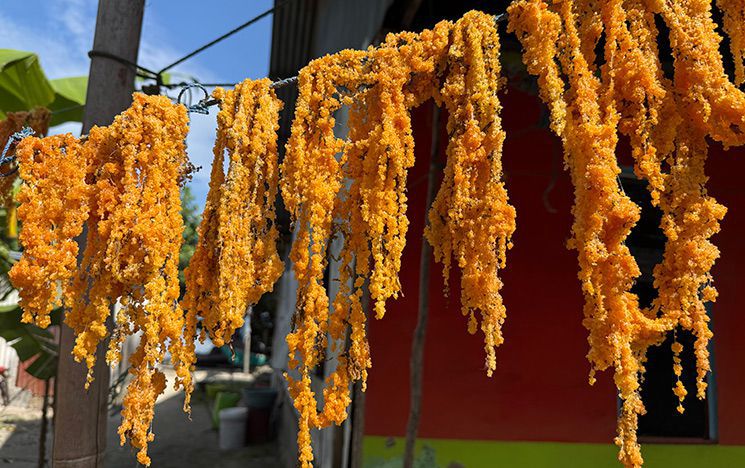
Hanging-drying methods adopted for seaweed in remote island. Photo by Raminder Kaur.
Pricing structure for seaweed
Based on informal interviews, the pricing structure of the seaweed is as follows: punggawa buy SP-type seaweed from farmers at 4,000 IDR (£0.18) per kilogram and sell it on the mainland for between 5,000 IDR (£0.22) to 6,000 IDR (£0.27) per kilogram. Meanwhile, for Euchema cottonii seaweed, they purchase it at 13,000 IDR (£0.58) per kilogram and sell it on the mainland for 15.000 IDR (£0.67) per kilogram. Cottonii is more expensive because it yields a higher value seaweed that is in greater demand globally for its superior gelling and firming properties.
The gross profit margin—ranging from 1,000-2,000 IDR per kilogram—allows punggawa to cover key operational expenses, including labour for seaweed processing in Makassar. Drying and cleaning are conducted by local labour, creating informal employment opportunities for village residents. Costs for transporting seaweed to mainland markets are absorbed by the punggawa. Furthermore, by accepting seaweed in all conditions, punggawa assume post-harvest risks that would otherwise fall on small-scale farmers. On average, a single punggawa can manage 2–3 tons of seaweed per month, representing a modest yet stable flow of commodities and income that supports the island’s microeconomy.
Patron-client systems
The economic relationships between punggawa and seaweed farmers exemplify a classic patron-client system characterised by:
- reciprocal exchange mechanisms
- financial advances as punggawa provide cash loans for daily subsistence needs of seaweed farmers
- obligatory reciprocity as farmers must exclusively sell their harvest to their patron
- structural organisation and market segmentation as each village contains multiple punggawa operators
- client portfolios where individual punggawa typically maintain 20-30 dependent clients
- socio-political dimensions with characteristic dual power roles as many punggawa simultaneously hold formal leadership positions
- political mobilisation, with punggawa’s capacity to deploy client networks for village elections
- institutionalised influence with punggawas’ embedded authority in the village beyond purely economic transactions.
As expressed by the Tagale village head, himself a punggawa: "The punggawa wield substantial power and influence...during village elections, they can mobilise their followers.”
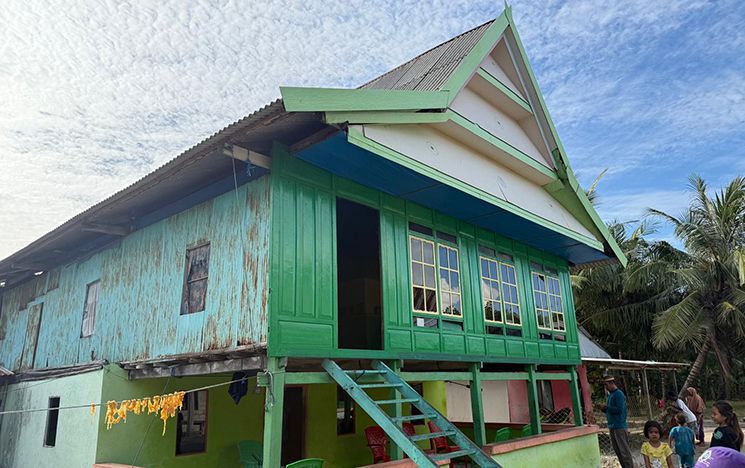
Typical Tamparang island house with main living quarters on the first floor. Photo by Raminder Kaur.
The go-between model
This intermediary model from cultivation to purchasers provides critical market linkage and financial liquidity for smallholder producers. Since punggawa reside in the same villages as the farmers, the income earned through processing and strategic management of the flow of seaweed tends to remain within the local economy, rather than being extracted by external entities. However the go-between model is largely informal and vulnerable to broader price fluctuations in mainland markets and climate-related supply interruptions. The absence of formal associations or institutional support structures also limits the punggawa’s bargaining power and access to credit or technical improvements in the mainland. While the punggawa model demonstrates strong local resilience, its long-term sustainability would benefit from greater institutional integration with formal organisation in the village (such as BUMDES, the village-owned enterprises) and targeted initiatives to build the seaweed-cultivation capacity of village residents in the remote island.
Most punggawa are men of middle to upper social class. How gender and intersectional dimensions contribute to power relations within economic relationships between punggawa (male and female) and seaweed farmers (male and female) need to be examined in this research.
By Muhammad Zamzam Fauzanafi, Mia Siscawati, Raminder Kaur, Bradley Parrish and Renee Picasso Manoppo.