Women’s empowerment and female agency in coastal areas of the Global South
Sharing research and highlighting stories on how coastal women develop alternative economic activities by working as seaweed farmers, making and selling food, and joining community meetings.
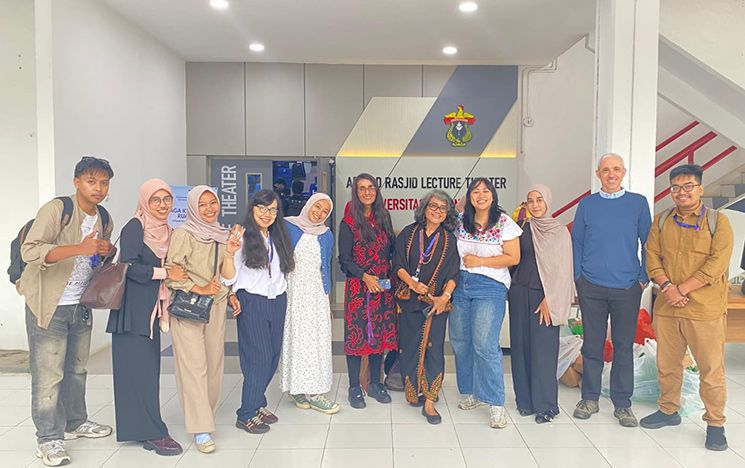
POWERE team with the conference organisers at Hasanuddin University campus.
Sharing research on women in coastal areas
With the POWERE team, I attended the 2025 World Conference on Governance and Social Sciences (WCGSS) at Hasanuddin University, Makassar, South Sulawesi, Indonesia. Representing POWERE, I delivered a presentation titled “Women in Changing Coastal Areas of the Global South: Local Gender Dynamics, Intersectional Marginalisation, and Everyday Negotiation from the Margin”.
My paper focused on a systematic literature review and observations of rural-coastal women in the Global South and included preliminary fieldwork conducted in a coastal area of South Sulawesi. I explored how these women are not merely passive or submissive in response to the multiple forms of marginalisation present in coastal regions. Instead, they actively engage in adapting to and negotiating these challenges, while also developing strategies and mechanisms for empowerment and transformation.
Understanding empowerment and female agency
In this presentation, I was glad to share a decolonising framework for analysing women’s empowerment and female agency in coastal contexts of the Global South. This framework emphasises context-specific experiences to understand empowerment and agency across cultures. Empowerment and agency are embodied and articulated in various forms rather than being singular. While in the neoliberal-capitalist paradigm, self-centrism, individualism, mobility, and organized action are approached as bold representations of power, agency, and autonomy, in the Global South, coastal women expressed power and agency mainly through daily activities, care, solidarity, and a sense of collectiveness. For them, home and family can be a critical site of empowerment.
How women adapt in coastal communities
From the preliminary fieldwork in a coastal area of South Sulawesi, I gained an insight on how coastal women adapt and negotiate gender segregation in coastal communities.
By working as a seaweed farmer, I have a chance to create alternative economic activities to generate income because I can manage my time between being a farmer and doing domestic work. I can also attend meetings in PKK (a government supported women’s community organisation).” A female seaweed farmer
My husband is involved in caretaking and child-rearing, which allows me to join community meetings and participate in making and selling squid and fish crackers..” Woman living in coastal area
These stories highlight how coastal women living on small islands have the ability to navigate gendered economies and segregation by developing alternative economic activities. They transformed their domestic spaces to generate income while still providing care and love for their children. Additionally, they utilised their spare time to participate in community organisations and attend meetings, where they exchanged knowledge and engaged in a system of collective support.
The World Conference on Governance and Social Sciences
This year’s WCGSS, held from 11-12 November 2025, was focused on the theme of “The Future of Maritime Society: Science, Prosperity and Sustainability” that covered nine key issues related to current developments of maritime studies, from climate change, local wisdom, environmental technology, policies, mobility and migration, ecological literacy, resource extraction, restoration, to disaster mitigation.
Prof. Raminder Kaur, from the University of Manchester and the Lead of POWERE, was among the keynote speakers at this conference. The 2025 WCGSS organised 16 panel sessions, totaling 113 paper presentations, featuring more than 200 panelists and speakers, including five papers from the POWERE team. My presentation was part of Panel 1 which also consisted of paper presentations by POWERE team members.
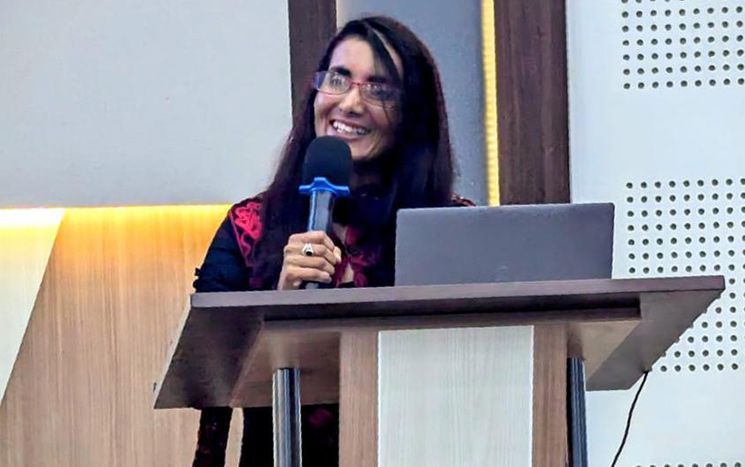
Professor Raminder Kaur delivering a keynote speech.
The conference experience
I needed to travel for more than 10 hours to visit Makassar from the location of my ethnographic work, a small island in the districts in South Sulawesi. The transportation included a 40-minute diesel boat ride. This conference offered a vital academic experience, allowing me to explore a wide range of issues related to coastal and maritime life, particularly from gender and feminist perspectives. As a first-time attendee at an academic conference focused on coastal and marine studies, participating in the WCGSS was significant for me. It helped me build connections with researchers, policymakers, and activists from both Indonesia and abroad who are engaged in this field. The knowledge and insights I gained from the conference will serve as valuable resources for my ethnographic work with coastal communities in South Sulawesi. Most importantly, attending WCGSS deepened my understanding of the relevance of maritime studies in both academic and social contexts.
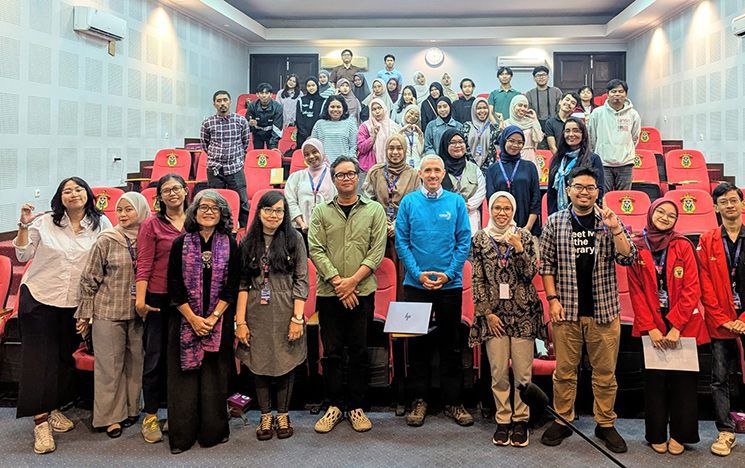
POWERE team with the audience.
By Diah Irawaty