How much electricity?
Our researchers track how electricity is used on the islands of Tamparang.
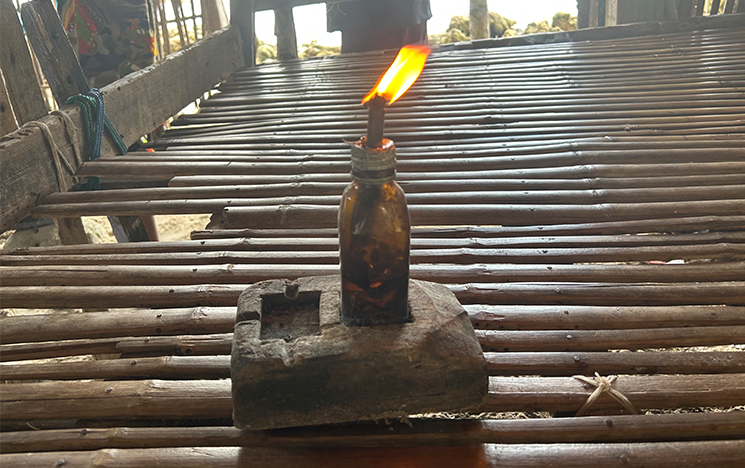
Cepo-cepo - carosine fuelled lighting system from pre-electricity era.
Tracking electricity needs
How much electricity do we need? When does need become a comfort? And when does comfort become a luxury? From social data questionnaires with adults in 30 percent of the three island villages that we are working in from 2025 for the POWERE project, it seems that virtually all respondents prioritise lighting as a need, followed by a water pump in Biyawasa that still has potable groundwater, then charging a smartphone. The latter serves as a communication tool as well as an entertainment and in some cases an education portal.
Electricty for entertainment
Not all island residents have televisions sets and nor do they watch them much apart from perhaps in the evening just before bed time. This is when the communal generator comes on between 6 and 10 in two of the three villages. In the third, the generator has broken down altogether with householders relying more on solar panels of different sizes, but the pattern of electricity consumption remains similar.
Religion
Some respondents mention sound systems for the all-important karaoke sessions, but this would fall into luxury. However, for the mosque and its daily creed for calls to prayer (adzan) five times a day, electricity is classed as a need for its sound system that is attached to a megaphone on their roofs. The need is honoured not just by village residents but also by the Ministry of Religion who has provided a few of the mosques in the villages with a SuperSUN solar panel system to power the sound system.
Fans
Electrical fans are less mentioned as a priority need. Most see them as crossing the line into comfort especially for prayer times in mosques. Others on the island would see fans as a luxury, or perhaps a consumer accessory—as seen with women including the bride at weddings when decorative peacock-like fans have been replaced by electrical gadgets that keep the face from sweating and meticulous make-up from running. Electrical accessories here are simultaneously need, comfort and luxury.
Refrigerators
It’s clear that context and custom determine points on the spectrum of need-comfort-luxury: what in one case becomes a luxury, in another case becomes a need depending on affordability, what peoples have become accustomed to, and for what purpose or occasion. Refrigerators that those in towns and cities would class as a need for a hot place where the average temperature is between 22-34 degrees centigrade is in fact a luxury on the island.
The only time I have seen them is in small general stores to keep canned drinks cool. But as the electricity supply can be on-and-off on the island, refrigerators often break down, after which they just serve as cool cupboards. They are less of a need as food is consumed fresh—fish and rice and for the more well-to-do, squid, octopus and vegetables—with any daily leftovers eaten by cats. Dogs are nowhere in sight on the islands for being seen as haram according to Islam. Irons to press clothes might be seen as a need elsewhere but here most people wear polyester or other mixed fabrics that don’t need ironing. A need in one place becomes folly in another.
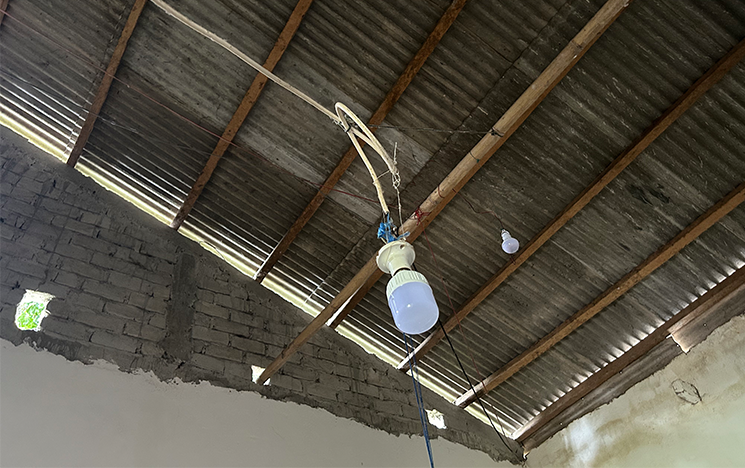
LED lamp precariously hanging from the ceiling.
Electrical lighting
Most important is electrical lighting. This has largely replaced the traditional cepo-cepo—a small bottle on a wooden block with kerosene and a wick that lit a flame, which can be both smoky and impractical to carry around. Flashlights that can be recharged and wrapped around the head are a must for fishermen. Lights that can be left on to navigate wooden steps on traditional stilt-homes for early morning duties have also become a need. And public lighting of coastal paths means one does not fall over its uneven path, roughed up by heavy downpours and tidal currents. These have all become needs now. One wonders how it was in the past before electricity was introduced through diesel power on the islands just over a decade ago.
Benefits of electricity
What emerges is that when people get used to electricity, it becomes a need. Gradually, a taste of comfort or luxury also leads to a comfort or luxury item becoming a need. The body becomes easily accustomed to anything that makes its life easier. And if that source is no longer there, it complains more than it adapts with the body memory recalling better times as a constant comparison. It is such phenomena that lead politicians among others to decree that electricity is a right, ones that they base their campaigns on for underprovided areas, and ones by which many are seduced “Electricity is not only light, but the bridge to the future”, declared one. Electricity becomes wrapped up in utopian visions of the “good life.”
The good life brings with it a growing pyramid of needs ascending to comfort, ascending to luxury and right at the top is electricity as a right where each slowly become attached to need. This need-comfort-luxury-right spectrum may be fine with those renewable energies that do not pollute the earth or come with extractivist exploitation, but if communities go down the quick-fix fossil fuel path with more and more generators, and if the goal is to electrify all 8 billion plus people in the world, that is a not-so-bright road to climate change disaster. These are some of the issues that we raise in our work in remote islands villages in which the POWERE team work to co-develop floating solar units in Indonesia, lessons that can also be shared more widely.
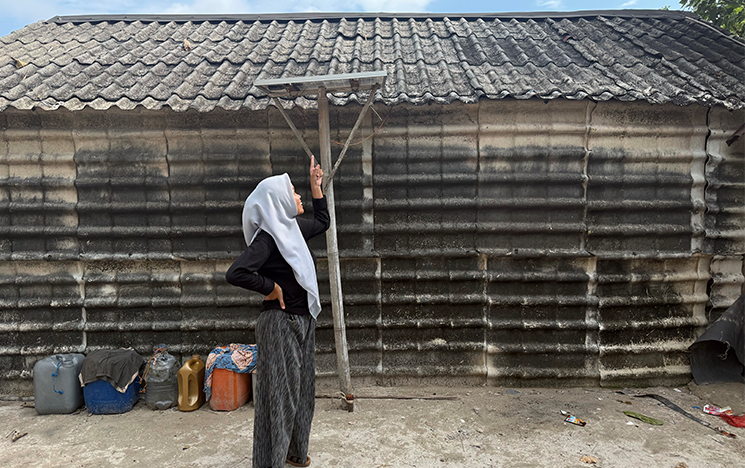
POWERE team members tracking solar panel arrangements.
By Raminder Kaur.