A dance of wires
Our researchers explore the electric infrastructure of houses on the islands of Tamparang.
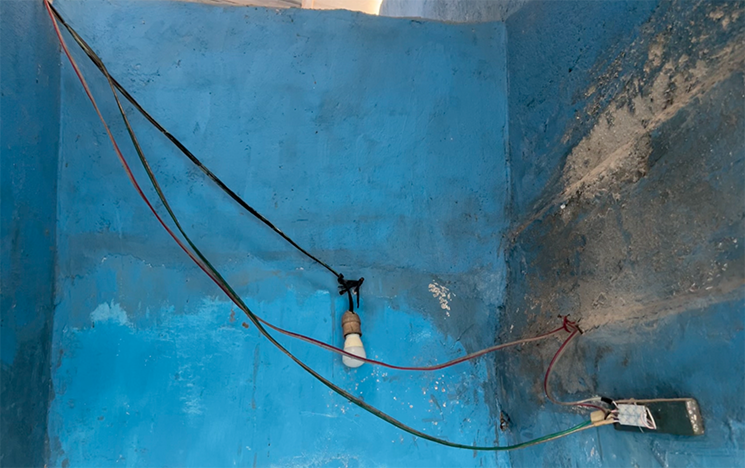
Electric infrastructure
Go into any house in villages on the islands of Tamparang and you will be greeted with smiles and interest as to the nature of your work. Look around their houses and you will find that wires that are usually hidden away in homes on the grid, here in off-grid contexts they circle and spiral around the walls, swerve around door openings from one room to another, cross and drape roof beams, and/or hang from ceilings to connect to light bulbs, and sometimes nothing at all. Red, black, blue, white, cream, brown, thick and thin, single and multiple. The infrastructure becomes outerstructure, the backstage comes to the fore with a dance of wires.
These wires are not to be hidden away, but to be displayed not only for utilitarian purposes but also in terms of a flourish of wealth and connectivity. Even if the houses are not connected to a solar panel or the diesel generator is not working, the wires remain in their choreographed positions, waiting patiently to buzz to life again.
Sockets
Some rooms may have sockets inserted in the wall at eye level height, away from the curious hands of small children. Commonly, wires join at junctions and enter and exit walls through holes in the brickwork or for low-income households, corrugated iron. They may meet with strings and ropes that hold up loops of other wires that are cut too long, or attached to a light bulb dangling on or between walls. They may even be seen as dangerous or hazardous by the rational observer, but for an essential dance of frisson, these issues do not seem to matter to the occupant.
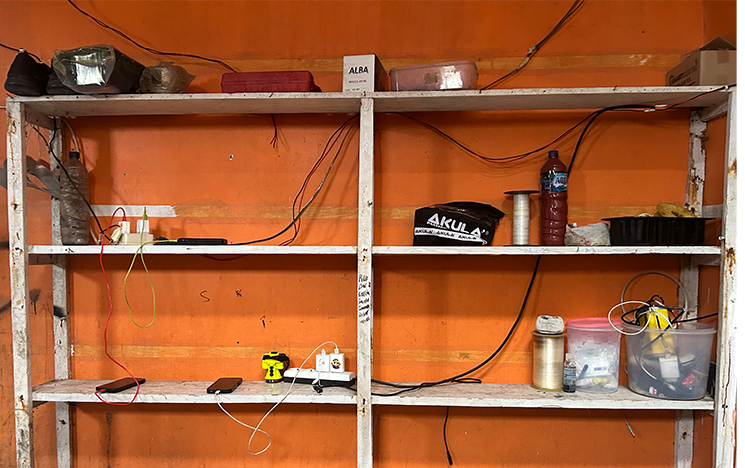
Wire set up behind the shelves of Biyowasa local store.
Multi-purpose wires
Old wires may masquerade as ropes but hardly ever ropes as wires although they can be handy in certain non-electrical contexts as resilient ropes. If attached to mosquito nets, ropes may double up as washing lines, a function that often meets the end of an electricity wire’s life when a live wire becomes a dead wire. Yet wires can be revived—those that may have frayed or torn are dextrously twisted and woven together; and if outside, covered with skilfully positioned plastic bottles to protect them from the rain while, along with old CDs, stopping mice using wires as tightropes between houses. Other cables may be tied together with strips of plastic bags to provide nestled knots over knots, enough to throw any health and safety regulator into a tizzy.
It may not seem the case but there is a system of logic at work. Some are connected to solar panels, while others may be linked with the diesel-fuelled generator. Some work and some may not, perhaps because the solar panel no longer works or the household has not paid its dues for the communal generator. Whether wires are positive or negative are also well understood and never the twain shall meet without the earthed wire. Some wires are left dangerously exposed, but they may be needed for a quick connection to anything else. Other wires meet at congested junctions near appliances such as batteries, inverters, and around key appliances such as television sets or sound systems. Often the mother switch would be connected to mobile multiple socket points to enable the charging needs of phones or a rice cooker on the floor.
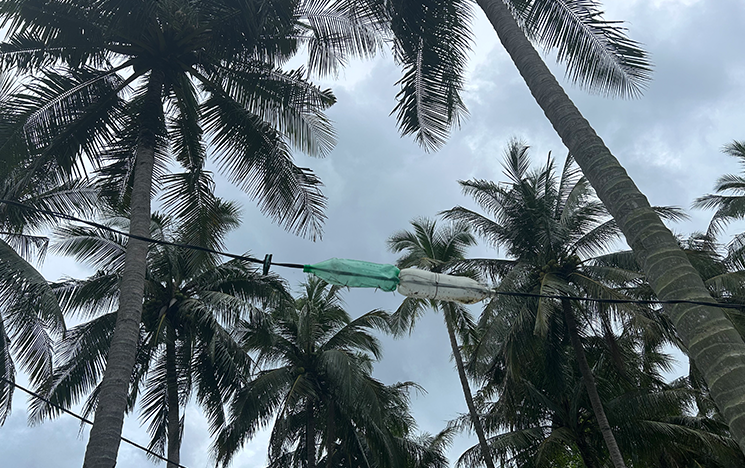
Plastic bottles preventing mice running across the wires from house to house.
Switches
Each house that has paid its monthly bill on the island of Biyawasa has a wire that connects to the main cable that trails the coast, reusing the infrastructure that was laid down by The Ministry of Energy and Mineral Resources and Mining Company when they built the solar power plant in 2013. It acts as a relic to a bright past of cheap accessible electricity for all. What came with this era was not just free wiring but also meters to measure the units used. People invested their spare cash in plastic switches to mount them next to doors for easy-to-flick-on lighting as well as buy more electrical appliances. These switches remain on the walls, but they are not always wired up. In fact, there may be another plastic covered cable that is pinned against the wall with clips or nails on its journey to an electrical hotspot. And these then need to be plugged in to generate any light. Dangling lights then illuminate with the push of a plug into a socket rather than the flick of a switch.
Wire functions
Householders know the functioning of each wire—whether it’s alive or dead, solar panel or generator-connected—not necessarily due to cognitive knowledge of their inner workings but because they live with them, and know them intimately without having to understand their technological or scientific properties. This phenomenon applied to women as much as men for they were the ones who stay in the homes more than their male relatives. They had a working knowledge of the outerstructure rather than the infrastructure. Some people on the island have picked up on the terminology—aki being the more popular term for battery that most people knew (more than knowledge of the inverter which, however important for converting direct current into alternating current, was also likened to an aki and sometimes even dispensed off if it proved to be an unaffordable accessory to disastrous consequences). Some also used English terms like dynamo for the generator, or positive and negative for the component electrical wiring.
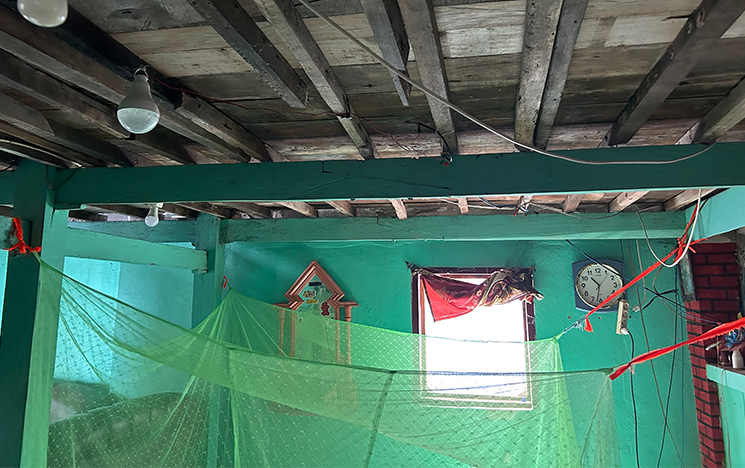
Wires, ropes and moquito nets converge.
Assembling wires and usage
While the wires danced in their electrical choreography so did knowledge about them in a creative reassemblage—from the intuitive to the cognitive, the intellectual to the corporeal. One is not oppositional to the other but grows in tandem as they interweave like fishermen’s knots on a rope. These wires are less entangled as one might find in India when low-income households take electricity from the main supplying line and haphazardly channel it into their homes, leaving a bundled nest of wires around electricity poles. Here in Biyawasa, the wires are more discernible that, with a bit of familiarity, the eye can easily track from supply to end use, or even no use. Rather than an organised anarchy of entangled cabling, the operative metaphor in the islands of Tamparang is a dance of swerving twists, spiralling knots, and a charge of cascading drops to electrify the space.
By Raminder Kaur