Floating islands
Exchanging knowledge on climate change and learning more about coastal community lives.
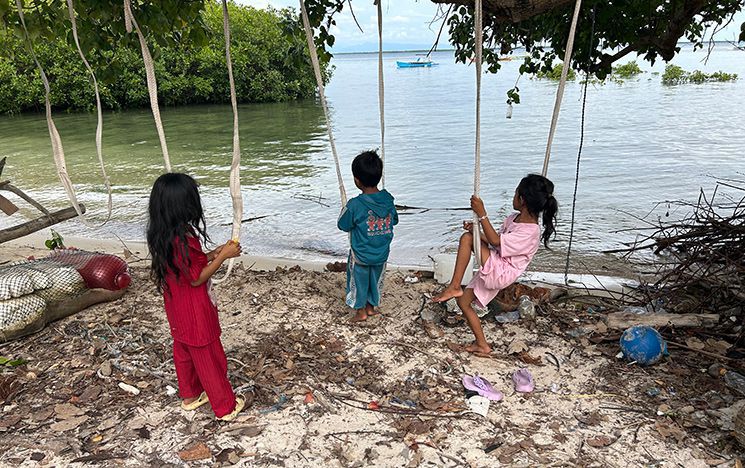
Children play at edge of a remote island in Indonesia.
Climate change
“Does the sea regularly come onto the path?” “Yes,” said the teenage girl nonchalantly. “Have you heard of climate change?” “No,” and she walked ahead of us.
Such lack of knowledge on this term – now bandied about in the connected world as if it was confetti – is a common occurrence on these off-grid islands off the main coast of Sulawesi in Indonesia. Coastal residents observe changes in the environment but rarely connect it to anthropogenic climate change if indeed they ever use that term or its Indonesian equivalent perubahan iklim.
While the island of Biyawasa (a pseudonym) has two communal diesel operated generators (gensets) for their electricity needs and use benzene or diesel to operate their boats, they do not connect the use of fossil fuels to the eventual rise of sea levels. Nor do they blame the more polluting carbon producing cities. Changes in the environment becomes another part of the unpredictable rhythms of the seasons.
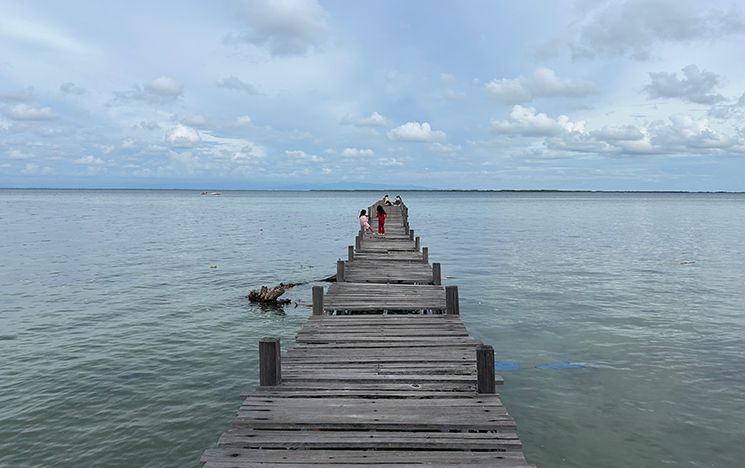
Wooden pathway going into the sea, one of few places where you can get good internet access.
Exchanging knowledge
The POWERE project’s goals are to consider such factors while also attuning people to the need to move away from fossil fuels for electricity generation. There are four Super Sun solar systems on the island generating 900 watts of power. One is attached to the mosque, another to the sub-village head’s house, and the other two to the more affluent households. This distribution of the system was a part of a government-backed programme for which beneficiaries had to be located near a public facility such as a school and had to personally invest nearly 2 million rupiah to install it. Sometimes people come to these places to charge their phones but most feel ‘shame’ to do so, and if they need to charge in case the communal generator has broken down, go to their relative’s homes who may have a smaller solar panel generating upwards of 250 watts of power.
Action learning is a key part of the fieldwork process and we have set up a series of workshops to discuss climate change and related issues with them in a two-way iterative and reflective exchange of knowledge and skills. While we can learn about their lives and aspirations, they too can learn about connecting the dispersed dots, how climate change can affect their lives, and even begin to change or at least think about changing their everyday behaviours and fuel dependencies.
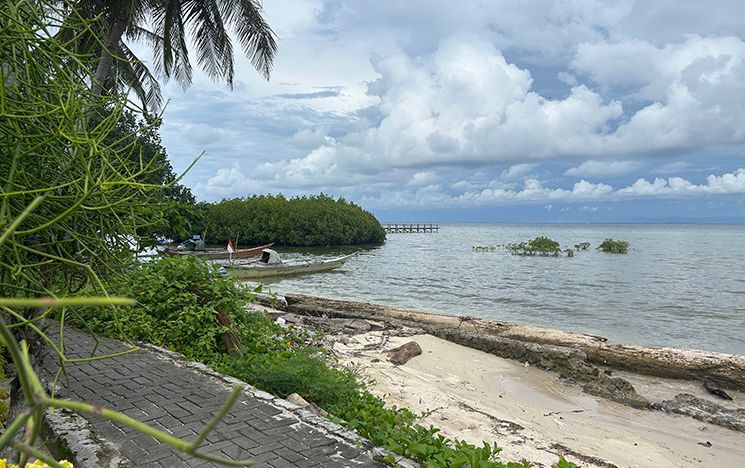
Keeping the tide at bay, away from the coastal path.
Effects of climate change on seaweed harvests
Seaweed farmers observe how the sea is getting too hot to grow Cottoni (pronounced Katoni on the islands) in the rainy season when they usually grow it. Some have seen their crops diseased and decided not to grow it for capital is needed to buy the seedling from the mainland in Takalar.
One fifty year old man in Rannu on the nearby island wasn’t sure why his seaweed crop was changing. He said: “I can’t rely on seaweeds. When it’s good all year round, I don’t need to borrow money from the punggawa (go-between or middleman) for my needs. When it’s bad quality or diseased I get less money for it so have to borrow more money….The seaweed get moss/ lichen (caurin) and this is not good. There was also more dirt (cairan) in seaweed. I don’t know but maybe it is because of the waves.”
It is such observations learned through intuition and experience that form the foundations of their experiences of climate change, and one for which more renewable energy supplies can go some way to providing sustainable alternatives.
By Raminder Kaur and Della Arlinda Birawa.