POWERE’s networking event
Sharing knowledge around renewable energy, women’s empowerment and island communities.
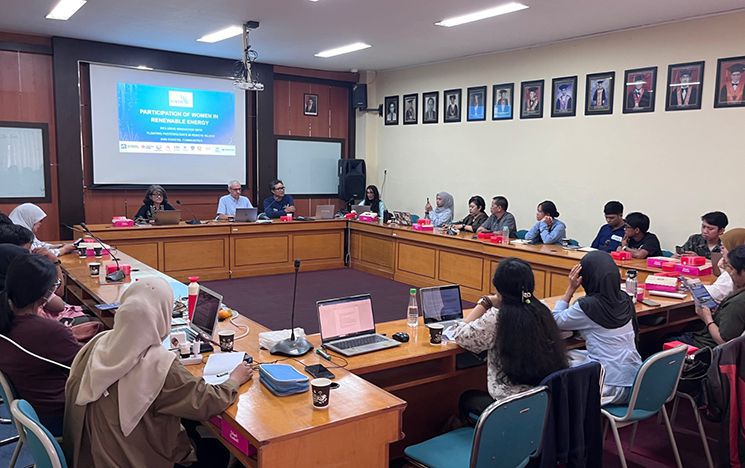
POWERE event at Hasanuddin University in Makassar in November 2025.
Making connections
On a November afternoon, we invited participants to POWERE’s first ever networking event. When they arrived, we were quite surprised by the enthusiastic turnout. About 46 people gathered in the Social and Political Science Faculty Senate meeting room at Hasanuddin University (UNHAS) in South Sulawesi’s provincial capital, Makassar. The participants were a mix of NGO activists, academics, researchers, scientists, and representatives from the pseudonymous Tamparang island communities.
The event began with a round of introductions, leading to my overview of the POWERE research project and the goals for the day: to build a network around renewable energy, women's empowerment, and island communities – specifically the Tamparang Islands. Included here was also Dr Bradley Parrish’s presentation on solar and social infrastructure for seaweed farmers – peer learning networks and social business model to sustain community-based floating photovoltaics (FPV).
Ensuring clean water, biodiversity and renewable energy
A representative from Blue Forest, an NGO that has been working in Tamparang since 2010, was among the first to comment. According to her, the POWERE project aligns with the action plan they have established together with the Tamparang Island Committee, which focuses on: ensuring clean water access, protecting biodiversity, implementing renewable energy, and managing waste. She also mentioned that the proposed FPV design was interesting, but added: “Seaweed farming in Tamparang already uses a long-line method that takes up considerable sea space. This will be a challenge when installing the FPV system there.”
Using solar power
Regarding seaweed farming, an UNHAS lecturer in marine and fisheries sees potential in placing the FPV offshore alongside the octagonal seaweed farming system she is developing. She proposed that the FPV could be used as an energy source to pump nutrients across the entire octagonal seaweed platform. "Let's exchange data moving forward... and perhaps we can collaborate," she added.
Another participant, an electrical engineering lecturer at UNHAS, outlined the challenges faced with solar power projects in Tamparang. He stated: "Solar power systems often face issues, and in several cases, the matter has even been taken to the prosecutor's office, with some people imprisoned due to corruption related to these projects." Many of those solar projects are now abandoned, mainly due to damaged batteries. He then offered the following advice: "Solar power is good, but without maintenance, it's pointless. The panels must be cleaned regularly, otherwise their electricity output drops. Don't install them under trees, as they easily get dirty from falling fruit or leaves. They also need to be placed in a secure location, perhaps in a dedicated shelter or enclosure."
Women’s empowerment
The discussion then shifted to the topic of women's empowerment. An UNHAS anthropology lecturer reminded everyone: “When we talk about women's participation, the expectation isn't just symbolic – it should mean they are truly present and able to participate fully and meaningfully."
This statement was responded to by the POWERE postdoctoral researcher, Diah Irawaty, who said: "Women have unique experiences. For example, in Rannu village, women act as both agents and producers of knowledge. They empower themselves through groups, sharing stories – like asking their husbands to watch the children during PKK (Persatuan Kerukunan Keluarga or Family Enpowerment and Welfare) meetings. We want experiences like these to form a new vision: women can drive transformation for themselves, their families, and their communities."
Another POWERE postdoctoral researcher, Runavia Mulyasari, added that women are central to the project because: "They see the real value in renewable energy. They'd rather save up to buy it themselves than borrow – this has often been the case with household solar panels."
Then another UNHAS Anthropology lecturer pointed out that currently: "There's still a gap between electricity and women. Women are often afraid to handle electrical systems." Therefore, he believes special training for women is necessary, especially in maintaining the FPV: "Maintenance has always been the recurring issue..."
I responded to his input by stating that one of the main activities in the POWERE project is to establish a women's group that will work as FPV operators. They will be trained in FPV maintenance and repair, as well as in forming a business unit to manage the system.
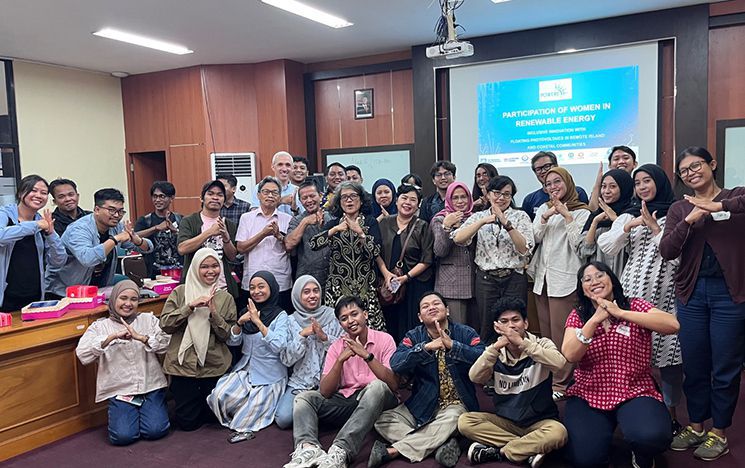
Attendants at networking launch do the POWERE gesture.
We ended the event with a commitment to launch the POWERE network with proposals to align our interests and work together in compatible areas in the near future.
By M. Zamzam Fauzanafi