Organic experts
Biyawasa-based experts are often self taught. They learn through practice, initiative, watching others, and from the internet.
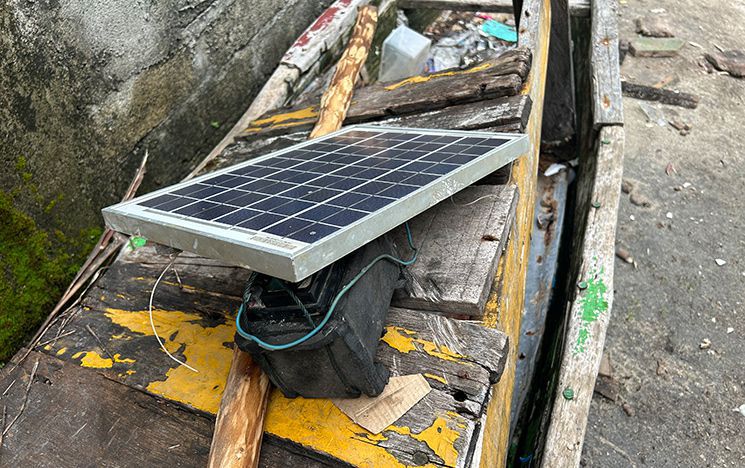
A small 40-watt solar panel unit attached to a house in Biyawasa.
Bringing experts to the islands
We rarely find trained working professionals residing on remote islands. Midwives and other medical experts make flying visits, some not coming at all as is blatantly evident in the sad-looking, empty building of the health centre (poskesdes) in Biyawasa. Even public-school teachers stationed in the island villages who have their first homes on the mainland only return to the island for their scheduled teaching, which is every other week, sometimes opting not to come at all that week. Fortunately, there are a few local teachers who trained on the mainland and returned to work on the island.
Occasionally, efforts are made to bring in experts at great length to see to technologies that need fixing. Biyawasa community members have sent “proposals” to the Ministry of Energy and Mineral Resources to inspect the faulty 15-kilowatts solar power plant that they had installed on the island in 2013, the last one being sent in July 2025, seven years after it stopped operating. They were still waiting for a response in December of that year.
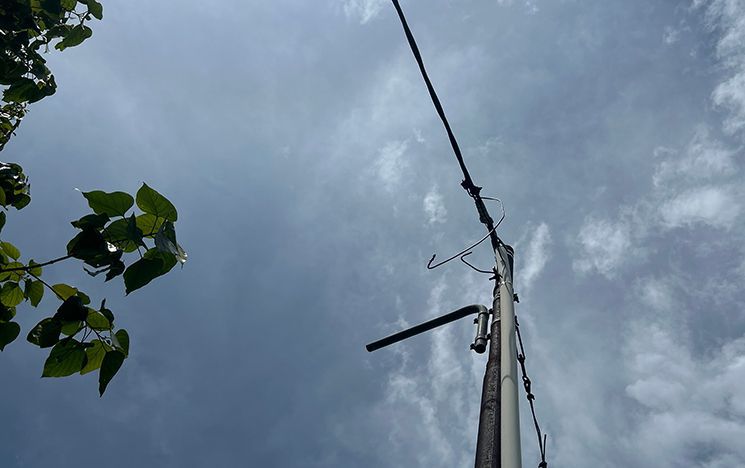
Cables from the disused solar power plant that has been reused for channeling electricity from two communal diesel powered generators in Biyawasa.
Learning to repair through practice
Repair of the communal generator cost was at great expense. Since it started delivering electricity to village residents in 2018, it has broken down three times. The operator took faulty parts of the Mercedes Benz machine to the mainland to get them fixed.
On the first occasion, the “dynamo” had to be taken for the generator caught fire. On the second, the wires burnt in the AVR (Automatic Voltage Regulator), a device that regulates a stable output. The generator’s operator phoned up his brother-in-law who worked on a ship for a mining company in Kalimantan who advised him to replace the part. He explained: “He knows about engines, but is not an engineer.” The operator ordered the part online for 1 million IDR (approximately £50), but it was the wrong type, so he had to order another.
Through trial and error, and although he did not study anything of the kind nor specialise in science in his schooling up to the age of 18, the hands-on operator became the expert. He explained: “I learn from practice, not from theory.”
The third time the generator broke down was due to a fault in the fan, and this part had to be taken to Makassar. Again, the repair cost 1 million IDR. The operator tried to disburse these costs to the electricity consumers, which led to arguments and the development of divisions in the village.
Learning from watching others
Another man in his 50s, a punggawa (middleman, locally pronounced as pinggawa) of fish and sea snails, also learnt to be a technician by default rather than design. Even though his schooling was only up to elementary school, he elaborated: “I learned from experience before. Often watching other people… Before I lived here, I usually watched at home when I was still in Sotong [on the neighbouring island]”. After village factions developed, he acquired a communal diesel-run generator of 15 kilowatts capacity to provide cheaper electricity to the homes around him in the south of the island. Again, he learnt on the job to the point that he was recognised as the local expert: “I'm the one who fixes it. If I don't fix it, there will be no light in this [area]. Everyone knows that.”
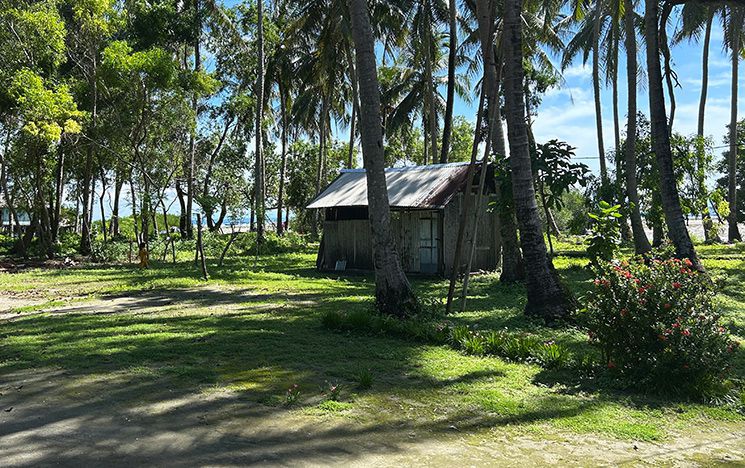
A communal generator in a shelter delivering 40 kW of power to off-grid island households.
Making creative use of learning resources
The lack of professional support has led several on the island to train themselves for important tasks. While there are elementary schools in each village (for children aged 6-12), sometimes a junior high school (ages 13-16), and a couple of senior high schools (ages 16-18), there are no further educational or vocational training centres on the four islands of Tamparang. The opportunities for developing new interests and skills on top of those learnt from their elders on the islands are scarce. The ones that can afford it and have their family’s support may go to the mainland for more education. But the less affluent must make creative use of whatever avenues lie around them.
Online learning and experimentation
One young man aged 17, the third oldest boy in his family of four brothers, took to online learning alongside his regular fishing with its unpredictable income for his household. His family could not afford regular payments for the communal generator, so they took to buying a second-hand solar panel. He became responsible for the electricity decisions and works in his household. He fixed the wires to the wall while connecting them to the solar panel, acquiring the necessary skills by way of the internet. He explained:
“If there's something I want to learn, like connecting cables, fixing electricity, finding out why the cell phone charging cable breaks down, I look on YouTube. They usually give examples like this. Or there's also that free app like cici, which is used if you want an example of learning to cook. I usually use that too.”
Such experimentation was not without incident or accident. For instance, once he wanted to check that the wiring had worked for a lightbulb, so he inserted his finger to check the electricity was on, only to receive a terrifying shock going up his right arm. Never again!
He was versed in essential items such as inverters in solar panel systems – essential to convert the direct current from the solar panel into alternating current for appliances. However, he also found ingenious ways of circumnavigating the use of an expensive inverter to charge his phone especially when he was on a long fishing trip: “I bring an aki [battery] and a [solar] panel. There's a small battery charger for charging cell phones. You can usually use it directly from the aki to the cell phone. It's on the boat. I usually use an inverter if I have one. If not, I buy that cable charger, which is cheap, the cable that plugs into the aki can be directly connected to the cell phone.”
Before going away on his long fishing trips, he had taught his mother about what to do – and, of course, what not to do – with the solar installation at home, so that she too became an organic expert of electricity.
Such knowledge was acquired not in a traditional school of learning but driven by economic necessity and a curiosity satiated by the endless information available on the internet. The youth’s hands-on knowledge and skills – acquired while working on a fishing boat –provided a flexible foundation for further developing his technical knowledge.
Asking remote experts
This phenomenon was also the case for an older fisher who doubled up as the “maintenance engineer” for the first communal generator, seeing to its general running as well as tending to the breakdowns that happened on the three occasions from 2018. As he had previously worked on the mainland, he had a friend who worked with the state electricity provider, PLN. To this day, he phones his friend up should he have any queries.
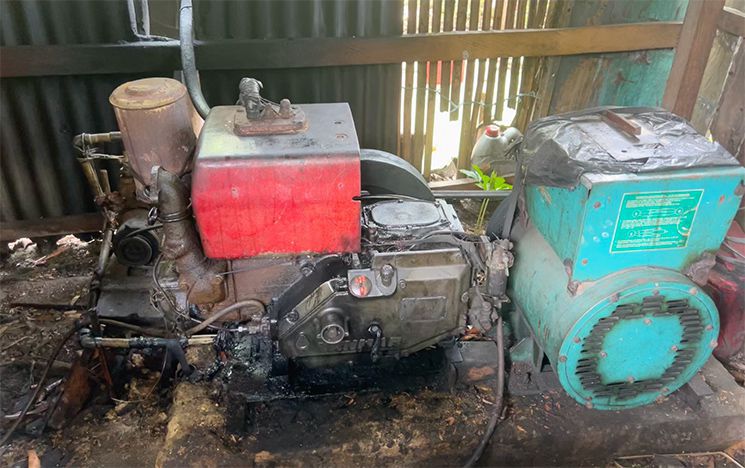
A second communal generator delivering 15 kW of power to off-grid island households.
Taking the initiative
In another case, a young woman was married at the age of 13 in a ‘twin marriage’ with her sister (who was one year older) to two brothers in Biyawasa. The sisters came to the village together from another island and set up their home next to each other. The younger sister, now aged 17, had a three-year old child and had to give up her seaweed tying at 3,000 IDR per rope to be more with her daughter. Their only income became whatever her husband bought in from his daily fishing trips.
Despite her limited education and impoverished state, she showed great initiative, having bought a small second-hand 40-watt solar panel system to charge a bulb, the sole light for her downtrodden two-room home. For mobile phone charging, she went next door to recharge in her sister’s home. Her enterprising spirit was catalysed by a keen sense to achieve: she gathered foam in a large bag so that one day she will have enough funds to buy material that she will sew herself into cushions and pillows.
The bricoleur and the engineer
Biyawasa-based experts grow organically to shine as beacons on the island. The anthropologist Claude Levi-Strauss had once talked about the bricoleur and the engineer as metaphors for different forms of thought in traditional and modern societies: the bricoleur is skilled at gathering whatever lies to hand to recombine them to make something new. By contrast, the engineer worked in a more logical and linear fashion, like the archetypal scientist who adopts a totalising vision. While the line between traditional and modern is questionable, the above examples are remarkable cases of how the bricoleur technique leads to an engineer-like awareness, practice coming before the theory of all things to develop holistic knowledge. As they say, necessity is the mother of invention as well as the nurturing of bricoleur-engineer experts.
By Raminder Kaur and Della Arlinda Birawa