Plastic paradise
Remote islands find large amounts of plastic and fabric waste washed up on their shores. Learn more about how Rannu village residents are upcycling rubbish in creative ways.
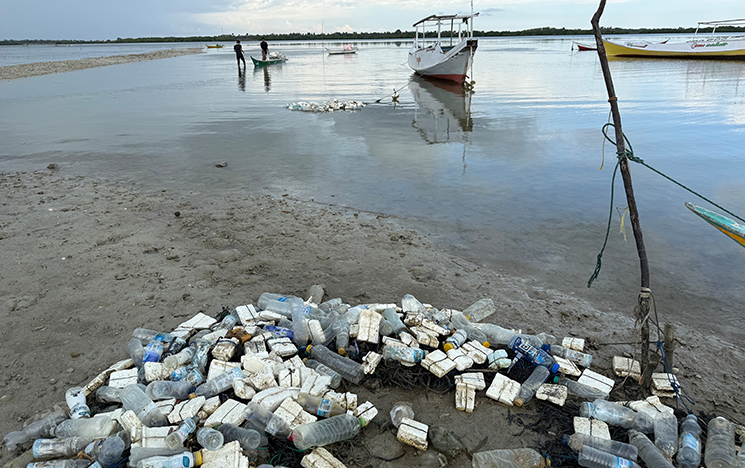
Plastic bottles on a rope waiting to be laid out in lines with seaweed seedlings.
Rubbish washing up on islands
A paradise island in the middle of an aquamarine blue sea may only have been a pigmented figment of the imagination of artists like Paul Gauguin who painted colourful exotica of Tahitian life. Nowadays, remote islands, even if they are not inhabited, become the unfortunate destination of the world’s debris. Some are so notoriously ravaged that those in the Great Pacific Garbage Patch - comparable to an eighth continent, have been nicknamed Trash Island, Rubbish Island or Plastic Island.
Remote islands suffer from two main problems. They are subject to the drifts and eddies of ocean currents (gyres) that pull rubbish into a swirling vortex, and the modern world’s excessive reliance on packaging comes to be dumped on their doorstop with a swirl of washed up plastic and other debris on their beaches. In addition, island residents don’t have anywhere to throw their own rubbish so either burn it, throw it on the ground or into the sea themselves. The first phenomenon is due to excessive use, careless disposal, and perhaps too much choice when it comes to global consumer capitalism. The second phenomenon is due to no choice for communities in marginalised regions, yet still subject to the plastic tentacles of a care-less capitalism.
But what we find in the Indonesian islands of South Sulawesi where many seaweed farmers are concentrated is that plastic bottles and other buoyant waste is reused to hold up seaweed lines (bentang) in rows on farms. In Rannu located in a large natural bay on a remote island, a vast part of the sea bobs with empty water and other plastic bottles interspersed with seaweed SP (Eucheuma spinosum) in the dry season and Cottonii (Eucheuma cottonii) in the rainy season. The organic jostles closely with the inorganic close to the shore.
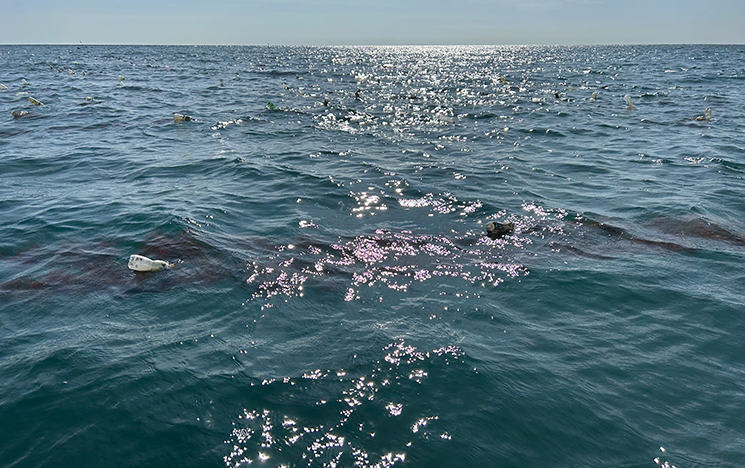
Plastic bottles keeping seaweed lines buoyant.
Seaweed farms
The seaweed farms are so vast around Rannu that poles with flags on polystyrene blocks or other large empty plastic canisters have to be installed on corners so that boats can safely navigate them on their way to and from the village. The farms are highly valued for bringing in substantial income to village residents. Any breakages are likely to lead to conflicts when accusations are volleyed around, should anyone accidentally or even wilfully break the seaweed lines. And if anyone is caught breaking any lines, a summary fine of anything between 500,000 IDR to 1 million IDR (about £25-£50) per line duly follows - a community-based regulatory measure to ensure boat operators are careful and vigilant about other people’s farms.
Elsewhere, empty plastic bottles are strung up outside people’s homes as spare ropes are hung out to dry, waiting for the next occasion for seaweed tying, a task relegated to women. Yet this plastic recycling does not necessarily translate into environmental consciousness. The recycling is born out of the needs of the economy rather than ecology. There is a missing link in this creative reuse with a wider environmental conscientiousness about the need to reuse and recycle.
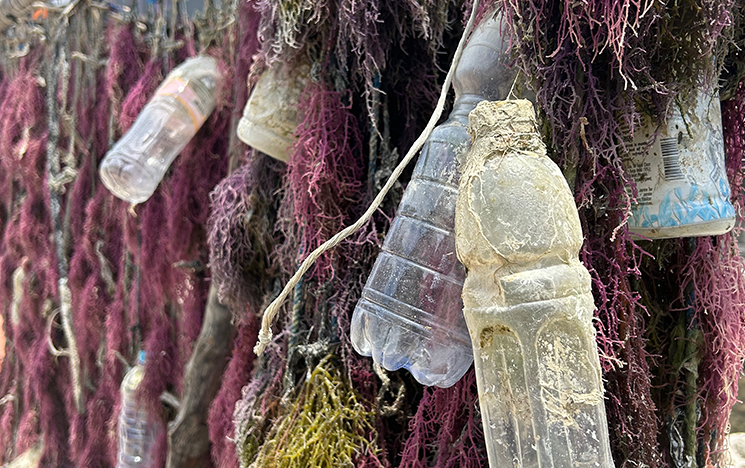
Seaweed and plastic bottles hanging out to dry.
Disposing of rubbish
Rannu residents are themselves not provisioned with any effective waste disposal mechanisms or systems. They too burn what rubbish they can, and anything they can’t, they throw into the sea or into the edges of the village especially the mangrove areas to the sides and back of the village. Plastic wrappers and cups are thrown about paths at random because there is no community rubbish gathering system in place. What exists is a household-based cleaning system where women are tasked with keeping the fronts and backs of their houses free from debris especially as it is likely to attract the nuisance of flies, mice and other small pests - again, a form of utilitarian environmentalism.
Recycling
There are other signs of recycling in Rannu linked to local economies. One widowed woman shows creative reuse of fabrics to make small mats to wipe feet when walking into the house or from wet bathrooms into the rest of the house. The multiple fabric pieces act as ingenious devices to effectively gather dirt as much as moisture. Selling for 20,000 IDR each, they are present in many houses in Rannu and make for a tidy income for the woman. In the village of Biyawasa on another island, plastic is collected by a local worker and sold to a mainland company who recycle it to make other goods.
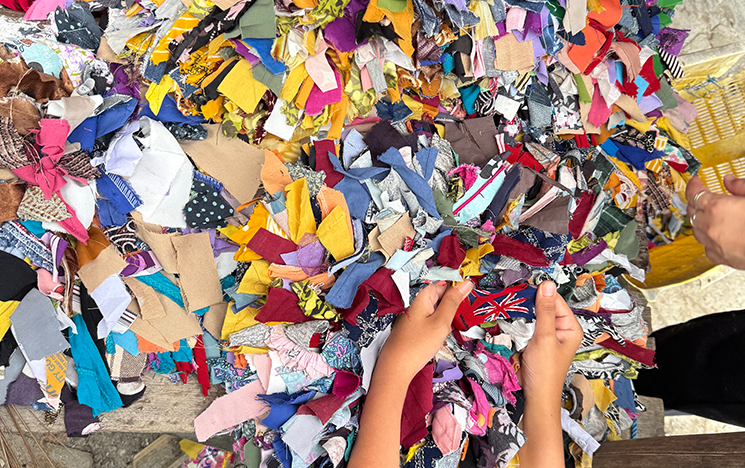
Ingenious reuse of waste materials to create door mats.
Such examples provide instructive lessons. If rubbish is connected to income and finance, then waste can become a valuable resource in a circular economy. It can also have artistic interest as is demonstrated by the mat-making woman, and also evident in environmental artists’ work across the world: probably first demonstrated in the Global South by the Panjabi artist Nek Chand who in the 1950s gathered broken bangles, ceramics and industrial scraps to make a 25-acre fantasy rock garden in Chandigarh in North India.
Nowadays, there are several NGOs and enterprises that demonstrate ingenious ways of recycling waste so that it can be reused as furniture, flooring, boats and other items. There is much scope to bring such creative expertise into villages like Rannu and other remote villages left out on the scrap heap. It is also a potential that can be explored by POWERE for floating solar units where their buoyancy is provided by recycled materials including plastics.
A couple of moot points remain, however. Silica-based solar panels, which would be present on floating solar units, largely rely upon exploitative extraction of rare minerals, and the products are not immediately recyclable after their roughly 20-30-year shelf life. While there are alternative and recyclable innovations in solar panels being developed by scientists and engineers, they are not yet at a stage where they are ready for wholesale distribution in the Global South. Remarkable projects are making strides here as with the development of perovskite for next generation solar with the REACH-PSM (Resilient Renewable Energy Access Through Community-Driven Holistic Development in Perovskite Solar Module Manufacturing) project in African countries, but they’re not yet accessible for local markets in Indonesia, the country with the greatest number of islands, numbering 17,000. Once they do become widely available, we can develop more sustainable floating solar models, ones that form a part of circular economies and do not further rubbish the seas. For this to transpire, however, we need to wait for the next cycle of the project.
Currently, we can at best work with local communities to envisage and act for more sustainable futures. We may indeed find that old silica-based solar panels end up having other surprising, perhaps more mundane, reincarnations in the villages as with upscaling them to power solar lamps on paths, or reusing them as part of make-do tabletops, shelving, fences, greenhouse walls and covered shelters for drying seaweed, and public art installations to raise renewable energy awareness, come rain or shine.
By Raminder Kaur.