Off-grid power mappings
Our researchers visit several villages to find out more about electricity provision on remote off-grid islands in Sulawesi.
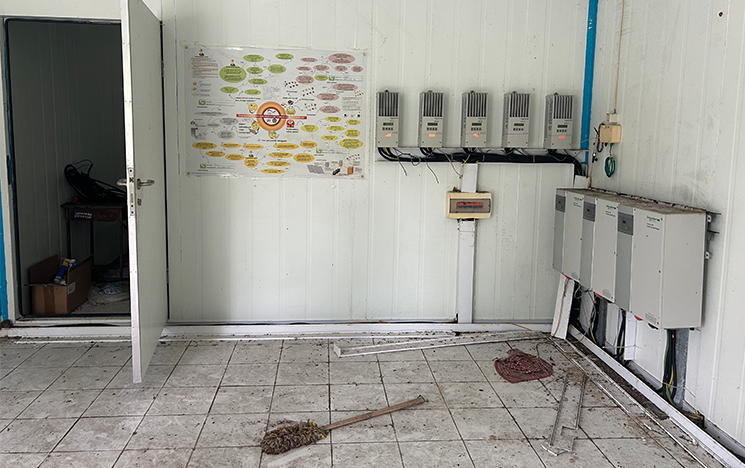
Abandoned solar power plant after it started malfunctioning in Biyawasa.
Electricity supplies in Indonesian villages
Our research explores the conditions for electricity supplies in three off-grid Indonesian villages in remote islands of Sulawesi. We have observed how energy flows with power and electricity accrues with the more affluent and politically powerful elites.
Biyawasa
In Biyawasa, there was a communal solar plant that functioned for about five years, delivering 15 kilowatts of power to the village. It brought with it a sense of egalitarianism with accessible energy for all. “The whole village was lit end to end,” recalled one resident.
After it broke down, a period of darkness ensued. Electricity became concentrated with politico-economic elites such as heads of villages or punggawa-men who had amassed wealth while acting as the middleman between seaweed farmers and fishers and wider markets located on the Sulawesi mainland.
These more affluent men either:
- bought smaller solar installations for themselves
- invested in a diesel-powered generator for the community
- became beneficiaries of government backed schemes to support distribution of combined solar panel, battery and inverter units known as SuperSUN.
These were to be distributed to public facilities like schools but as installation costs had to be covered, the men decided to install them on nearby private households who could afford the initial costs. The distribution led to more concentration of power in these already wealthy households.
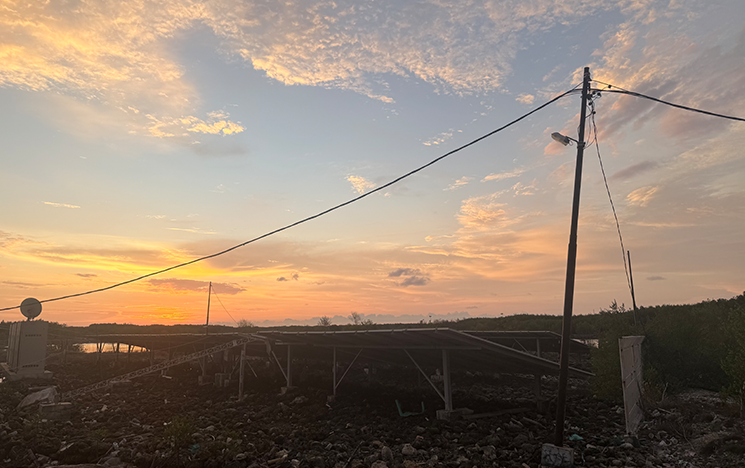
Sunset over broken down solar power plant in Rannu.
Diesel-run generators
Those who operated communal, diesel-run generators also began to charge their consumers. For the larger communal generator delivering 40 kilowatts in Biyawasa, the charge for connection is 90,000 IDR a month (approximately £4). Initially it served the entire village, using the same cabling as was used for the solar plant.
However, after an argument about the high price of electricity buy-in, the village split and a smaller generator of 15-kilowatts was bought to serve 32 households in the poorer areas of the village. Approximately 90 households continued to be served by the older generator, not least because they had no choice in the matter.
The man who bought the smaller communal generator was a punggawa of fish and sea snails, buying them from the fishers and selling it on the mainland. Along with a retired religion teacher who donated his land for the solar power plant (hibah), they factioned off from the rest of the village, which is served by a communal diesel generator in the hands of the sub-village head.
The mosque
In the process, the punggawa and the teacher also sought help from the Ministry of Religion, stating that it’s too far to walk to the mosque on the other side of the island and got a subsidy to build a mosque along with funds donated by the community. This mosque is currently incomplete but has walls, floors and a mihrab indicating the direction of Mecca along with a pulpit. This is enough for this faction of the community to congregate for prayers in their own space.
The mosque runs on the smaller communal generator in the evening when it’s switched on from 6-10 pm, but also has a small solar panel set that aids calls to prayer (adzan) through the megaphone installed on the roof. The retired teacher is now the imam of this mosque and used his own voice for the calls to prayer, rather than a recording as is common on the other village mosque here and in other villages in the islands that we have called Tamparang. This is not least due to the fact that the new mosque initially only had a microphone and not the full sound system.
Rannu
In the larger village of Rannu more than 300 households are located on a nearby island and there are nine SuperSUN installations. Two are in two mosques, one in the village head office and others in the houses of local elites. These are located near public places like a kindergarten, primary and secondary schools, a public clinic, and a village-owned business. This setup was used as a pretext to qualify for a government programme aimed at extending state control in so-called “3T” areas—regions that are remote, on the borders, or less developed. One SuperSUN installation has no claims to be near a public facility but is close to a public figure (the daughter of the village head.)
The installation cost of 1,800,000 IDR for the SuperSUN was enough to exclude many from solar benefits. The installation intended for the public only extended as far as the main householders’ families. Poorer residents were excluded, having to fall back on the diesel generator for electrical needs, which was too expensive for some households.
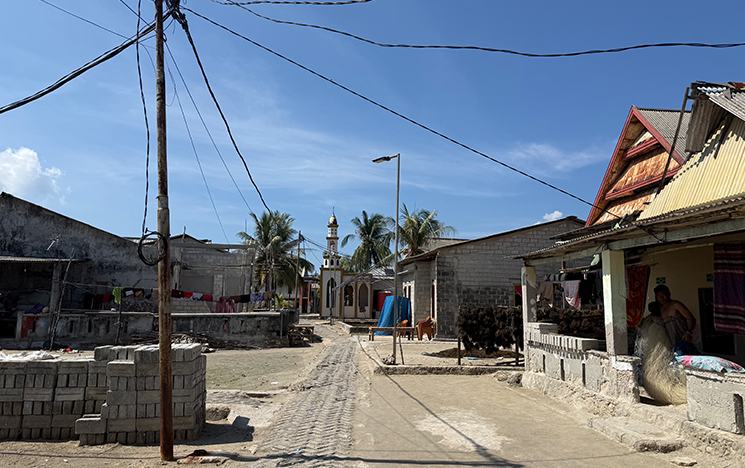
Power cables being reused to channel electricity from communal diesel fuel generator.
Katinting
In the village of Katinting, the communal diesel-fuelled generator has broken down. The village head provided five small generators, which were located into five different hamlets of Katinting. However, this fast solution for the broken-down communal generator didn't last long. And now, the entire village electricity needs are supplied by a few solar panels.
There is only one SuperSUN facility here, which is installed in the mosque. The people used the community fund to pay for its instalment. The subvillage head has a smaller solar installation to run lights, fans and a sound system. Other households who can afford it have also installed solar panels, some bought second-hand. However, these too break down as not everyone is well-versed in their installation and maintenance. They learn as they go along, and do not always appreciate details like the necessity of an inverter to convert direct current to alternative current for appliances.
Many of the village residents in Katinting rely upon the mosque to charge their smartphones, leaving them there at virtually all times of the day. At least this building is open to everyone, and using it to get electricity isn’t something to be embarrassed about—it can actually be a benefit. The power mapping here is not so direct but alternates between privatised households and communal properties such as a place of worship, which in comparison with its SuperSUN, is the more accessible, egalitarian and powerful.
By Raminder Kaur and Della Arlinda Birawa.