Modcons
Our researchers learned more about life's modern conveniences such as Wi-Fi, TV and solar panels, and how villagers are using these.
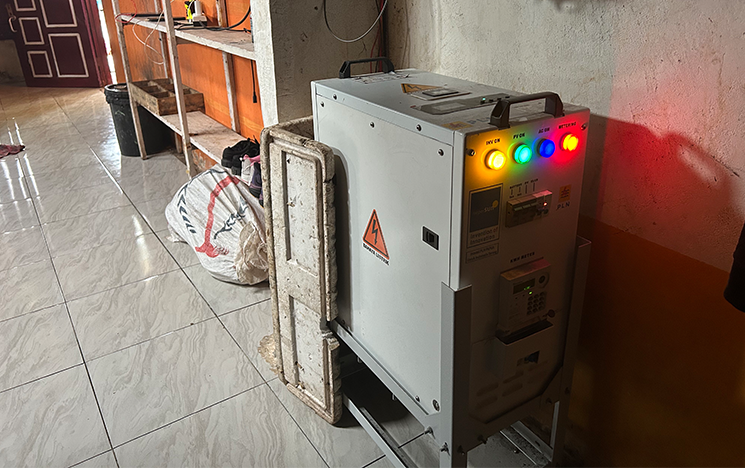
SuperSUN unit enabling day-long solar powered electricity.
Modern life
Remote islands may be far away and off the grid, but island life is not cut off from the rest of the world in Indonesia. While certain traditions continue, inhabitants’ desires for a “good life” along with a wealth of modern conveniences (modcons) mirror to some extent those in mainland towns and cities even while island inhabitants may be critical of the mayhem and pollution there. While some travel away from the island for educational and work opportunities, media waves and capitalist consumerism travel towards them.
Wi-Fi
They are also under the universalising umbrella of outer space satellites such as Starlink (a division of SpaceX) that, along with a nearby tower, enable Wi-Fi connectivity—a double edged superhighway that benefits digital information oligarchs more than it benefits them, as connectivity for island residents shifts with the drifting clouds and is usually quite weak.
Communal generator
Most on the four islands in Tamparang have diesel-fuelled generators, either for their homes or for the community when ten-day payments guarantee that they get electricity for four hours in the evening up until 10. Even though some people want electricity for longer so they can watch more soap dramas, those who are more influential decree that fishermen need to go to sleep so as they can wake up early to get a good catch. Indeed, catching a high-grade octopus selling for about 80,000 IDR a kilo (approximately £4) is ample to pay for one month’s electricity from the communal generator. A good catch tips over desires for a good life while also sustaining it.
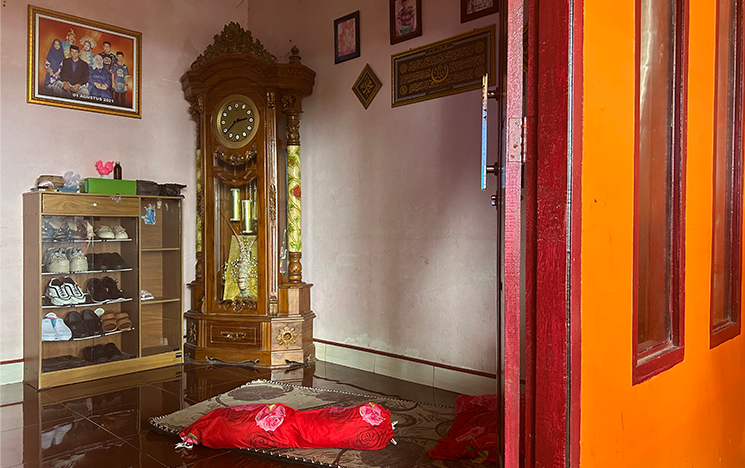
Grandfather clock installed for ornamentation over utility.
Television
For those who have television sets, they routinely come on at 6 in the evening to showcase soaps such as Amira, much loved by the women; cartoons including those from Malaysia such as Upin & Ipin—animations with Islamic ethics loved by the children as much as they are approved by their parents; and talent shows like L’Akademi where viewers can nurture their dreams to become a Dangdut star, a hybrid popular music loved by virtually all. Indeed, the most popular asset for young men are not supersonic cars and motorbikes—for they wouldn’t go far on the island —but large sound systems complete with speakers and a microphone for karaoke sessions broadcast to the village.
The television set is kept on—no matter if no one is sitting there viewing it. As postdoctoral scholar, Diah Irawaty, said in a workshop that she facilitated in Rannu on a nearby island, “You don’t watch television. The television watches you”. Its constant chatter adds to village gossip and the cluck-cluck of hens and cockerels stalking around the grounds. When the fiery sun drops in the sky, the evenings come ablaze with a fanfare of sounds and audio-visual motions at the switch of a generative button.
Solar panel plant
However, the older island residents in Biyawasa remember a time when the government’s solar panel plant ran so that people could wallow in electricity at any time of the day. Paying only 3,000 IDR per month for its maintenance (as opposed to 90,000 IDR for a communal generator), it was also a time when even the poorer families could save and do more shopping, some investing their savings in rice cookers and television sets. This era was met with all-day karaoke sessions and a feast of afternoon movies including those from India relayed on the national television channel.
Enjoying Indian culture
From this period when the solar plant operated for five years, women fondly remembered watching Indian movies like Kuch Kuch Hota Hai, Tapasya, Tu Hi Hum and Dilwale Dulhania Lejayenge. Shah Rukh Khan is a favourite among Indian actors, one woman declaring that she “could be his second wife.” Others sang Hindi songs without always knowing the meaning of the lyrics. Sometimes this was not necessary for Dangdut reversioned the songs with their own Indonesian lyrics. This is why, once when I was walking in Rannu, I stopped in my tracks to listen to a familiar Hindi film tune, Main Yahaan Hoon (I am Here), from the Indian film, Veer Zaara, coming out of one of the houses, simultaneously learning a few Indonesian words about painful love from the translated song.
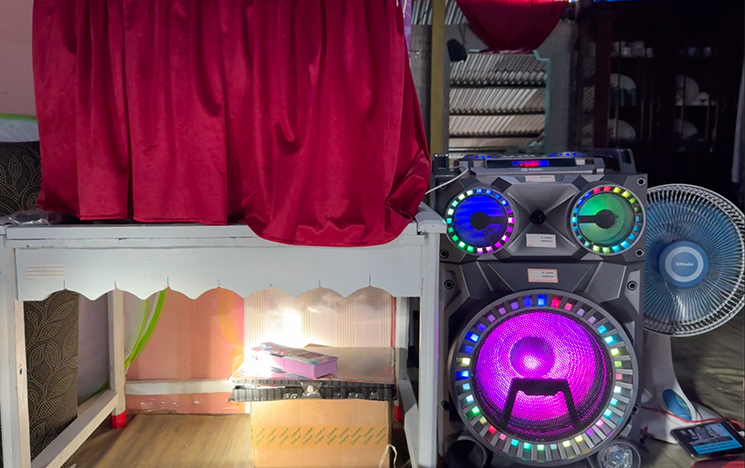
TV set and karaoke sound system.
Solar panels
Those households that have a solar panel can avail of electricity all day long. This may be as little as 40 Watts just to charge phones or light a bulb. Or they could be up to 900 Watts for buildings that harbour the government-subsidised SuperSUN units, enough to run rice cookers and standalone fans all day. Electric fans are rarely hung in the middle of a room for they are expensive, not suited for rooms with low ceilings; and/or there are no handy experts around to install them. So those that can, go to the mainland to buy dinky Hello Kitty fans or electric fans that have taller and mobile stands that circulate their cooling breeze.
Water pumps
Other island modcons are water pumps as Biyawasa is still blessed with sweet water (unlike Rannu where groundwater is salinated and large bottles of water are bought from Biyawasa). Solar rechargeables like flashlights that can be strapped on the head, are also important for night-time fishing. Occasionally, women may have an iron but would hardly use it for most of their clothes are made of polyester or mixed fabrics that don’t need ironing.
Printers and phones
These are the most prevalent appliances that use electricity in island homes. In one case, Biyawasa’s subvillage head owned a printer—but no computer—for it also enabled him to do hard copy scans of necessary documents. In another poorer household led by a fifty-year old, he had purchased a second-hand Nokia phone to contact his relatives on the mainland. Now that the phone had malfunctioned, he said, “Buying rice is more important than buying another phone…If I want to contact them, I just turn up at their homes”.
Conserving energy
In a project such as POWERE to connect remote islands with reliable renewable energy, it is not enough to just electrify. Alongside such endeavours, systematic capacity-building activities on maintaining electrical systems, as well as exchanging knowledge on conservation and environmental impacts are required. More electricity should not mean more consumption but considered conservation; and modern-day appliances requiring more electricity need not be the solution to their needs. A man in a general store on an island village earned about 1 million rupiah a day. Their goods were at least 50 percent more expensive than on the mainland. His family of four had 15 LED lamps (with only three connected to the solar installation) for an average-sized home alongside a television, refrigerator, washing machine, water pump, two fans, and two mobile phone chargers. Growing affluence led to growing electricity needs. The ironic fact was that when we met him, he was sporting a t-shirt with the writing “Dark Life” on it.
Washing machines
One family in Biyawasa had invested in a washing machine. But they decided to sell it back on the Sulawesi mainland. When we asked the housewife why, she replied, “The washing machine didn’t really wash. I had to wash the clothes again with my hands!” Not only did the appliance waste time and money, but it was also a waste of energy—both in terms of electricity and the manual labour of having to wash clothes twice. Rather than being an allusion to convenience products designed to make your life easy, modcons might in effect be shorthand for modern-day cons, intricately entwined with wasteful electricity use, which a few can see through. This understanding is very stark when we leave the islands to venture back onto mainland towns and cities with their glare of bright lights designed not to illuminate but to bedazzle and befuddle customers into over lit shops and shopping malls.
By Raminder Kaur.