Electric women
Women of all ages from remote coastal villages participate in workshop about electricity.
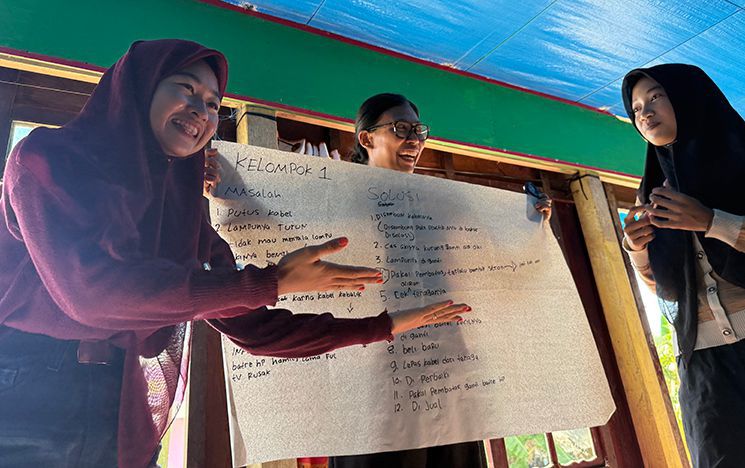
In a workshop facilitated by the POWERE team, women present solutions to fix broken electrical items.
Engaging remote coastal women in solar power
“Floating solar is a good solution for these island residents because there is not enough land. And the broken PLTS (solar power plant) was also submerged in the tide before. Now I think the batteries are too old to be fixed.“
Role models are few and far between. But when one comes across one, they can have a phenomenal effect on people’s desires and directions in life. To engage remote coastal women in “inclusive innovation” in a technological project such as a floating solar unit for electricity, we need to catalyse interests amongst them but also foreground women who have already pierced new frontiers as signposts for the future – signposts that enable an opening of new horizons and declare women too can do it.
An electrical workshop for women
In November, the POWERE team spearheaded a series of workshops in the marginalised villages of Katinting and Rannu (both of which are pseudonyms) on a Sulawesi island in Indonesia. Beginning with the lead facilitator and postdoctoral scholar, Diah Irawaty, in conversation with electrical engineer, Iriani from South Sulawesi’s provincial capital Makassar, about twenty women in both villages keenly listened to her life story in a discipline that is usually seen as the domain of men.
The women were of all ages, from age 13 to those in their sixties. Some had gone on to study at a senior high school (for ages 16-18) with some only studying to elementary school level with a couple of older women with no schooling at all. In Katinting in particular, children often don’t go to school for it’s located a mile away and the path is waterlogged on rainy days. Those that do go find that the teacher who has a second home on the mainland does not always turn up.
Their arena for learning then becomes the life around them in the village, which we wanted to augment by setting up workshops to create a fun and friendly space to actively learn about subjects like climate change, electricity, and how to support new initiatives with savings and loans systems in partnership with CARE Indonesia. The latter was particularly important for in the rainy West monsoon (barat) season, many of them do not have any way of earning income as it is the off-season for SP seaweed farming, which many of them work with.
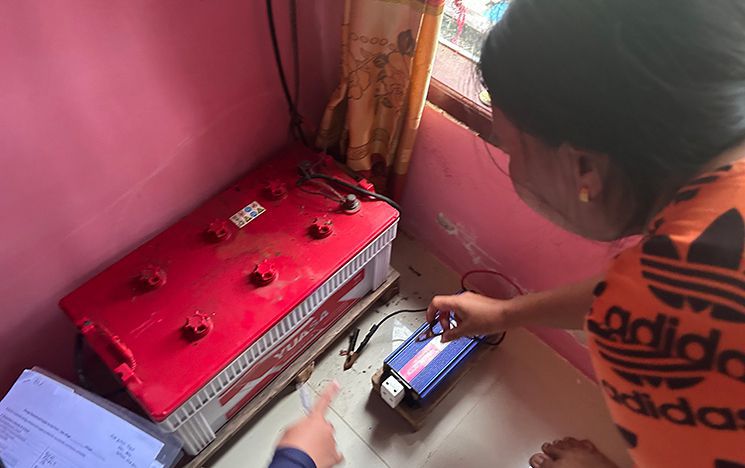
Woman tending to solar battery in her home.
Iriani’s story
I was born in Makassar. When I was 18 at senior high school I wanted to be an engineer. In my extended family, there is no female engineer and I wanted to be the first women to do this. We live with electricity every day but we don’t really understand it. So I was curious to learn.” Iriani
Electrical engineer
Iriani, along with her sister, turned to science while the males in her family turned to the sea: “My sister is a pharmacist and my older brother is a seaman. My dad is a sailor too. Most of the men in my extended family are sailors.”
She recalled how she received a scholarship for four-year degree, which turned out to be very stimulating: “I made a circuit with lamps as an experiment in the lab. I also learnt a lot about high voltage transmissions in big towers and it excited me to work in this area.”
While a male-dominated area, she still blazed ahead: “The degree course was 80 percent men and they were very helpful. It is a good career for women because electricity is not just for men. Women also have an interest in it. It is also well-paid.”
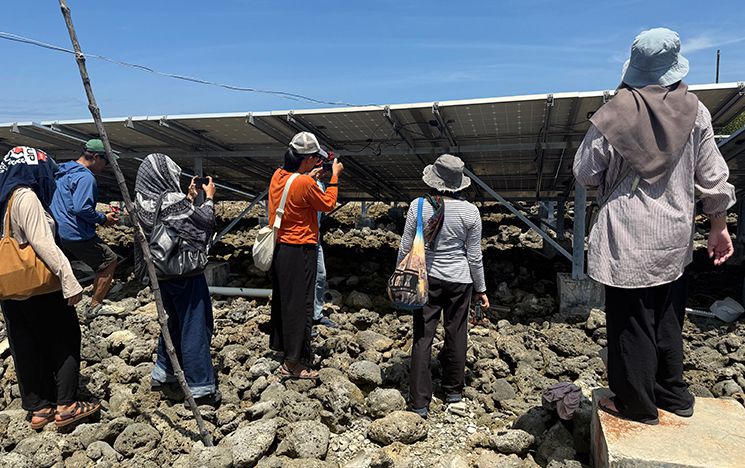
Iriani had accompanied the POWERE team to remote Sulawesi islands on two occasions, and noted not just the need for more electricity but different levels of awareness about it in the villages:
“I see that in Rannu men and women have quite a lot of knowledge about electricity, more than in Katinting. Once I asked a woman here, about the solar panels and she replied: 'They are rarely broken. We’re quite capable of taking care of the equipment'. This is because they are better educated and, on the whole, wealthier than those in Katinting.”
Discussing the hazards of electricity
But there are several hazards as well. For instance, there is limited space in Rannu and they don’t make electrical poles for the cabling. They swing from house to house. Nevertheless, the cables are well-covered. However, in the house, when the cable’s insulating cover is broken, people repair it by covering it with plastic, a material which can melt.
In the workshops, she alerted participants to such hazards. She also elaborated on how science and technology is woven in everyday lives. The participants then took to discussing technologies in their life that had broken down, while also thinking about how to provide solutions. A panoply of subjects were raised from television sets to “pregnant” (hamil) solar batteries (that dysfunctioned) as they had not been attached to an inverter. In an off-grid village where the communal diesel-fuelled generator had broken down, they also drew and discussed solar panels on some of their houses, and the way they are connected to a controller (perambat in Makassar language), the battery (aki) and an inverter, for which Iriani provided accessible explanations including elaborating on positive or negative charges.
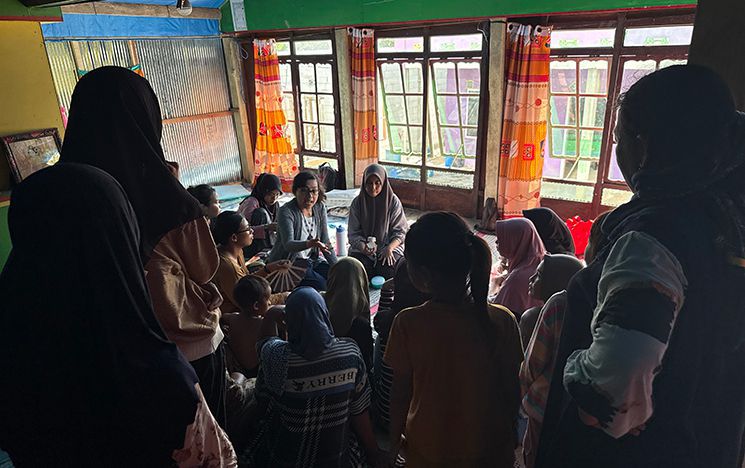
During the workshop.
This was the first time anybody had taken any time to systematically go through the essential workings of a solar panel unit in Katinting. Even the women’s husbands thought it unnecessary to explain it to them, occasionally pointing out some bare mechanics for operation should they be away from home for a long time on their fishing ventures.
Iriani then brought out a toy solar powered car, and a solar lamp before ending with a short film, pointing out the do’s and don’ts of electric wiring in a house to avoid short circuiting and electric shocks.
Gaining knowledge
Women’s faces were illuminated with knowledge at the end of the workshop. They demonstrated both embodied knowledge - subjects that they had taken for granted that was given voice and expression in the workshops - and embodied ignorance or learnt behaviours that were based on half-knowledge relayed to them by non-experts about how to manage solar and other technologies. They went away feeling empowered in that they had mastered new perspectives, with some of the younger women gaining confidence in public speaking. And who knows - may even open a door to an electrical engineering career in the future.
By Raminder Kaur.