Warming seas
Our researchers explore seaweed farming to understand how women's lived realities often remained hidden.
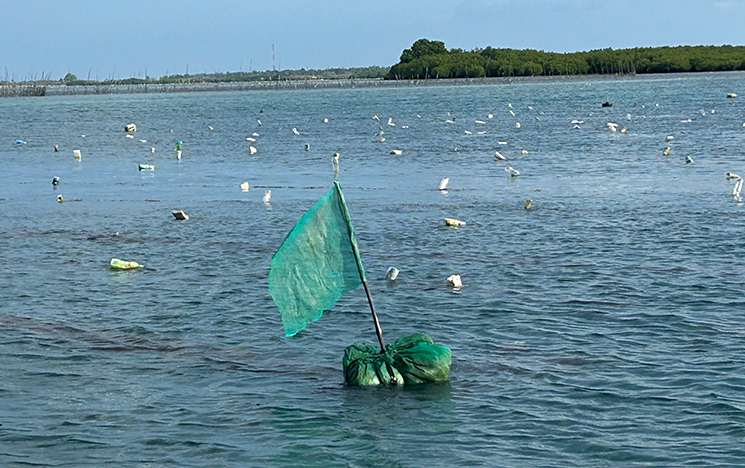
Seaweed farming
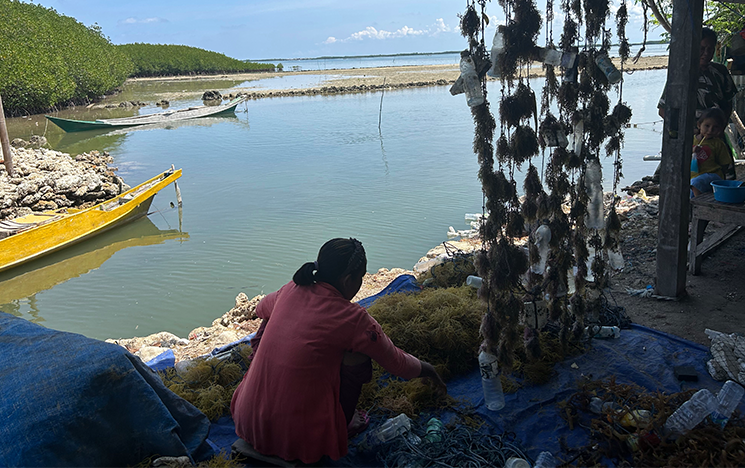
In many coastal communities across the Global South, seaweed aquaculture is more than an industry—it is a lifeline. Our research team has been reviewing decades of studies on women in seaweed farming, hoping to understand not only the promises attached to this “climate-smart” livelihood but also the lived realities that often remain hidden. Women form the backbone of seaweed production, yet their knowledge, labour, and everyday struggles remain largely invisible in policy and research. Empowerment is often celebrated, but far fewer studies ask how it coexists with marginalisation shaped by gender norms, economic precarity, geographical remoteness, and environmental vulnerability.
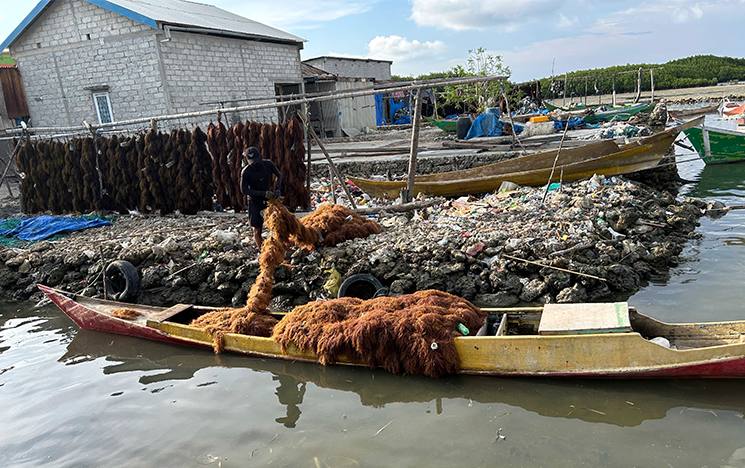
Changing sea temperatures
In this blog post, we focus on the pressures of environmental stress. During fieldwork, we met farmers who read the ocean with embodied attentiveness—through the feel of currents, shifts in the wind, and the warmth of the water against their skin. “It’s already November, but the weather feels uncertain,” one farmer told us. “The sea is warmer than usual, and even the cottoni seems confused.” That “confusion,” they explained, can trigger diseases that wipe out months of labour in just days.
Another morning, we saw farmers hurrying back from offshore plots, harvesting earlier than planned. “When the sea temperature changes suddenly, fungus spreads fast,” a farmer explained. “We have to harvest and dry immediately or we lose everything.” Each failed harvest deepens financial strain, pulling families further into a cycle of debt that erodes resilience.
For landless farmers and waged labourers, the risks are even sharper. “My family doesn’t have land, so I work on our neighbour’s small farm as a waged labourer. Seaweed farming has helped me support my family,” one woman said. But as the ocean becomes more unpredictable, a single failed harvest can mean losing the very job she relies on.
Across field sites, people describe seas growing too warm, rains falling off-beat, groundwater turning salty, floods creeping closer to their homes. They may not use the term “climate change,” but they feel its presence—intimately, daily. These shifts are not abstract; they are lived as threats to livelihood, water, and home.
Listening to these stories reminds us that resilience is not only about withstanding change. It is about sustaining dignity, belonging, and ways of life rooted in coastal communities.
By ChuChun Yu, Raminder Kaur, Mia Siscawati, Runavia Mulyasari.