The e-boat has arrived!
POWERE (Participation of Women in Renewable Energy) supports women-led energy innovation in seaweed farming communities of the Indonesian archipelago. This month, women in villages on the Tanakeke islands test drove seaweed farming boats powered by an electric engine—a first in Indonesia.
By Bradley Parrish, Diah Irawaty, and Runavia Mulyasari
POWERE (Participation of Women in Renewable Energy) supports women-led energy innovation in seaweed farming communities of the Indonesian archipelago. This month, women in villages on the Tanakeke islands test drove seaweed farming boats powered by an electric engine—a first in Indonesia.
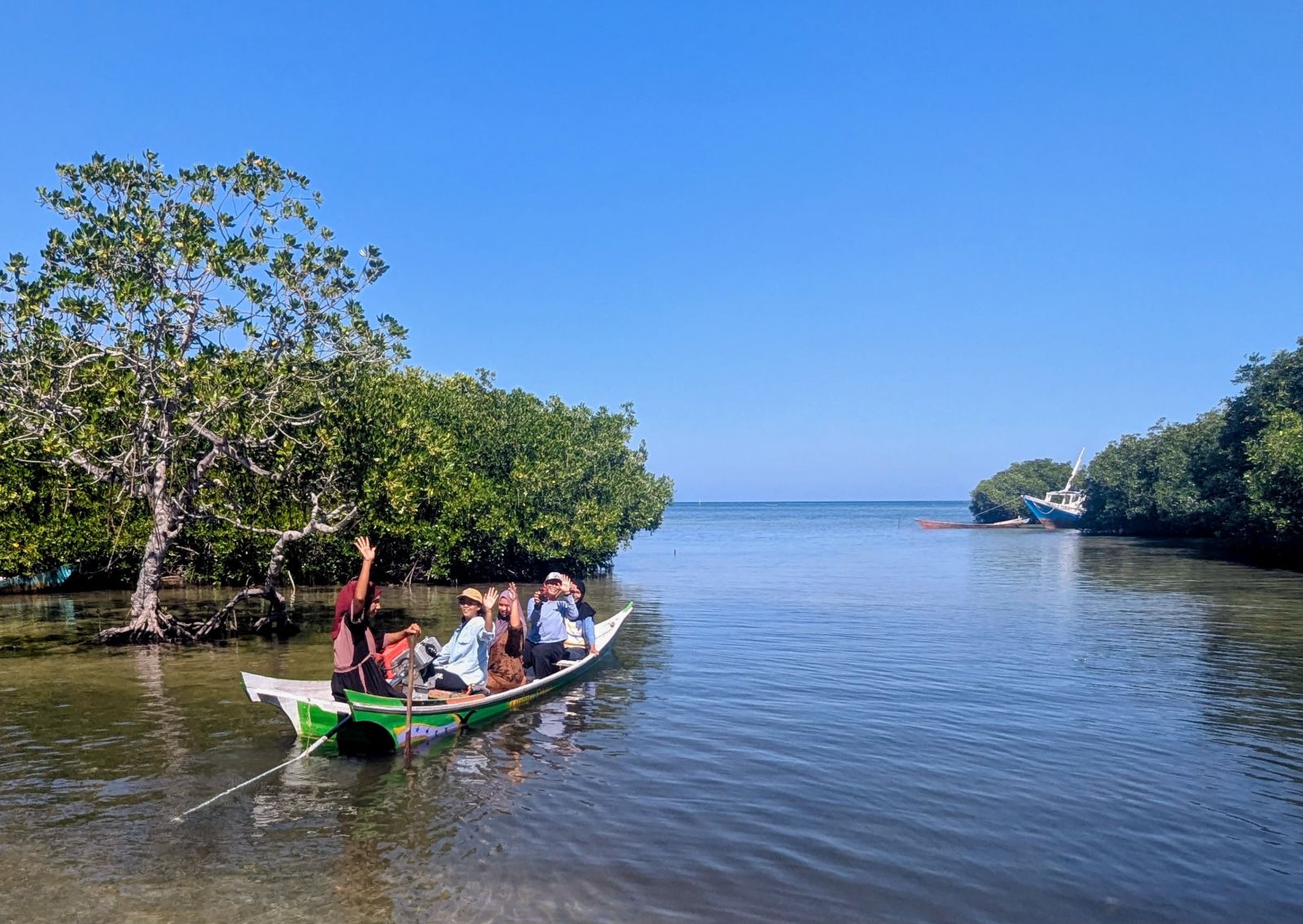 Photo credit: Bradley Parrish — A seaweed farmer waves to the crowd of onlookers during her test drive of the electric boat motor.
Towards solar-powered boats
Daeng Tarring gave a triumphant wave as she sped away from the shore in the first test drive of the electric boat motor. These test drives mark the first time electric boat motor technology has been introduced to seaweed farmers in Indonesia. Participants from women’s action learning groups facilitated by POWERE were trialing the technology to decide whether they would want to use it in conjunction with the village-owned floating solar power units that will soon be installed. These units are being co-designed and managed by the women's groups on behalf of the community.
The electric boat motor itself is being developed by an Indonesian woman whose start-up, Azura, was founded with the mission to bring this technology to rural coastal communities throughout the country. She and her team were invited to Tanakeke to test the concept with the seaweed farmers.
In two of the island’s villages, the e-motor boat trials generated great excitement. More than 40 women and a dozen men gathered at each village’s local mosque to learn about the electric boat motors—how they differ from gasoline motors and how to operate them. After being introduced to the motors, everyone moved outside to the seashore, where a jallepa was waiting. These are the small flat-bottomed boats predominantly used for seaweed work.
Dg. Tarring, one of the rare women in the community known for her boating skills, jumped into the driver’s seat with several other women following her into the boat. She flipped the switch and the engine started with a muted purr, then lowered the propeller below the water's surface, hit the throttle and they were off. They could be seen from the shore, crisscrossing the open water, testing the engine’s limits and trying out its unique reverse motion feature. When they came back to shore, the next group took their places, and so it went for the rest of the morning.
After her inaugural test drive, Dg. Tarring shared her impression: "Piloting a boat with the e-motor system was a truly memorable and valuable experience—something I never imagined possible. It felt like driving a luxury car: no noise, no exhaust fumes, and greater stability; I felt much safer operating my jallepa. It is also very easy to use. I am confident that the women here can handle it. I hope the e-motor boat system becomes a reality in our village. By using rechargeable batteries, we can avoid the hassle and costs of buying gasoline.”
Two other women who went along for the ride, Dg. Munia and Santi have never operated a motorized boat and only use lepa-lepa style boats, which are smaller rowboats. They expressed great hope that with the e-motor they can use a motorized jallepa to transport their seaweed. Some of the men had questions about the battery charge as they speculated about the possibility of longer trips beyond the near-shore activities the motor was designed for.
The Azura design team adapted the technology of their Manta One electric motor specifically to accommodate the demands of near-shore seaweed farming. They increased the size of the motor to 4 kW from the standard 2 kW to accommodate heavy loads of freshly harvested wet seaweed. This required a special cooling system, larger battery and custom mount to fit the jallepa style boats.
Enterprising ideas
The test drives sparked an outpouring of creativity from the women about how this technology could reshape their scope of opportunities in addition to tending to their seaweed lines. After the test drive in their village, the women’s group had a small discussion to share how they envisioned using the e-boat for their daily activities as well as seeing opportunities to develop businesses for the women’s group.
Dg. Bangu shared her first experience using the e-motor: “The e-motor boat is really great. It has no noise, and it is very fast (laringya kencang). We can even talk to each other while we are on the boat. It is easy to operate and makes women able to do many things independently, for example, checking our seaweed farms, collecting fresh water from Romantan, or travelling to other villages to visit family or take care of administrative matters at the village office when the men are away. I remembered the village head once mentioned a plan to provide a jallepa for our village. The women’s group should ask him about it because it would really support our group and our village.”
Another participant, Dg. Sunnarik, immediately saw the business potential: “It could become a good business if we rent out not only the e-motor but also the jallepa owned by the village. If we offer a good price, people will use the e-jallepa. It is also better because there is no pollution.”
The women’s enthusiasm came from seeing the new e-motor boat technology not solely as a new form of transportation, but also from envisioning it as a community asset that could improve income-generating opportunities through women-led enterprise.
Why all of these new possibilities? Combustion engines start with a pull cord, which is off-putting for many of the women. The electric engine starts with the flip of a switch, giving the women confidence to drive the boats without the presence of their husbands. This opens a new level of independence in mobility that they were immediately ready to put to use in enterprising activities to meet their family’s basic needs.
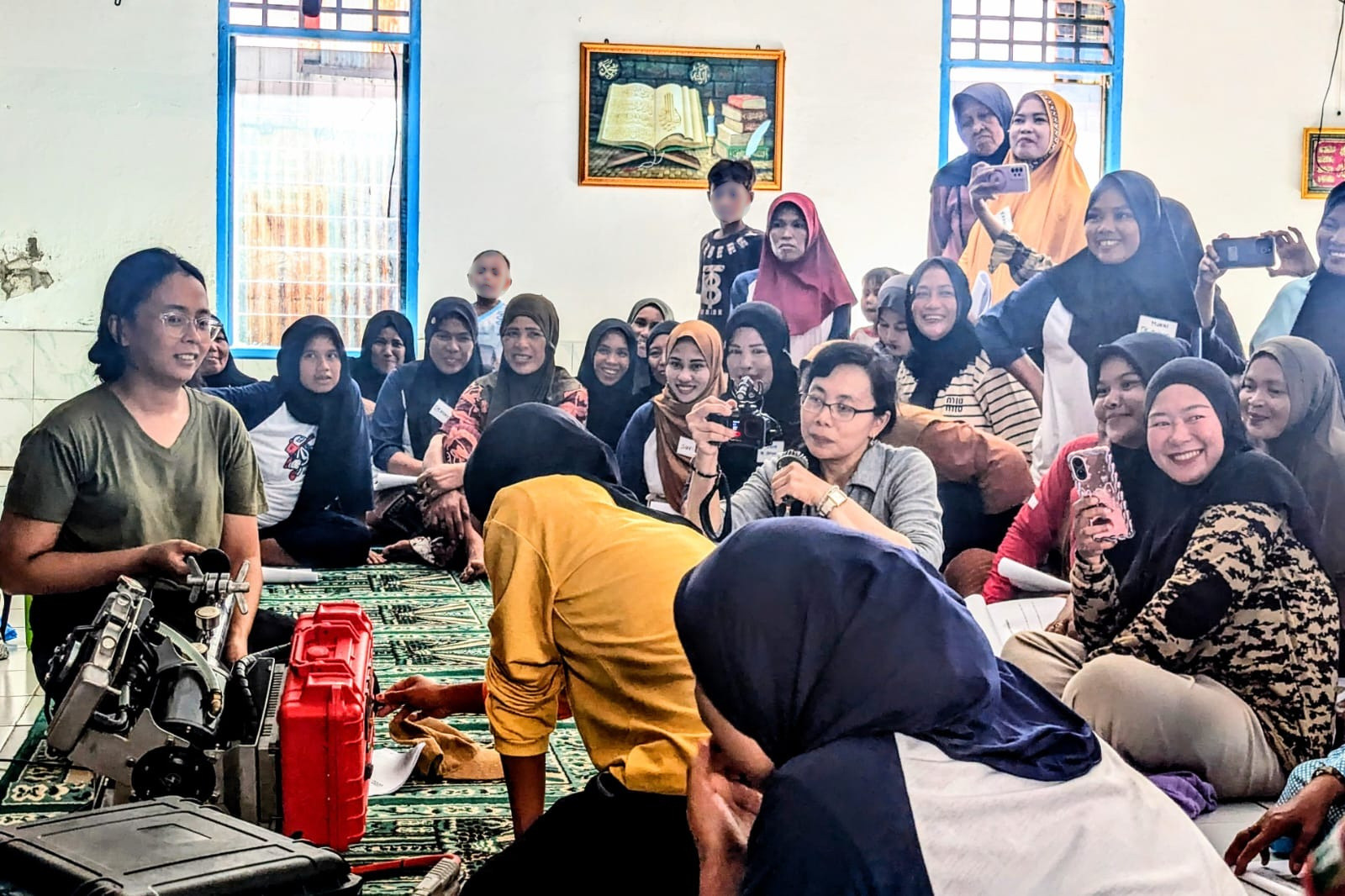 Photo credit: Bradley Parrish — Members of Bai Baine Kassa women’s action learning group learn about electric boat motors from Nadia Nabilla, founder of Azura.
Gender-balanced poverty reduction
Seaweed farming has been important for poverty reduction in remote island and coastal communities in Southeast Asia, and it has been especially empowering for coastal women.
Among all types of aquaculture in Indonesia, seaweed farming shows the greatest proportion of female involvement. Women officially head 40% of seaweed farms in Indonesia, and likely even more unofficially. Seaweed farming activities are flexible enough to accommodate other household responsibilities and multiple livelihoods. Profits from women-headed seaweed farms tend to be reinvested in family education, housing, and used as seed capital for micro-enterprises. Women’s prominent role in seaweed farming operations can also be a catalyst for wider social shifts in gender norms and expectations in coastal communities.
E-motor boat technology has the potential to play an important role in these shifts. As women gain greater independence in their near-shore mobility, their scope for heading the family’s seaweed operations also expands. Husbands equally supported this move. They noted that they would be able to go out for more extensive fishing and trading excursions if their wives were able to check the seaweed lines independently. Gender-balanced poverty reduction benefits the whole community.
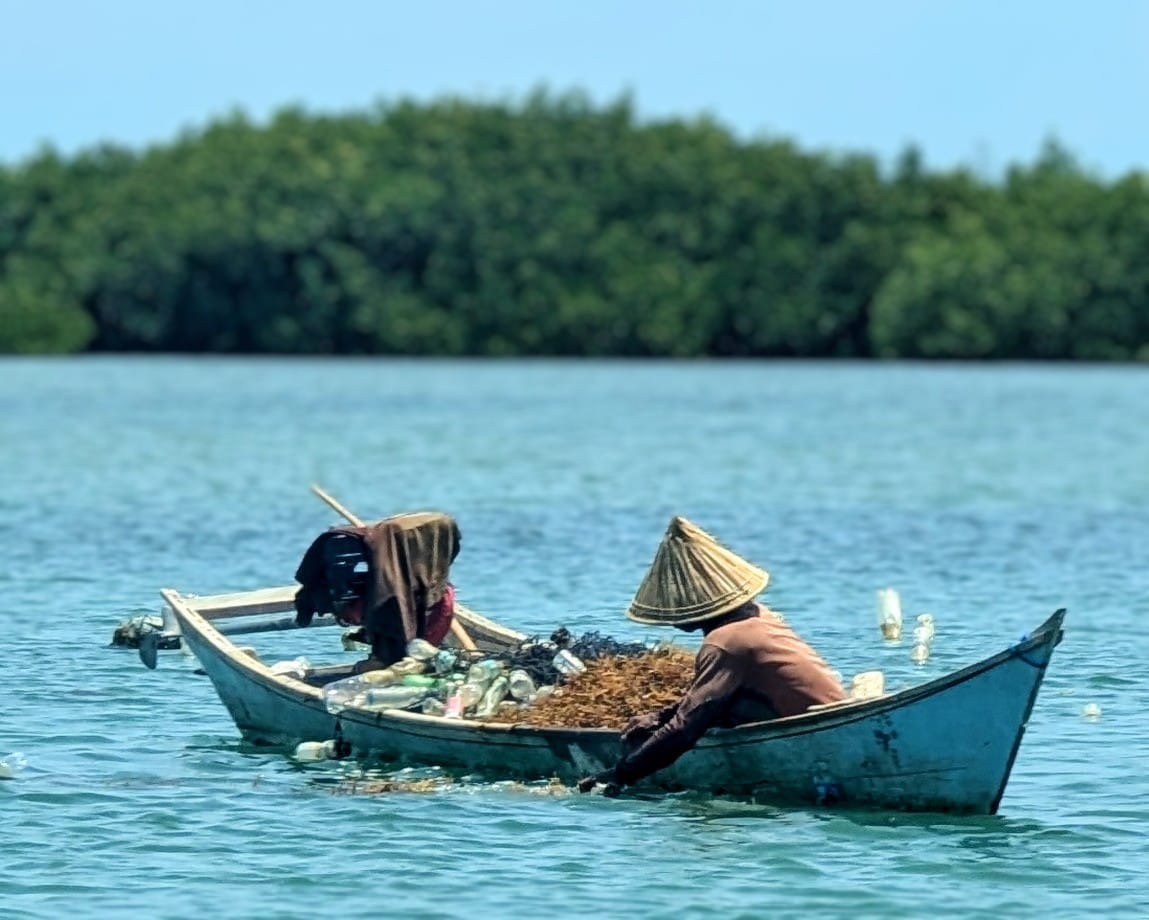 Photo credit: Bradley Parrish — A woman harvests seaweed in a jallepa boat.
Integrative sustainability solutions
Seaweed cultivation stands out from most agricultural systems because it requires no arable land, fresh water, fertilizers, or pesticides, giving it a remarkably low environmental footprint. What it does require, though, is boats used to tend the seaweed lines. Up until now the engines on those boats are powered by fossil fuels.
This is the primary energy demand for seaweed farming, as other onsite processes utilize natural means, such as sun-drying harvested seaweed. Dependency on fossil fuel creates an environmental footprint and subjects seaweed farmers to risks of significant cost increases as fuel prices rise. This reduces the financial resilience of farmers to weather the seaweed industry’s boom-bust price cycles.
Now, women-led innovation in Indonesia has the potential to transform this situation by using floating solar electricity generation to power the boats of seaweed farmers. This brings multiple social and environmental benefits, including reducing fossil fuel reliance and expenditure, along with cutting carbon emissions.
Creative-collaborative innovation
The goals of clean and affordable energy (SDG7) and effective climate action (SDG13) require integrative and inclusive solutions. Renewable energy supply itself is not a complete solution until it is paired with energy uses that satisfy unmet needs and open new possibilities for the community’s aspirations. Remote island and coastal communities in Indonesia–the world’s largest archipelago nation with over 17,000 islands–face particular infrastructure challenges that require a high level of self-sufficiency, yet opportunities to develop local knowledge, skills, and organizational capacities are severely limited by geography.
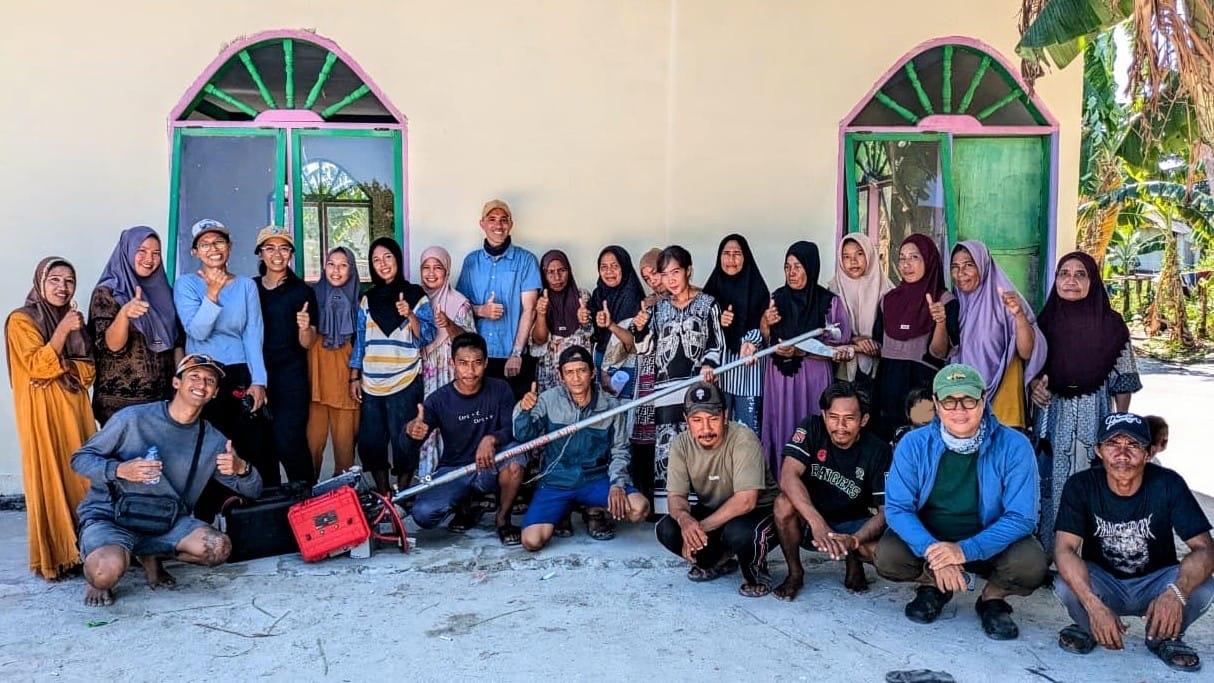
POWERE has adopted a unique approach to seeking solutions in such challenging geographies by coupling action research with action learning. Since December 2025, women’s action learning groups in Tanakeke have been meeting weekly for experiential learning sessions that combine collective action and reflection. They have developed capacities firstly to identify and articulate shared needs, and secondly to creatively and collaboratively find integrative and inclusive solutions to meet those needs.
In the past, technological solutions were introduced from the outside in supposedly complete, tried and tested packages. Local communities were expected to adopt the new technology by adapting themselves to it in whatever ways necessary. This resulted in a long history of failed solutions and abandoned technologies. Learning from the past, POWERE is trying out methods by which communities can instead adapt the technologies to meet their own self-identified needs and aspirations. This requires collaborative innovation and co-designed solutions.
As the POWERE project proceeds, we will continue to bring outside innovators together with community innovators to co-create and test-drive inclusive energy solutions.