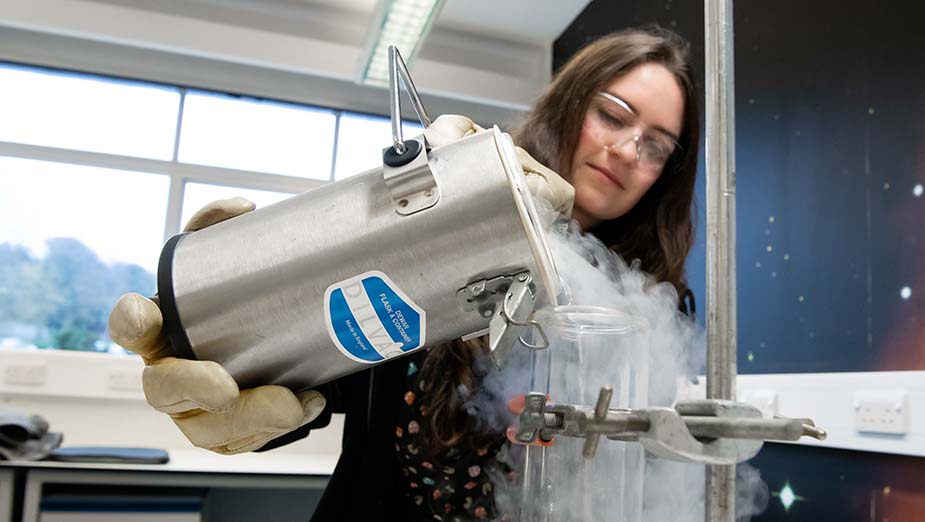
Autumn Open Day: Saturday 7 November 2026
Get a feel for campus life and learn more about your course. Join a campus Open Day, book a campus tour or visit us virtually.
Book your visit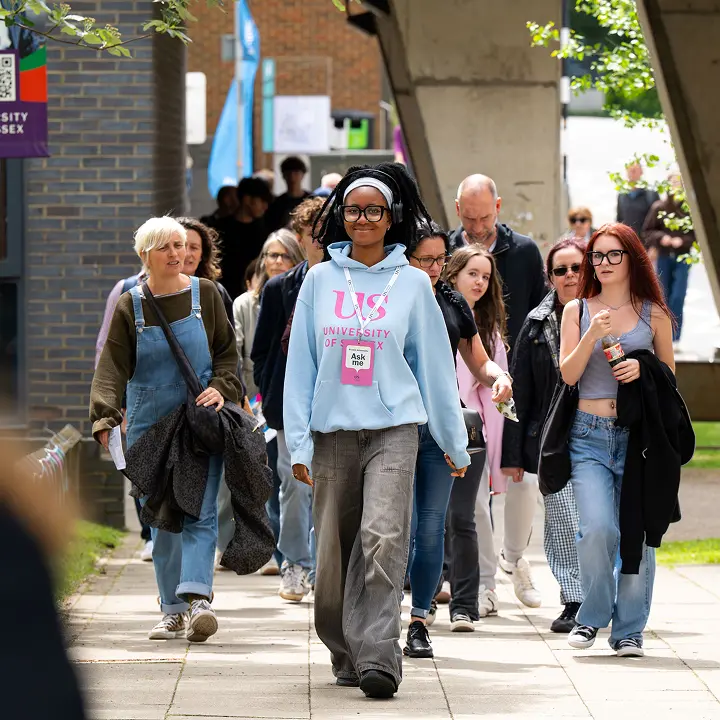
On campus - in person
You’ll study for this degree on our campus, joining our academics and fellow students. With in-person contact time, digitally supported educational resources, library collections and independent study, this course is designed to give you an inclusive education. Your learning experience may also include work placements, field trips, studying abroad and internationalisation experiences.
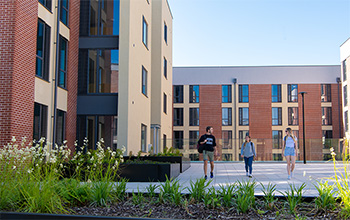
Find out about our beautiful campus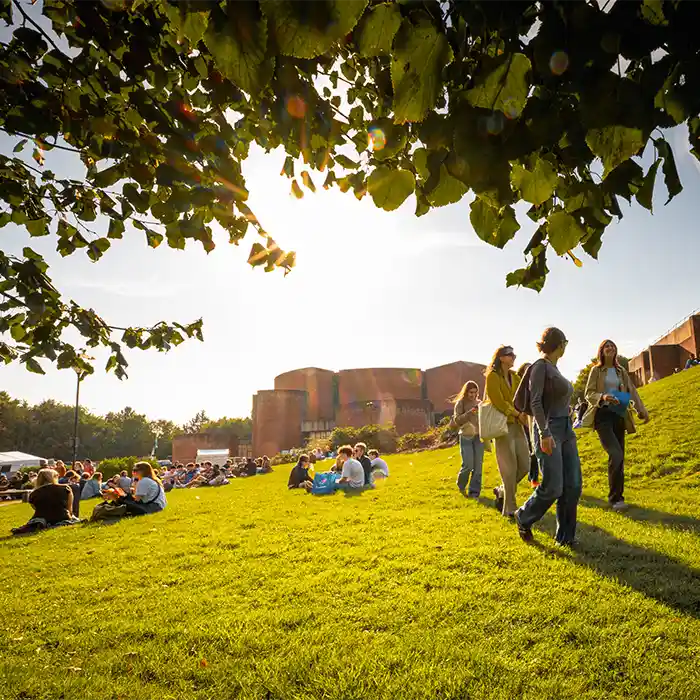
Virtual tour
Want to learn more about life at Sussex?
Our 360° virtual tour has been designed to introduce you to life in our diverse, supportive and inclusive community. Join our students for an immersive experience as they reveal why Sussex offers a space to follow your passions, find your voice, and discover people and places that will inspire you.
Begin your tour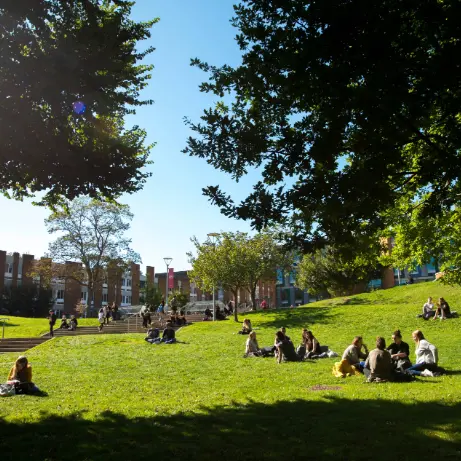

As a founding partner of ResearchPlus, a collaboration of research-focused universities, we engage with government, industry and civil society to support economic growth, prosperity and wellbeing across the whole of the UK.
Find out more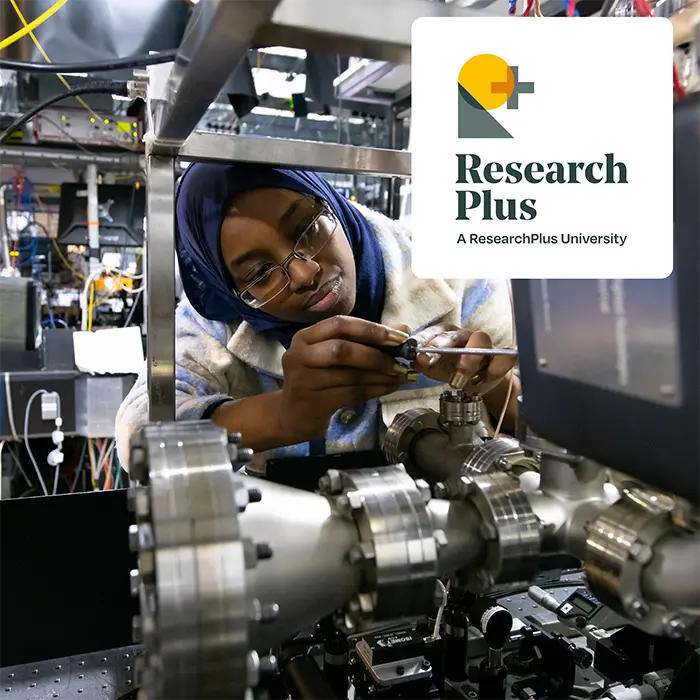
Modules
This is a single-honours course, allowing you to focus in depth on your core subject. Find out more from our guide to undergraduate study
-
 Silver
The student experience and student outcomes are typically very high quality.
Silver
The student experience and student outcomes are typically very high quality.
This rating was awarded in 2023, for four years. (Teaching Excellence Framework 2023)
Find out more about our approach to teaching and supporting you to thrive
-
Year 1 at Sussex
Your modules
Core modules
Core modules are taken by all students on the course. They give you a solid grounding in your chosen subject and prepare you to explore the topics that interest you most.
Autumn teaching
Spring teaching
- Heat and Modern Physics
- Mathematical Methods for Physics 2
- Physics Year 1 Laboratory
- Waves and Fields
Options
Alongside your core modules, you can choose options to broaden your horizons and tailor your course to your interests. This list gives you a flavour of our options, which are kept under review and may change, for example in response to student feedback or the latest research.
While it’s our aim for students to take their preferred combinations of options, this can’t be guaranteed and will be subject to timetabling. Options may be grouped and if so, students will be able to choose a set number of options from the selection available in any particular group.
Autumn teaching
Your degree
In your first year, you’ll explore classical and modern physics. You’ll learn to work with large sets of data, find out about the programming language Python and get to experiment in our teaching laboratories.
Teaching
Teaching methods typically include:

 60%: Lecture
 40%: Practical
Assessment
Assessment methods typically include coursework and examination.
Contact hours and workload
This year of study includes approximately 1,200 hours of work. This breaks down into about 420 hours of contact time and about 780 hours of independent study.
Engage and actively participate throughout your studies to get the most out of your course.
-
Year 2 at Sussex
Your modules
Core modules
Core modules are taken by all students on the course. They give you a solid grounding in your chosen subject and prepare you to explore the topics that interest you most.
Autumn teaching
- Applying Physics Skills
- Electrodynamics
- Mathematical Methods for Physics 3
- Physics Year 2 Laboratory
- Summer Research Placement 1
Spring teaching
Options
Alongside your core modules, you can choose options to broaden your horizons and tailor your course to your interests. This list gives you a flavour of our options, which are kept under review and may change, for example in response to student feedback or the latest research.
While it’s our aim for students to take their preferred combinations of options, this can’t be guaranteed and will be subject to timetabling. Options may be grouped and if so, students will be able to choose a set number of options from the selection available in any particular group.
Spring teaching
Your degree
In Year 2, you’ll use your developing problem-solving skills to solve more complex issues. You’ll work on laboratory experiments or data analysis projects.
Teaching
Teaching methods typically include:
 50%: Lecture
 20%: Seminar
30%: PracticalAssessment
Assessment methods typically include coursework and examination.
Contact hours and workload
This year of study includes approximately 1,200 hours of work. This breaks down into about 320 hours of contact time and about 880 hours of independent study.
Engage and actively participate throughout your studies to get the most out of your course.
-
Year 3 at Sussex
Your modules
Core modules
Core modules are taken by all students on the course. They give you a solid grounding in your chosen subject and prepare you to explore the topics that interest you most.
Autumn teaching
- Advanced Physics Laboratory A
- Atomic Physics
- Condensed State Physics
- Nuclear and Particle Physics
- Summer Research Placement 2
Spring teaching
Options
Alongside your core modules, you can choose options to broaden your horizons and tailor your course to your interests. This list gives you a flavour of our options, which are kept under review and may change, for example in response to student feedback or the latest research.
While it’s our aim for students to take their preferred combinations of options, this can’t be guaranteed and will be subject to timetabling. Options may be grouped and if so, students will be able to choose a set number of options from the selection available in any particular group.
Spring teaching
- Financial Derivatives
- Lasers and Photonics
- Monte Carlo Simulations (L6)
- Particle Physics
- Semiconductors and Nanomaterial Devices (L6)
- Stellar and Planetary Physics
Your degree
In Year 3, you’ll apply the knowledge you’ve gained to longer and more complex projects. You’ll cement your core physics knowledge with solid state, atomic and nuclear physics, and also take forward your own interests.
Teaching
Teaching methods typically include:
 59%: Lecture
9%: Seminar
32%: PracticalAssessment
Assessment methods typically include coursework and examination.
Contact hours and workload
This year of study includes approximately 1,200 hours of work. This breaks down into about 420 hours of contact time and about 780 hours of independent study.
Engage and actively participate throughout your studies to get the most out of your course.
-
Year 4 at Sussex
Your modules
Core modules
Core modules are taken by all students on the course. They give you a solid grounding in your chosen subject and prepare you to explore the topics that interest you most.
Autumn and spring teaching
Options
Alongside your core modules, you can choose options to broaden your horizons and tailor your course to your interests. This list gives you a flavour of our options, which are kept under review and may change, for example in response to student feedback or the latest research.
While it’s our aim for students to take their preferred combinations of options, this can’t be guaranteed and will be subject to timetabling. Options may be grouped and if so, students will be able to choose a set number of options from the selection available in any particular group.
Autumn teaching
- Atom Light Interactions
- Cosmology
- Data Analysis Techniques
- Galactic Astrophysics
- General Relativity
- Quantum Field Theory
- Quantum Optics and Quantum Information
Spring teaching
- Advanced Cosmology
- Advanced Quantum Field Theory
- Astrophysical Processes
- Beyond the Standard Model
- Electrons, Cold Atoms & Quantum Circuits
- Frontiers in Particle Physics
- Monte Carlo Simulations (L7)
- Practical Quantum Technologies
Your degree
In your integrated Masters year, you’ll work at the forefront of research. You’ll take the lead on a self-directed project, supported by a supervisor. You’ll also choose options relevant to your project to support you in the discovery process.
Teaching
Teaching methods typically include:
 52%: Lecture
48%: PracticalAssessment
Assessment methods typically include coursework, examination, practical work and written assessment.
Contact hours and workload
This year of study includes approximately 1,200 hours of work. This breaks down into about 300 hours of contact time and about 900 hours of independent study.
Engage and actively participate throughout your studies to get the most out of your course.
Spirit of Sussex Award
Feel involved in life at the University, make friends and enrich your experience with us – the Spirit of Sussex Award is our way of recognising your extracurricular and voluntary achievements.
-
Video transcript
Hi everyone! As I'm sure you've all heard by now, the Spirit of Sussex Award is now live.
Students across the Sussex community are already earning their points
What will you do to earn yours?
There's so many ways to get involved.
Head over to the website to start your Spirit of Sussex journey.
Text: The Spirit of Sussex Award is an exciting new programme designed to recognise and celebrate the things you do outside your course.
Participating in the Award makes it easy and fun for you to get involved and make the most of university life.
We regularly review our modules to incorporate student feedback, staff expertise, as well as the latest research and teaching methodology. We’re planning to run these modules in the academic year 2026/27. However, there may be changes to these modules in response to feedback, staff availability, student demand or updates to our curriculum. We’ll make sure to let you know of any material changes to modules at the earliest opportunity.
We’ll do our best to provide as much optional choice as we can, but timetabling constraints mean it may not be possible to take some module combinations. The structure of a small number of courses means that the order of modules or the streams you choose may determine whether modules are core or optional. This means that your core modules or options may differ from what’s shown here.
Check back in January 2027 for more details of the modules running in the academic year 2027/28.
Research placements (each summer throughout this degree)
Our MPhys course with a research placement is a stimulating intellectual challenge for well-qualified students, providing unique training for a future research career. You can apply to work on a research problem with a member of faculty in the Department of Physics and Astronomy each summer before Years 2, 3 and 4.
During the summer research placements, you receive funding to cover your living expenses.
Find out more about our research placements and summer projects at Department of Physics and Astronomy: Undergraduate Research
In the summer, you work in a research group or alongside a supervisor on a project where you can learn new skills and techniques that other undergraduates would never get to do, and contribute to science at the same time.”Daniel Pollard
Physics (research placement) MPhys
Find out more about studying Physics at Sussex, including astrophysics, theoretical physics and particle physics
Our experts
I work on the ATLAS experiment at the CERN’s Large Hadron Collider, seeking answers to fundamental questions such as ‘What is the nature of dark matter?”Professor Antonella De Santo
Professor of Physics
Prof Antonella De Santo
Professor Of Physics RSW Research MeritAward Holder
Careers
- 86% of Sussex undergraduates have completed work experience by the end of their course (University of Sussex Career Readiness data at point of graduation 2023/24)
We are a core part of the SEPnet (South East Physics Network) consortium, which gives us links to universities and industries across the region.
On your course, you’ll develop versatile and transferable skills. This prepares you for finding jobs in industry or academia. Many of our graduates go on to postgraduate research and PhD study. Others find graduate jobs in a diverse range of fields, including:
-
aerospace
-
consulting
-
geophysics
-
teaching
-
the scientific Civil Service.
Where do our graduates work now?
Surveyed 15 months after finishing their courses, our recent graduates from the Department of Physics and Astronomy worked for employers including:
- Babcock
- EDF
- Frenetic
- KPMG
- National Physical Laboratory
- NHS
- Transport for Greater Manchester
- Deloitte
- BAE Systems.
(Graduate Outcomes Survey 2017-2022)
Working while you study
Our Careers and Entrepreneurship team can help you find part-time work while you study. Find out more about career development and part-time work
My job involves a lot of data analysis and research into ATLAS Supersymmetry. The research placement gave me a real idea of what it is like to do research as a job.”Emma Kuwertz
Research Fellow at CERN
Design your future at Sussex
Taking the next step in your career can feel daunting, but we’ll help you to explore, connect and flourish throughout your studies and beyond.
As a Sussex student, you’ll learn how to tackle real-world challenges and have access to tailored programmes of careers support:
- our Career Lab helps you to explore your options, build key skills and connect with employers. Take part in internships, community consultancy projects and insight visits, where you can learn about life at organisations such as Brighton & Hove Albion Football Club, the Knepp Rewilding Project, and fashion brand Puig
- one-to-one appointments with your Faculty Careers Consultant can enable you to identify your career goals, write an effective CV and prepare for future interviews
- entrepreneurship initiatives like StartUp Sussex and Ideas Lab can empower you to turn your concepts into reality.
Explore how our Careers and Entrepreneurship team can support you
-
 Winner
Entrepreneurship Catalyst Award
National Enterprise Educator Awards 2024
Winner
Entrepreneurship Catalyst Award
National Enterprise Educator Awards 2024
-
 Winner
Supporting Student and Graduate Employability Award
AGCAS Awards for Excellence 2024
Winner
Supporting Student and Graduate Employability Award
AGCAS Awards for Excellence 2024
-
 Top 50
Best Universities for Work Experience in the UK
2025 Higherin Awards
Top 50
Best Universities for Work Experience in the UK
2025 Higherin Awards
Fees
Note that your fees, once they’re set, may be subject to an increase on an annual basis. Find details on our Tuition fees page.
Home students
£10,050 per year
Channel Islands and Isle of Man students
£10,050 per year
International students
£28,100 per year
-
Additional costs
Note about additional costs
Additional costs to your tuition fees may include field trips, equipment, materials, bench fees or studio hire. These costs are best estimates based on current market values which we review each year. These costs may be subject to change due to unforeseen circumstances where the University has limited control such as a change in a service provider or government guidance. We will let you know at the earliest opportunity if there is any change to these costs. We will also tell you if these costs are mandatory for passing your course or optional. Find out how to budget for student life.
Placements
You will take part in research placements during the summer, usually on the University campus. You will get bursaries for your placements:
Year 1: £1,750 for a four-week placement
Year 2: £3,500 for an eight-week placement, conditional on applying to the institutional Junior Research Associate (JRA) scheme. If your application is unsuccessful, you will still receive the full bursary.
Year 3: £3,500 for an eight-week placement.
Find out more about the Junior Research Associate (JRA) Scheme
Living costs
We know the rising cost of living is on everyone’s mind, and affects us all in different ways. Our guide to living costs has been designed to help you plan and budget for life as a Sussex student.
Learn more about typical living costs
Scholarships
Details of our scholarships are not yet set for entry in the academic year 2027/28.
Contact us
Ask a student
Chat to Sussex students online via the UniBuddy chat platform.
Prospectus
What do you want to do next?

Legal information
We understand that deciding where and what to study is a very important decision. We’ll make all reasonable efforts to provide you with the courses, services and facilities described in this prospectus. However, if we need to make material changes, for example due to government or regulatory requirements, or unanticipated staff changes, we’ll let you know as soon as possible.
A-level - contextual offer
AAA
Pearson BTEC Level 3 National Extended Certificate and two A-levels - contextual offer
Grades AA in A-levels and Distinction in Pearson BTEC Level 3 National Extended Certificate.