News
UK Anti-Corruption Strategy 2025 draws on GI ACE research
By: Alexander Mason
Last updated: Wednesday, 18 February 2026
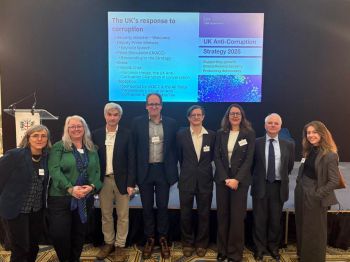
ACE researchers at the launch of the strategy. From left to right: Sue Hawley (Spotlight on Corruption), Dan Haberly, Heather Marquette (SOC ACE Director), John Heathershaw, Tom Mayne, Liz David-Barrett, Robert Barrington, and Maria Nizzero.
The UK Anti-Corruption Strategy 2025, published 8 December 2025, draws directly on evidence generated by Governance & Integrity Anti-Corruption Evidence (GI ACE) and its sister research programmes.
Building on its 2017 to 2022 iteration, the strategy sets out the government’s approach to stopping corruption at home and abroad, reducing the harm caused by corruption to growth, security, and democracy in the UK, as well as UK interests overseas.
GI ACE is a core component of the broader Anti-Corruption Evidence research programme. Based at the Centre for the Study of Corruption at the University of Sussex, GI ACE collaborates with a diverse range of leading researchers around the globe, as well as civil society partners, and engages with key stakeholders to drive impactful anti-corruption strategies. GI ACE is funded by the UK Foreign, Commonwealth & Development Office (FCDO).
GI ACE research on kleptocracy
The strategy twice references Indulging Kleptocracy: British Service Providers, Postcommunist Elites, and the Enabling of Corruption, a book authored by John Heathershaw, Tena Prelec, and Tom Mayne.
The book – based on years of research completed under the auspices of GI ACE project – examines how lawyers, real estate agents, bank managers, and others in similar professions play a key role in not only transferring illicit financial flows from kleptocracies, but also in laundering the reputations of kleptocratic political elites.
Specifically, the strategy references the book in its discussion of how kleptocrats’ access to UK elites “undermines and weakens our institutions” (Page 16) and reproduces a graphic which illustrates the “relationship between a kleptocrat and the services they receive and rely on in the UK” (Page 27).
GI ACE research on shell companies and financial secrecy
The strategy references a GI ACE working paper, authored by Daniel Haberly and Tom Shipley, that summarises research exploring patterns of global shell company formation and regulations governing offshore financial secrecy: Corruption, shell companies, and financial secrecy: providing an evidence base for anti-corruption policy.
Specifically, the strategy references the paper in relation to how corrupt actors hide identities and launder money through opaque, multi‑jurisdictional corporate structures (Page 34).
Other GI ACE research referenced
The strategy references impact achieved by the GI ACE project Curbing corruption in procurement using ‘red flags’ risk indicators (Page 79), stating that it has been “taken up by the governments of Uganda and Jamaica, alongside the World Bank, as an internal risk control instrument”.
Additionally, a GI ACE working paper authored by Daniel Haberly, Georgia Garrod, and Robert Barrington, From Secrecy to Scrutiny: A New Map of Illicit Global Financial Networks and Regulation, is also referenced (Page 79): “The benefits of leveraging data in anti-corruption efforts are further reinforced by recent GI-ACE work where multiple datasets were used to map illicit financial flows thereby identifying where anti-corruption interventions should be targeted.”
Analysis of the strategy
Robert Barrington (GI ACE Director of Operations) has written a blog: Evaluating the evidence base for the UK’s 2025 Anti-Corruption Strategy.
About the Anti-Corruption Evidence ‘ACE’ Programme
GI ACE is one of three component programmes of the broader Anti-Corruption Evidence Programme (ACE), which is referred to as “world leading” in the strategy (Page 77).
ACE, funded by the UK Government’s Foreign, Commonwealth & Development Office, aims to deliver new, practical research about what works in tackling corruption, illicit financial flows, and serious organised crime.
GI ACE’s sister programmes are SOAS ACE, led by the School of Oriental and African Studies (SOAS) at the University of London, and Serious Organised Crime (SOC) ACE, based at the University of Birmingham.
Contact
Contact the School office: lps@sussex.ac.uk.