Blog
Explore project findings through mixed media reflections on key themes and issues.
Holding enchanted conversations with ecofeminist methods
Posted on behalf of: Rachael Durrant
Last updated: Friday, 31 October 2025
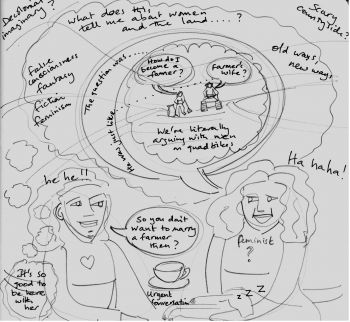
Image credit: Rachael Durrant
In the Women Back to the Land project, I’ve been exploring the experiences of women entering and progressing their careers in agroecology — how they build livelihoods rooted in care, cooperation, and respect for the land. Alongside these stories, I’ve been asking what kind of research practices support those same values.
My new open access paper, Re-enchanting the Research Encounter (Journal of Psychosocial Studies, 2025), reflects on how psychosocial methods – including group reflection, supervision, and journalling – have helped me to foster (more) honest, caring relationships with the participants in my research.
Psychosocial methods as ecofeminist practice
Psychosocial approaches start from the idea that research is always relational. They help us attend to the emotional, social, and ethical dimensions of our work, not just the “data.” This means recognising that how welisten, and how we respond, are just as important as what we find.
This orientation overlaps strongly with ecofeminist theory, which challenges separation between mind and body, people and planet, researcher and researched. Both psychosocial and ecofeminist methods ask us to notice interdependence, to value care and reflection, and to stay alert to power and vulnerability in our relationships.
Practices for listening and responding
Alongside the 50 interviews of various sorts that I’ve conducted as part of this project, I’ve also used group analysis, supervision and journalling to deepen my understanding. These practices enabled me to process not only what participants said during interviews, but also how the research relationships felt. As such, they’ve helped me to think through difficult moments during interviews and notice my defences to unwanted feelings – for instance, when growers shared experiences of pain and trauma.
My explorations with psychosocial methods have also shown me that attending to emotion doesn’t dilute the work or make it less rigorous – on the contrary, it has the potential to deepen it and make it more robust by inviting a more honest engagement with research participants.
How I will take this forward
My hunch is that practices like these could also offer valuable support for farmers, growers and those supporting them. By exploring ways of slowing down, noticing how collaboration feels, and holding safe spaces for acknowledging difference and difficulty, I suspect that we can strengthen the networks of care and connectivity that underpin our agroecological practice.
This is why I’m planning two gatherings for the coming year at which I hope to demonstrate and pass on some of these practices, as an offering to anyone who has participated in or engaged substantively with the research. These events will also offer an opportunity for screening the Women back to the Land film – as well as another chance for attendees to create their own graphic story-maps.
Watch this space for me information in the coming months.