Business School news
Read news relating to the University of Sussex Business School.
The Land that Holds Us: Business School research reveals the hidden barriers facing women farmers in the UK
By: Chimezie Anajama
Last updated: Thursday, 18 June 2026
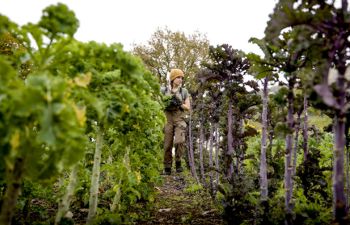
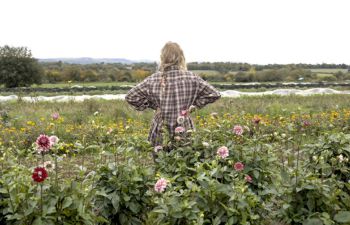
One of the women farmers stands on her farmland
In the UK, getting access to farmland often depends on inheriting land, having enough money to buy or rent it, and knowing the right people or networks. These factors can make it especially difficult for women who want to start farming. As a result, these barriers affect who gets to grow food, whose labour is valued, and how resilient and secure the UK’s food system is.
A new, short documentary, The Land that Holds Us, explores how women face particular challenges and barriers in getting access to land and building a life in farming in Britain. The film follows four women who are working hard to make a living from small-scale organic and agroecological farming, despite experiencing financial insecurity, housing insecurity and battles with planning. (Agroecology focuses on the design and management of sustainable food and farming systems.)
Led by Dr Rachael Durrant, Senior Research Fellow, Science Policy Research Unit (SPRU) at the University of Sussex Business School, the documentary highlights the daily lives of Zoe Proctor, Katie Hastings, Rosa Farber, and Collette Haynes as they work to build their farming businesses.
The film forms part of the wider Women Back to the Land project - funded by a Leverhulme Early Career Fellowship. Since August 2021, the project has been following the four women’s journeys into sustainable farming across Sussex and mid-Wales. The research has used observations, interviews, photography, illustration, film, and collaborative workshops to explore the opportunities and challenges they face and their motivations to make a living from farming.
Fragile pathways into farming
Both the research project and the documentary show how entry into land-based work is often informal, through volunteering or temporary work, and with no guarantee of long-term financial security.
As one of the documentary participants noted, “I didn’t know it was a thing you could do.” Others, like Zoe Proctor, described how volunteering and activism opened the door to farming: “We volunteered… and in that process, it made us aware of how much amazing food can be grown on just under an acre.”
These stories show that women often enter farming through informal and unpredictable pathways rather than established career routes, frequently relying on unpaid work and chance opportunities – barriers that make farming difficult to access or sustain long-term as a livelihood.
Gendered and invisible labour
The documentary also highlights how women’s work is often less visible and less recognised. Instead of focusing only on growing food, women frequently take on administrative tasks, caregiving, and the day-to-day coordination that keeps farms running.
As Collette Haynes, explains, “As the woman… I was just the jack of all trades… I’m not the grower that I set out to be.”
The film also highlights how decision-making power is not always equal. Rosa Farber describes how she often puts “other people’s perspectives ahead of mine… but then I’m like, wait, am I actually okay with where we’re going?”
Structural barriers to land access
Other structural barriers faced by women farmers include high land prices, housing insecurity, short-term tenancy agreements, and limited financial security. These factors can make it extremely difficult to establish a viable small-scale organic and agroecological farming business.
As Katie Hastings explains, “We don’t have long-term security… we can’t build any infrastructure… I’m earning less than minimum wage.”
Without secure access to land, farmers are often unable to invest in essential equipment, buildings, and soil improvements. One of the creative and temporary solutions participants rely on is patchwork farming – using several small plots of land in different places, such as “a field here or a bit of land there.”
While this can provide a way to keep farming, it often involves constant uncertainty and extra work.
For others, the challenges became too great. As one participant reflects: “It was so hard to make this my livelihood that essentially I had to give up on that dream of being a farmer and find something else to do.”
Sustainability, resilience, and identity
Despite these challenges, the documentary shows that land-based work, including organic and agroecological farming, is often deeply meaningful and life changing. Katie Hastings noted that working with the land gave her a strong sense of purpose: “It did completely change my life… I felt this sense of peace.”
At the same time, the documentary is honest about the personal cost of trying to make farming work under such difficult conditions. As Collette Haynes explains, “It’s been overwhelming… detrimental to my health.”
The Women Back to the Land project shows how unequal access to land affects not just individuals but also the wider food system.
Wider food systems
Small-scale organic horticulture and agroecological farming play a vital role in building healthier, more sustainable food systems. By growing diverse, nutrient-rich food while prioritising soil health, biodiversity and low-impact farming practices, these farmers are helping to demonstrate how food can be produced in ways that both nourish communities and care for the land.
Their work speaks directly to global efforts to achieve the United Nations Sustainable Development Goals, particularly those focused on zero hunger, gender equality, climate action and life on land, highlighting how equitable access to farming is essential not only for social justice, but for a more resilient and regenerative food future.
When fair and affordable access to land is restricted, diversity and innovation in the sector is reduced and makes the UK’s food system less resilient. At a time when farmers are facing growing pressures from climate change and rising costs, access to land is not a niche issue. It is a major question for the future of food production, rural livelihoods, and environmental sustainability.
Study at SPRU
In 2026, SPRU celebrates 60 years of world-leading science policy research and education. Find out more about post-graduate study at SPRU: Masters and PHD.