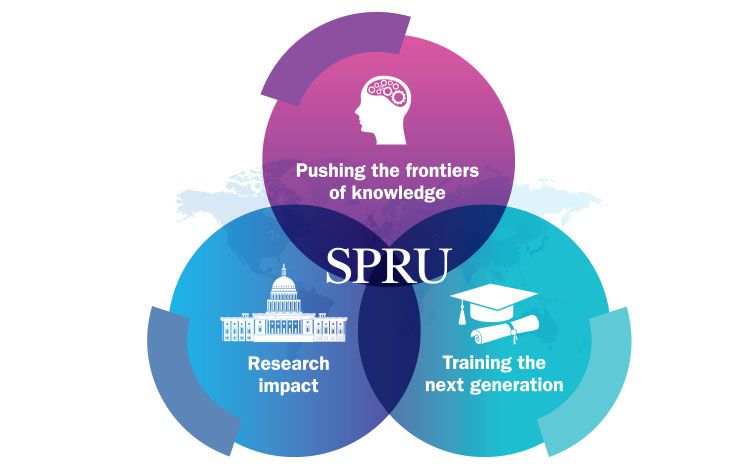
SPRU is a world-leading department where research and high-level policy advice are combined with postgraduate teaching in science, technology, and innovation policy and management. We welcome students, researchers and policymakers in business, government, and civil society organisations to find out more about us and our activities by using the links on this page.
SPRU - Science and Technology Policy Research is the centre of a worldwide network of interdisciplinary researchers addressing the analysis of the rate and direction of scientific change and innovation, the promotion and management of innovation, the regulation of technological risks, the search for effective energy policies and paths to a more sustainable society.
SPRU researchers are prominent participants in global academic and policy debates concerning weapons of mass destruction, biotechnology, pharmaceuticals, nuclear power, climate change, information technology, food safety, technology in development and the roles of public and private research organisations.
In SPRU we have created a unique international research culture founded on collegiality and mutual support that spans the divisions between the pursuit of competitiveness and wealth creation, social inclusion, sustainability and development. We maintain close and high-level contacts to the worlds of commercial innovation management, public policy making on science and technology, and civil society.
SPRU News
Two new SPRU MSc programmes beginning Autumn term 2012; applications now being received
These new programmes add to a suite of postgraduate programmes in Science and Technology Policy, and Technology and Innovation Management, further enhancing our leading expertise within this field. What’s more there are new scholarships available open to UK, Europe and Overseas students.
Other news
New Report - Carbon capture and storage: realising the potential?
Carbon capture and storage: realising the potential? is the culmination of a two-year project funded by UKERC and led by Professor Jim Watson, Director of the Sussex Energy Group.
The project is an independent, inter-disciplinary assessment of the viability of CCS technologies from now to 2030. Although these technologies could be a crucial component of global climate change mitigation strategies, there are significant uncertainties about their technical, economic and financial viability.
The report draws lessons from history, and concludes that previous technologies have faced similar challenges to those affecting CCS technologies today. In the past, such uncertainties have been resolved sufficiently for these technologies to succeed. While care is needed when learning from history, the findings offer some optimism that, given the right actions by government and industry, the uncertainties surrounding CCS can also be dealt with.
Please see the website for further details.