Campus tours
Join a campus tour this summer and get a feel for life at Sussex. With award-winning campus food, a National Park setting and buzzing Brighton on our doorstep, our location and facilities are hard to beat.
Book your visit
On campus - in person
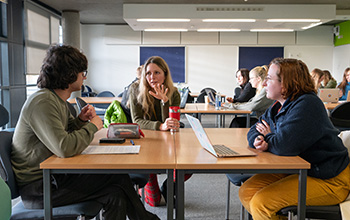
You’ll study for this degree on our campus, joining our academics and fellow students. With in-person contact time, digitally supported educational resources, library collections and independent study, this course is designed to give you an inclusive education. Your learning experience may also include work placements, field trips, studying abroad and internationalisation experiences.
Find out about our beautiful campus
Virtual tour
Want to learn more about life at Sussex?
Our 360° virtual tour has been designed to introduce you to life in our diverse, supportive and inclusive community. Join our students for an immersive experience as they reveal why Sussex offers a space to follow your passions, find your voice, and discover people and places that will inspire you.
Begin your tour

As a founding partner of ResearchPlus, a collaboration of research-focused universities, we engage with government, industry and civil society to support economic growth, prosperity and wellbeing across the whole of the UK.
Find out more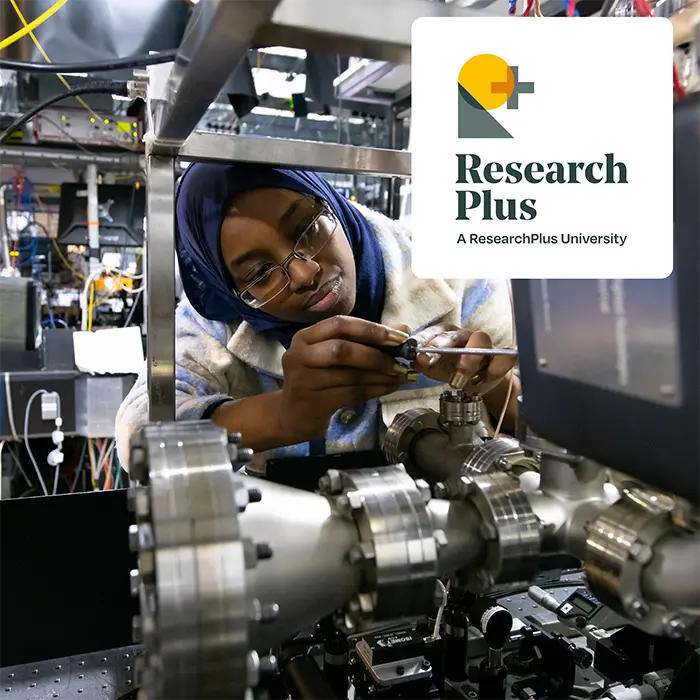
-
 Silver
The student experience and student outcomes are typically very high quality.
Silver
The student experience and student outcomes are typically very high quality.
This rating was awarded in 2023, for four years. (Teaching Excellence Framework 2023)
Find out more about our approach to teaching and supporting you to thrive
Core modules
Core modules are taken by all students on the course. They give you a solid grounding in your chosen subject and prepare you to explore the topics that interest you most.
Autumn teaching
- Foundation Mathematics A
- Foundation Mechanics
- Physics Foundation Year Laboratory A
- Properties of Matter
Spring teaching
- Electricity and Magnetism
- Foundation Mathematics B
- Optics, Waves and Modern Physics
- Physics Foundation Year Laboratory B
Your degree
In your Foundation Year, you’ll:
- build fundamental physics and mathematical knowledge
- develop your laboratory and problem solving-skills
- prepare for your full degree.
Teaching
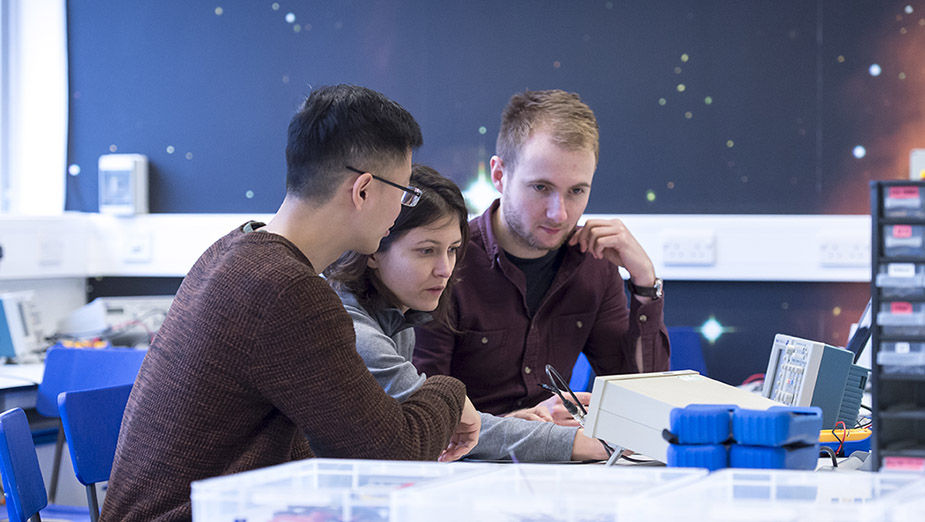
Teaching methods typically include lectures, seminars and practical laboratory sessions.

 50%: Lecture
 25%: Seminar
 25%: Practical
Assessment
Assessment methods typically include unseen examinations and coursework.
Contact hours and workload
This year of study includes approximately 1,200 hours of work. This breaks down into about 350 hours of contact time and about 850 hours of independent study.
Engage and actively participate throughout your studies to get the most out of your course.
We regularly review our modules to incorporate student feedback, staff expertise, as well as the latest research and teaching methodology. We’re planning to run these modules in the academic year 2026/27. However, there may be changes to these modules in response to feedback, staff availability, student demand or updates to our curriculum. We’ll make sure to let you know of any material changes to modules at the earliest opportunity.
We’ll do our best to provide as much optional choice as we can, but timetabling constraints mean it may not be possible to take some module combinations. The structure of a small number of courses means that the order of modules or the streams you choose may determine whether modules are core or optional. This means that your core modules or options may differ from what’s shown here.
Find out more about studying Physics at Sussex, including astrophysics, theoretical physics and particle physics
I work on the ATLAS experiment at the CERN’s Large Hadron Collider, seeking answers to fundamental questions such as ‘What is the nature of dark matter?”Professor Antonella De Santo
Professor of Physics RSW Research MeritAward Holder
Entry requirements
Is a Foundation Year for you?
You will need to demonstrate your potential to do well on a demanding degree, including the potential to succeed in your chosen discipline.
The following sets out some of the most common academic qualifications. However, each application is reviewed on its individual strengths and merits.
This course is available in Clearing
CCall our Clearing hotline 01273 007825 to explore your options and speak to our specialist teams. Our phone lines are open Monday to Friday 9am to 5pm BST. You can also apply for this course online now.
Apply online for this course
Fees
Note that your fees, once they’re set, may be subject to an increase on an annual basis. Find details on our Tuition fees page.
Home students
£9,790 per year
Channel Islands and Isle of Man students
£9,790 per year
On 19 March 2026 the UK Parliament set out that the tuition fee cap for 2026 entry will be £9,790. As the University of Sussex keeps fees for Home students and Channel Islands and Isle of Man students in line with UK Government-approved levels, fees will be £9,790 in 2026. In line with our terms and conditions, the University charges fees at the maximum levels set by the UK Government.
International students
£23,500 per year
If you’re an international student, note that fees for the foundation year are at the standard lower rate but fees for courses you can choose to continue your studies are at the standard higher rate. This means your fees will rise from lower to higher level after the foundation year.
Living costs
We know the rising cost of living is on everyone’s mind, and affects us all in different ways. Our guide to living costs has been designed to help you plan and budget for life as a Sussex student.
Learn more about typical living costs
Scholarships
Our goal is to ensure that every student who wants to study with us is able to regardless of financial barriers, so that we continue to attract talented and unique people.
-
Chancellor's International Scholarships
£5,000 in the first year of full-time study
-
Climate Leaders Scholarship
£3,000 cash per year of full time study.
Scholarships recipients will be supported to develop a high level project plan and provided with mentoring support.
-
Emily O Akinluyi Scholarship
£5,000 cash award
-
Sanctuary Scholarship (Undergraduate)
- Full 'Overseas' tuition fee waiver
- £16,440 per year of undergraduate study (up to 4 years)
- Sussexsport membership
- Guaranteed continuation of housing
-
Sussex Bursary
£1,000 in your first year of study (either Year 1 or Foundation Year).
£500 in your subsequent years of study.
-
Sussex Pakistan Scholarship (Undergraduate)
£4,000 discount on the first year of tuition fees
-
Sussex Türkiye Scholarship (Undergraduate)
£4,000 discount on the first year of tuition fees
-
Undergraduate Enrichment Award
£6,000 over 3 years of study
Please note: Foundation Year courses are not eligible for USA federal Direct Loan funds. Find out more about American Student Loans and Federal Student Aid
Contact us
Ask a student
Chat to Sussex students online via the UniBuddy chat platform.
Prospectus
What do you want to do next?


Legal information
We understand that deciding where and what to study is a very important decision. We’ll make all reasonable efforts to provide you with the courses, services and facilities described in this prospectus. However, if we need to make material changes, for example due to government or regulatory requirements, or unanticipated staff changes, we’ll let you know as soon as possible.