News
Demonstrating Nature-based Solutions at Work
Posted on behalf of: Dr Cynthia Olumba, Cranfield University - Work Package 1 - REAL NbS Project
Last updated: Tuesday, 17 March 2026
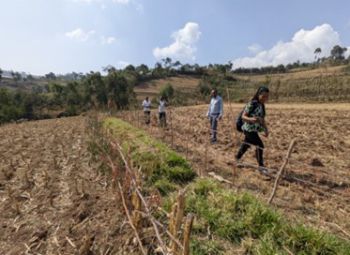
Bund and grass strip experimental site in Jimma, Ethiopia
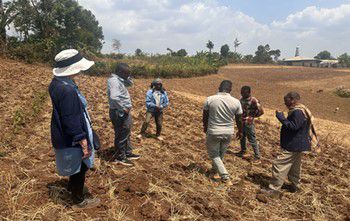
Informal conversation with farmers at one of the experimental sites in Jimma
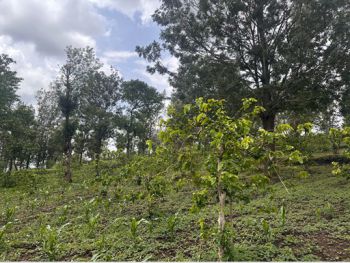
Agroforestry plot, Olarash
Recently, the UK-based Work Package 1 team, Prof. Jane Rickson and I (Dr. Cynthia Olumba), visited the experimental field sites of the REAL NbS Project in Jimma (Ethiopia) and Arusha (Tanzania). These visits followed the project’s inception workshops held in autumn 2024, where farmers, community members and other stakeholders collaboratively identified and prioritised the nature-based solutions (NbS) that are now being tested on farmers’ fields. Walking through the experimental plots with farmers, local field officers, and research partners at the field sites gave us a unique opportunity to observe the experiments' progress firsthand and hear directly from those managing the land.
Experimental Plots in Jimma, Ethiopia
At the field sites in Jimma, we visited experimental plots established on farmers’ land across three villages: Garima, Ilala, and Siito. In each village, four farmers are participating in the study, testing different land management treatments on their cropped land. These trials focus on NbS co-selected during the project’s inception workshop. These include soil bunds, grass strips, and planting of trees/shrubs. For the soil bunds and grass strip experiment, four treatments are being tested:
- Soil bunds
- Soil bunds combined with grass strips
- Grass strips alone
- Control plot (no NbS)
We also visited the tree/shrub planting trials, which include four treatments:
- Trees alone
- Trees combined with shrubs
- Shrubs alone
- Control plot (no trees or shrubs)
These treatments are implemented across farmers’ plots, allowing the project to evaluate how the NbS perform under real farming conditions. The Jimma team has run demonstration days at some of the field sites.
What Are We Measuring?
Across all treatments, the project is monitoring several indicators of NbS success, which were co-selected during the project’s inception workshops, including:
- Soil fertility
- Soil erosion control
- Soil moisture retention
- Crop yield
By tracking these indicators over time, the project aims to understand how NbS contribute to reducing soil erosion while improving soil health and yield.
Farmers’ Changing Perspectives at Jimma
Our informal conversations with the farmers hosting the trials were among the most valuable aspects of the visit.
Many farmers told us they were initially sceptical about allocating parts of their farmland to the experiment. They worried about losing productive space, especially with soil bunds, and about the extra labour required to construct and maintain them. Trying new approaches can feel risky, especially when livelihoods depend on the land.
Several farmers also mentioned that at the beginning of the trials, they preferred to use grass strips alone, mainly because the grass cuttings had direct value as animal feed and there was the potential to sell grass for extra income. In contrast, soil bunds were initially less popular because they require labour to construct and they take out areas of previously cropped land.
However, after observing the experimental plots over time, their views have started to change.
One farmer at Siito explained:
“At first, I preferred the grass strips alone because they provide feed for animals, and they are easier to establish than constructing soil bunds. But after seeing the results, I realised that the soil bunds help support the grass strips in controlling erosion. Now I think the benefits are worth the effort.”
When asked which approach they considered the most effective, many farmers identified the combination of soil bunds and grass strips as the best option. They see this mix as offering the strongest protection against soil erosion, while still providing fodder benefits and supporting higher yields of the main cash crop.
Also, farmers mentioned that they are already seeing clear differences between the control plots and the NbS plots, particularly in crop performance from the last cropping season.
Insights from Field Officers at Jimma
The visit also highlighted how the project is influencing local advisory practices.
During discussions with local field officers, they explained that before the REAL NbS project, they mainly promoted soil bunds as a standalone measure against soil erosion. However, through the project, they have gained new insights into the synergistic benefits of combining soil bunds with grass strips, both in terms of stabilising soil and improving crop performance. After seeing the results from the experimental plots, they are now beginning to promote this combined approach more actively in their extension work with farmers.
Experimental Plots in Arusha, Tanzania
At the project site in Arusha, the experiments focus on a different set of NbS, co-selected at the workshop held in Tanzania last autumn. These include:
- Cover cropping
- Agroforestry
- Contour planting
- Rotational grazing
Each of these practices is implemented alongside control plots, allowing the project team to compare the performance of the NbS treatments with conventional land management approaches. The plots are set up across three villages: Enguiki (upper catchment), Olarash (middle catchment), and Meserani (lower catchment),
As in Jimma, the research team is measuring co-selected indicators of NbS success: Soil fertility, Soil erosion control, Soil moisture retention, and Crop yield, to understand how the NbS interventions affect both soil health and farm productivity.
Farmers’ Experiences in Arusha
Farmers in Arusha also shared positive experiences with the NbS being tested.
The cover crop used in the experiment at Meserani is a local species, ‘Lablab’, which farmers reported provides multiple benefits when used as a cover crop, including better ground cover that reduces runoff and erosion, and improvements in soil condition. It can also be harvested for its seeds, providing additional household income.
In one field, a farmer walked us along contour bunds established across the slope and pointed out how water now infiltrates more effectively, rather than washing away soil. Having observed the benefits, he explained that he intends to extend contour bunds across all his fields.
These responses suggest growing confidence among farmers in the potential of NbS to improve land management.
Work Package 1 is collecting field observations and quantified data to provide sound evidence to underpin this confidence in the use of NbS.
Reflections from the Field
One of the most encouraging outcomes of the visit was hearing that several farmers plan to continue using these practices even after the project ends and are interested in expanding them to other parts of their farmland beyond the experimental plots.
Some have already begun sharing what they have learned with other farmers in their communities, informally demonstrating and discussing the practices with neighbours. This type of farmer-to-farmer learning is often a powerful pathway for spreading sustainable practices beyond the original project sites.
Our visit also reinforced how important collaboration between researchers, field officers, and farmers is in developing and testing solutions that are both scientifically sound and practical for local communities. It was a powerful reminder that the project is not only generating data but also supporting learning and behaviour change among extension workers and local institutions.
Looking Ahead
The project will continue monitoring the experimental plots in both Jimma and Arusha to deepen understanding of how these NbS interventions contribute to controlling land degradation.
While scientific measurements will be collected throughout the project, farmers’ experiences already offer valuable early insights into how these practices are performing in real farming conditions. Farmers’ willingness to maintain and expand the NbS interventions suggests strong potential for wider adoption.
We are grateful to the farmers who welcomed us into their fields, as well as the field officers and project partners at Jimma University and the Nelson Mandela African Institution of Science and Technology for their continued collaboration.