Lena Raballand
Understanding how individuals and corporations capture the state through political financing.
Email: lena.raballand@sussex.ac.uk
Applying to study for a PhD at the Centre for the Study of Corruption
We are interested in receiving applications from potential PhD students, and generally the CSC faculty have the collective capacity to supervise around 5-6 students at any one time. We suggest you identify a potential supervisor amongst the CSC faculty before submitting an application, and email them with an initial proposal. They will be able to let you know whether they have the capacity to take on new students, and whether they feel your research proposal fits within the areas they are currently looking to supervise.
You can increase the prospects of being successful if a) you have selected a topic that is within the expertise and research interests of a CSC faculty member b) the proposal you submit as part of the application process is clear, well-written and well thought-through c) you have a track record of academic excellence at a well-regarded institution and d) you have a clear plan for how the PhD will be financed.
Although we welcome PhD students who have been practitioners or come through less conventional routes, this is a PhD in a university Politics department, and so we expect all students to be operating at that level. One pathway to this is to undertake an MA in a relevant subject, such as our Masters in Corruption & Governance.
We receive far more applications from potential PhD students than we are able to take on, and so we always advise students to have a back-up plan to approach another department at Sussex or another university. If you do join us, you will become part of a vibrant research community of corruption specialists - one of the largest specialist research groups in the world in this field.
For further information on how to apply, please visit the Sussex Politics PhD page and refer to the guidance on how to write a good proposal.
Understanding how individuals and corporations capture the state through political financing.
Email: lena.raballand@sussex.ac.uk

Under What Conditions are Preventative Anticorruption Agencies Effective?
Email: john.lawes@sussex.ac.uk

Examining the Application and Impact of Chapter Five of the United Nations Convention against Corruption (UNCAC) in the Recovery, Return and Use of Proceeds of Corruption.
Email: juliet.ibekaku@sussex.ac.uk
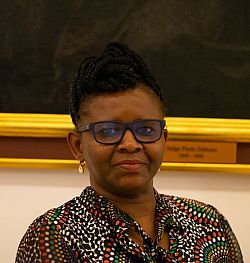
An analysis of the legacy of colonialism in the Caribbean and its impact on the character and logics of corruption across the region.

Mandating Accountability: The role of norms and legislation in integrating supreme audit institutions into national anti-corruption efforts.
Email: mp622@sussex.ac.uk

Email: ejs45@sussex.ac.uk

Thesis title: Analysing the Influence of UNCAC and G20 Membership on Anti-Corruption Measures in Saudi Arabia’s Public Procurement Reforms (2006–2022): An Exploratory Study Using the Lens of Institutional Isomorphism.
Thesis title: The effectiveness of internal control in tackling corruption.
Thesis title: Corruption in Central and Eastern Europe: The influence of the European Union on the control of corruption in the Czech Republic, Macedonia and Romania”.
Moletsane Monyake
Thesis title: Anti-Corruption Reform, Political Will and Collective Action in Sub-Saharan Africa.
Thesis title: Party Funding Regimes and Corruption in Western Europe: Linkages, Relationships and Trends.
Thesis title: Populism and populist politicians in the politics of Taiwan.
Thesis title: Narratives of (anti-)corruption in Xi Jinping's China.
Thesis title: Corruption risks in public procurement contracts: monitoring delivery of goods, services and works projects in Mexico.
Thesis title: Election Results: When, where and under what conditions are they accepted? A global comparative study.
Thesis title: Policing corruption or corrupted policing? A study of social norms and corrupt behaviour in the Ghana Police Service.
Thesis title: Climates of corruption: the concept of corruption, the role of power and the challenge of climate change policymaking and action.
Thesis title: Evaluating anti-corruption effectiveness in international development.
Thesis title: Legislative ethics in Nigeria.
Thesis title: The Transition Game: The persistence of elites and extractive practices in the energy sector in successor Yugoslav states.