Research news
Bright, Bold and Clashing – what a baby looks for in a book
By: Imogen Harris
Last updated: Thursday, 4 June 2026
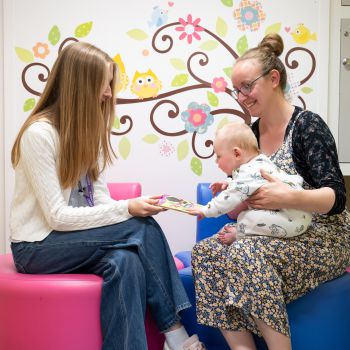
Babies are drawn to bold, bright and even "clashing" images that many adults find unappealing, new University of Sussex research has found.
The study reveals that the picture book images parents are least likely to choose, featuring high contrast, vivid colours and simple shapes, are actually the ones that capture infants’ attention the most, offering new insights into how to design books that engage the youngest readers.
The research published in the Journal of Experimental Child Psychology, involved two experiments in which single pages from 100 board and picture books were shown to 54 infants aged 2 to 12 months while their eye movements were recorded. The books were selected to capture the full range of illustration styles currently found in bookstores, including some picture books aimed at preschoolers to allow the team to test infants’ responses to more visually complex images.
For each page, researchers measured how long infants looked at the image, how many fixations they made and the size of their eye movements, combining these measures into a single index of visual engagement. The results revealed that babies are attracted to bold colours and simple shapes, while adults favour soft colour palettes and detailed, aesthetically “gentle” illustrations.
A second experiment replicated these findings with a new group of infants and additionally asked adults to rate how much they liked each image, allowing the team to compare infant visual engagement with adult aesthetic preferences.Lead author of the study, Doctoral Researcher Taysa-Ja Newman, said “Babies’ visual systems are still developing, so they see images differently from adults. Illustrations that might look gentle or aesthetically pleasing to us are often hard for babies to see clearly”.
Many contemporary baby products and picture books favour soft pastel or neutral colour palettes, sometimes referred to online as the “sad beige” baby aesthetic, but the study suggests these styles may not align with how infants actually see and engage with to images. To understand what visual features were driving babies’ attention, the researchers analysed the colour and spatial properties of each illustration.
- Babies were most visually engaged by pages featuring high colour contrast, for example red/white/brown, red/lime green, black/yellow and purple/red/white combinations.
- Babies looked longer at pages with highly saturated reds, blues, purples and teals, echoing long-established findings from the Sussex Baby Lab on infants’ colour preferences.
- Pure black-and-white pages did not rank among the most engaging, challenging the belief that monochrome books are best for young babies.
- Pages with low contrast, pastel palettes, or little variation in colour held infants’ attention least.
Professor Anna Franklin who co-leads the Sussex Baby Lab said: “The images babies looked at the longest were often the ones adults liked the least. Babies’ attention was drawn to bold colours and strong contrasts that might look less aesthetically pleasing to adult eyes.”
One of the images that generated the highest infant engagement was a bright red and brown monkey face with thick outlines, which adults rated among the least appealing. Meanwhile, a soft pastel illustration of a tortoise and hedgehog hugging, which was rated highly by adults, was among the least engaging for infants.
Understanding which visual features capture babies’ attention could help guide the design of picture books and other visual materials for infants.
Franklin added: “Sharing books with babies has many benefits, from language exposure to social interaction. Understanding which kinds of images capture babies’ attention may help support those early book-sharing experiences.”
Newman added: “Our findings have implications for our understanding of infant visual development and can also act as a guide for baby book designers and publishers.”
The Sussex Baby Lab, who conducted the research, has over a decade of experience uncovering the secrets to baby development and growth. Previous research from the University of Sussex in partnership with EmpathyLab has shown that reading plays a key role in building empathy in children, which in turn is associated with greater engagement in reading for pleasure as well as greater prosociality.
Professor Robin Banerjee, Professor of Developmental Psychology and Pro-Vice-Chancellor for Global and Civic Engagement at the University of Sussex, and expert advisor for EmpathyLab said “This work is especially timely as 2026 is the National Year of Reading. The findings add to a growing recognition of how engaging with books in the earliest years of life can serve as a key building block not just for reading enjoyment, but also for empathy and healthy relationships.”
These latest findings could help babies engage with books from at young as two months old and provide reassurance to parents that how they care for their newborn will give them the best start in life.
This work supports the UN’s Sustainable Development Goals: SDG 4 (quality education). You can read more about our work on the SDGs here.