Research news
University of Sussex scientist part of the winning team for the £1m Longitude Prize
By: Imogen Harris
Last updated: Thursday, 19 March 2026
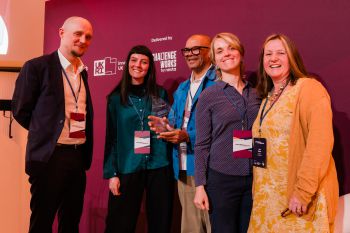
The Animorph team L-R: Szczepan Orlins, Software Architect & Developer, Hannah Blows, Service & Experience Design, Jon Rowe, Unity Developer, Eszter Muray, Designer, Prof Julia Simner, Lead Scientist.
It was revealed yesterday, 18 March 2026, that Sussex neuropsychologist Professor Julia Simner is part of the award-winning team receiving the £1 million Longitude Prize on Dementia.
The prize was awarded to CrossSense Ltd for their AI companion that identifies everyday objects and guides people living with early-stage dementia through daily activities with the ultimate aim of supporting them to live safely in their own homes for longer.
Professor Simner, from the University of Sussex, was the Lead Scientist on the project, working with the team from its inception to ensure that the technology addressed the real needs of people living with dementia. Drawing on her background in neuropsychology and multisensory cognition, Professor Simner helped shape the design, and oversaw testing throughout the product’s creation.
Using augmented reality, the smart glasses place helpful visual cues into the real world – for example labelling objects or highlighting potential hazards like a hot hob – helping users feel more confident and independent at home. CrossSense also includes a soft-spoken AI assistant called Wispy, which can see and hear what the user does, allowing it to guide attention, name objects, remind routines and help with everyday tasks such as making a cup of tea.
By asking gentle prompts, Wispy understands and learns a person’s unique way of doing things, with the AI adapting to each user’s needs as their dementia progresses. By encouraging conversation, reminiscence and problem-solving, Wispy also provides cognitive stimulation designed to help maintain neural connections, to slow early cognitive decline and improve overall quality of life.
Working with a panel of people affected by dementia, Professor Simner and the team observed improvements in some users’ ability in naming objects, and other cognitive abilities in visual-spatial understanding, short-term and working memory; a component of memory that allows individuals to actively use information in the moment, such as following a conversation, solving a simple calculation, or remembering instructions.
Reflecting on her contribution to CrossSense, Professor Julia Simner said
“As science lead for the CrossSense smart glasses, my focus was on integrating psychological science into the heart of the technology and ensuring it was robustly tested with real people in real homes. Working with the brilliantly creative team at CrossSense has been a genuine privilege, and we're especially grateful to the 250 people with lived experience of dementia who co‑designed this with us. It shows how technology works best when it’s guided by the people it’s meant to support. With their insights, we were able to create an assistive technology that feel gentle, intuitive, and truly helpful.”
In reaction to the award Szczepan Orlins, CEO, CrossSense Ltd said:
“Winning the Longitude Prize on Dementia is a dream come true. As a small team with big ambitions, the prize’s support has accelerated CrossSense in ways that wouldn’t have been possible otherwise. The technology is designed to support daily living, integrating multiple senses to simplify essential tasks. We’re grateful to the people living with dementia and their families who helped shape it. This win brings us closer to making CrossSense available to the public within the next year.”
Caroline Purslow, Head of Global Health, Challenge Works, who run the prize, highlighted the valuable role universities play in driving innovation:
“UK universities are world leaders in cutting-edge research. To translate that excellence into real-world innovation, we must incentivise, support and reward researchers and scientists to scale academic concepts and ideas to become impactful technologies. Challenge prizes like the Longitude Prize on Dementia level the playing field for innovators to prove that the solutions they have developed for pressing problems can be scaled to improve the world we live in. CrossSense’s strong scientific grounding – thanks to Professor Simner’s work – has resulted in a technology that the judges agreed could revolutionise how people live after a dementia diagnosis. Its AI companion helps people to maintain their independence and autonomy so that they can continue to do the things that bring them fulfilment and joy.”
The prize’s panel of international expert judges agreed that the winning solution was a genuine breakthrough technology with revolutionary potential for people living with dementia and their families.
The £1 million grand prize will support the winner to make CrossSense available to the public in early 2027, with the future ambition that it would also be used by local authorities, care providers and NHS services such as memory clinics.
Dementia is a progressive condition and there is currently no cure. Around one million people in the UK are living with dementia and this number is projected to rise to 1.4 million by 2040[1]. The number of people worldwide living with dementia is projected to rise significantly from approximately 57 million in 2019 to over 150 million by 2050.
The Longitude Prize on Dementia is funded by Alzheimer’s Society and Innovate UK and is delivered by Challenge Works. It has driven the creation of personalised, technology-based tools that are co-created with people living with dementia, helping them to maintain their independence at home.
Find out more about CrossSense at crosssense.com.
Find out more about the Longitude Prize on Dementia and all five finalists at dementia.longitudeprize.org
This work supports the UN’s Sustainable Development Goals: SDG 3 Good health and wellbeing. You can read more about our work on the SDGs here.