Research news
Sussex research shows humans descended from one-eyed ‘Cyclops’
By: Caroline Sutton
Last updated: Tuesday, 3 March 2026
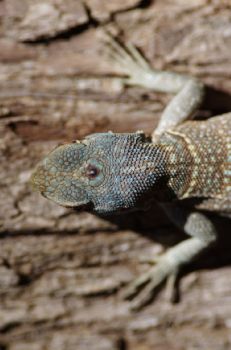
Collared Iguana (Oplurus cuvieri) with pineal gland by Daniel Goeleven
New research that challenges thinking on the evolution of human brains suggests we descended from a small one-eyed Cyclops creature around 600 million years ago.
In a new study, published in the journal Current Biology in February, researchers from the University of Sussex and Lund University in Sweden found that all vertebrates evolved from a distant ancestor that had a single eye positioned on top of its head. Remains of this so-called occipital eye survive today as the pineal gland in our brains, which plays a key role in regulating sleep.
“This discovery explains the origin of the nerve circuits that analyse images in the retina,” said Professor Tom Baden, Co-Director of Sussex Neuroscience at the University of Sussex who co-led the study with Dr George Kafetzis.
“This helps us understand not just how our eyes work, but more fundamentally, what they are. The results are a surprise. They turn our understanding of the evolution of the eye and the brain upside down.”
The study’s conclusions are founded on comprehensive comparative analyses of light-sensitive cell types across a broad spectrum of animal taxa, scrutinizing their physiological roles, anatomical placements, and developmental genetics.
This ‘cyclops’ was a small worm-like creature which once had two eyes which disappeared through evolution to a patch of light-sensitive cells on its head to help the animal sense day and night and orient itself. Millions of years later, its descendants returned to a free-swimming life, and the need for paired vision returned. New image-forming eyes evolved from parts of this ‘cyclops eye’.
The remains of the ancient cranial eye persist in all vertebrates as the pineal gland, a light-sensitive organ that produces melatonin and helps regulate circadian rhythms.
“In mammals and birds the gland lies deep beneath the skull, but in many fishes, frogs and lizards it is still light-sensitive,” said Professor Baden. “These animals therefore retain a true ‘living fossil’ of the eye at the top of the head. By studying it, we can investigate how early light-sensing organs worked and how the neural machinery for vision first evolved.”
The study clarifies the link between the cyclopic cranial eye of our ancestor 600 million years ago and the pineal gland’s role in regulating sleep according to light.