Press releases
Climate scientists solve monsoon puzzle and warn of risks to fishing
By: Vicky Welstead
Last updated: Monday, 24 August 2026
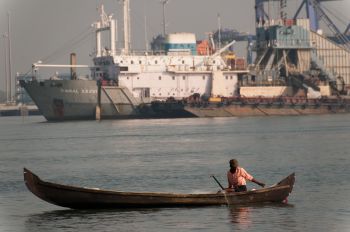
A new study has reconciled a long-standing paradox in the South Asian summer monsoon cycle. Climate scientists have discovered why geological records from land and sea have told opposite stories about monsoons throughout history, and found that rising temperatures over Southern Africa reduce upwelling in the Arabian Sea, which could damage marine productivity and fisheries.
The South Asian summer monsoon is one of the world’s most important climate systems. It delivers rainfall across the Indian subcontinent and drives upwelling in the Arabian Sea, supporting one of the planet’s most productive marine ecosystems. Yet for decades, terrestrial records of monsoon rainfall and marine records of Arabian Sea upwelling have appeared to move in opposite directions over many thousands of years, leaving scientists puzzled about the overall pattern.
A global collaboration of scientists including the University of Sussex, Ninjing University and Ohio State University, has found the contrast happens because rainfall and marine upwelling are governed by different hemispheric drivers.
The researchers separated the effects of Northern Hemisphere and Southern Hemisphere solar forcing. This found that monsoon rainfall over South Asia is primarily controlled by Northern Hemisphere insolation, while Arabian Sea upwelling is shaped by Southern Hemisphere insolation through warming over Southern Africa and subsequent atmospheric teleconnections.
Professor Felix Creutzig, Bennett Chair at the University of Sussex and co-author of the study explains: “When summer hits the Northern Hemisphere the subsequent warming strengthens monsoon rainfall over South Asia. But warming over Southern Africa can weaken Arabian Sea upwelling through remote atmospheric pathways. As well as solving a major paleoclimate puzzle this discovery highlights a modern day risk as rising temperatures outside South Asia may alter the whole monsoon system, posing serious threats to fishing stocks and livelihoods.”
The danger is that Southern African warming can influence the South Asian monsoon system independently of local climate change over Asia. This may have implications for rainfall, marine productivity, fisheries, and livelihoods across the region.
The study also poses a risk for climate intervention strategies such as solar radiation management. Interventions that alter solar forcing unevenly across regions could have unintended effects on monsoon rainfall and ocean upwelling.
Professor Creutzig added: “Our results show that the monsoon cannot be understood as a purely regional system. It is coupled across hemispheres, so climate risks and climate interventions must be evaluated with a much broader geographical lens.”
The research combined proxy records from caves and marine sediments with climate simulations covering the past 150,000 years. It shows that increasing solar insolation in Northen and Southern Hemispheres influences the monsoon pattern in different ways, leading to complicated dynamics.
The authors stress that understanding the mechanisms at work in climates of the past is vital for future climate risk assessment. As areas such as Southern Africa warm faster than the global average, effects on the South Asian monsoon and Arabian Sea upwelling may become increasingly important.