Collaborating with charities, NGOs and communities
Find out how we work with various people and organisations to tackle the Sustainable Development Goals (SDGs).
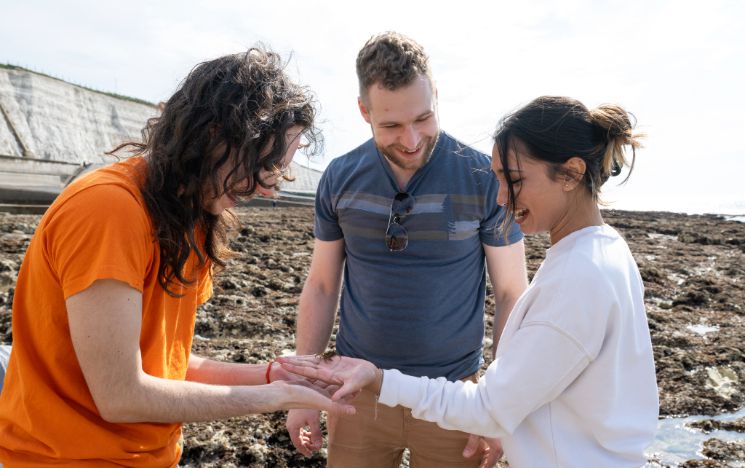
Working together for a greener, fairer future
Our students and researchers work with non-governmental organisations (NGOs), charities, communities and partners locally and internationally to connect research and education with knowledge-sharing and practical action.
Our collaborations contribute to the United Nations Sustainable Development Goals (SDGs) and take many forms, including student volunteering, research partnerships, community engagement and the development of educational resources.
By bringing together academic expertise and the experience of organisations working directly with communities, we help address social and environmental challenges and support more sustainable futures.
Find out about our:
- student volunteering programmes
- partnerships with NGOS and other organisations
- international partnerships for climate adaptation and resilience
- sustainability education
- engaging with the community.
Student volunteering programmes
Our students make a positive contribution to local communities through volunteering with charities and organisations tackling social and environmental challenges.
Opportunities include supporting Sussex Nightline, a confidential listening service run by trained student volunteers offering non-judgemental support to fellow students.
Students can also volunteer with organisations such as Mind, which supports people experiencing mental health problems, and FareShare, which tackles food waste and food poverty.
Partnerships with NGOs and other organisations
Our researchers collaborate with charities, NGOs and other community partners to protect nature and improve people’s lives.
For instance, the ‘Ripple Effect’ project sees our academics team up with local NGO Friends of the River Medway to inspect levels of pollution in the River Medway through citizen science.
Our researchers also work with conservation charities The Blue Marine Foundation and Sussex Wildlife Trust to monitor biodiversity off the Sussex coast since a trawling byelaw in 2021. These partnerships engage with the SDGs to protect and restore nature and improve the lives of local communities.
Our partnerships also address inequalities and improve outcomes for children and young people.
In the Joined Up Lives project, we work with local authorities and their virtual schools to explore how education, social care and criminal justice services can work together more effectively to support young people facing overlapping challenges.
International partnerships for climate adaptation and resilience
Our international research partnerships help communities prepare for and respond to the impacts of climate change.
One example is the Climate Adaptation and Resilience (CLARE) programme, a UK-Canada research programme that supports locally relevant research and practical action to strengthen resilience to climate change and natural hazards across Africa and the Asia-Pacific.
CLARE brings together researchers, governments, regional institutions, NGOs and local communities to improve understanding of climate risks and turn evidence into solutions.
Through CLARE, we are a lead partner in the PASSAGE project, which focuses on strengthening the resilience of pastoral communities in Ethiopia, Kenya, Somalia, South Sudan and Uganda.
These communities depend on livestock and natural resources for their livelihoods and are particularly vulnerable to drought and other extreme climate events. Working with regional and local partners, the project is improving drought monitoring and forecasting, including information about water availability and pasture conditions.
Through cooperative planning with communities and local authorities, the project develops early action plans, helping to prepare for climate risks, protect lives and livelihoods and avoid climate change disasters.
Sustainability education
We work with local schools to help young people explore climate change and sustainability through creative approaches.
Dr Perpetua Kirby and Dr Rebecca Webb have collaborated with primary, secondary and special schools, using creative activities to help students engage with climate change, biodiversity loss and the uncertainties of a changing world. Their open-access toolkit, ‘Creating with uncertainty: sustainability education resources for a changing world’, was developed with local NGOs Green United and Brighton Permaculture Trust. It offers ten on-the-ground sustainability topics including impacts, mitigation and adaptation, each with activities that can enrich the curriculum.
We also take creative approaches that give young people opportunities to imagine and shape more sustainable futures. Funded by the Sussex Sustainability Research Programme, the ‘Improvised Collaborative Storytelling’ project is prototyping a game in which secondary school-aged young people, guided by a trained local educator, use improvised storytelling to model a sustainable future for a setting such as a neighbourhood.
The game connects groups of young people across communities and involves partners in countries including Uganda, Ecuador and India, allowing them to respond to each other’s stories.
Our environmental education collaborations also extend to wider networks of local organisations and initiatives. Through our environmental education partnerships, we connect research with organisations working directly with communities, helping people understand environmental issues and take part in protecting the natural world.
Engaging with the community
We engage local communities and young people with climate change through accessible education programmes.
Our Summer of Research delivers local activities exploring climate risks, impacts, mitigation and adaptation. Events included Soapbox Science Brighton, where audiences on the seafront heard from researchers investigating how the natural environment can help tackle plastic pollution. Organised by Sussex academics since 2017, the event returns every year as part of the Brighton Fringe, celebrating women in STEMM.
The Sussex Beacon Series on Climate Action, also part of the Summer of Research programme, brought three Sussex researchers together to share work on how to tackle emissions fairly and work with local people on climate action. The speakers came from three of our Centres of Excellence and explored topics including fair approaches to reducing emissions, working with communities on sustainable infrastructure and finding creative ways to address the climate crisis.
Our first Sussex Climate Conference saw more than 200 sixth form students discuss threats to the planet and green career opportunities. Academic sessions covered topics from the sustainability problems posed by AI to ecosystem monitoring and the power of entrepreneurship.
Our engagement with local communities is also shaped through the Sussex Co-Lab, a collaborative programme designed to improve local communities by addressing challenges and making policies more effective. It brings together universities, local governments and health partners with businesses, artists, researchers and residents, using creative and participatory methods to enable more inclusive decision-making.
Community input is sought from the very beginning of each initiative. One example is Who Owns Brighton, a community research project led by the Brighton and Hove Community Land Trust that asks whether developments in the city serve residents’ needs. Working with community researchers and using Circus Street as a test site, the team is equipping residents with the skills and tools to scrutinise local developments and engage at different stages of the planning process.
Other Co-Lab projects include the Intergenerational Exchange Programme, which connects students with older people in Brighton and Hove to address social isolation and support wellbeing. Another example is Urban Fabric, in which residents co-created over 60 textile artworks reflecting the changing face of London Road, and a Newhaven residency in which residents mapped and reimagined their town to inform Lewes District Council’s planning.