Revealing the history of the Universe
Learn how Sussex researchers are probing how the Universe began with the discovery of its oldest stars.
The Astronomy Centre at Sussex
Since its inception in 1965, the Astronomy Centre at Sussex has been involved in world-leading projects to understand the cosmos.
Our researchers focus on the theory and observation of clusters of galaxies, on galaxy formation, and on many areas of theoretical and observational cosmology.
In the 2025 QS World University Rankings, Sussex’s Physics and Astronomy Department was ranked 2nd in the UK for citations per staff member, demonstrating the international influence and visibility of its research.
‘First light’ of the Universe
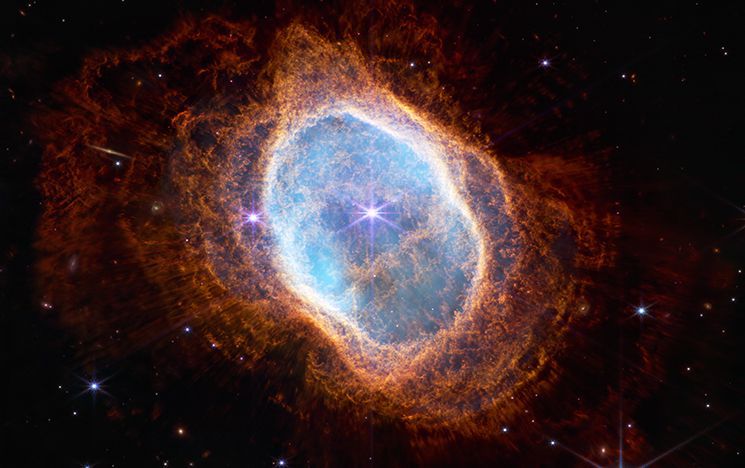
The James Webb Space Telescope, which launched in 2022, offers the most advanced window to the Universe.
Stephen Wilkins, Professor of Astronomy and Public Understanding, is leading the Sussex group involved in analysing observations from Webb and using it to refine and test supercomputer simulations of the Universe.
“Even with the small amount of data we’ve analysed so far, we’re gaining new insights into how the Universe works,” he says.
“Webb will show us almost the entire history of the Universe, from the first couple of hundred million years after the Big Bang, which happened around 14 billion years ago. What we’re hoping – and what I work on specifically – is that we will see examples of the first stars forming in the galaxy. We call this field ‘first light’ because that’s what we’re seeing: the first time the Universe was lit up.”
He is working with collaborators across the world to find objects that we don’t already know about. “We point the telescope at as blank an area of sky as possible and wait to see what emerges. We’re expecting to see that it’s not empty at all and that it contains thousands of galaxies, each of which contains billions of stars.”
Much of his recent work has involved predicting how galaxies are formed through supercomputer simulations. The hope is that information from the Webb telescope confirms these predictions. “If they don’t, that would be just as exciting as it would tell us that we have something fundamentally wrong in our model and will need to work out what that is.”
Image credit: NASA, ESA, CSA, and STScI.