Business School news
Read news relating to the University of Sussex Business School.
Sussex Awards 2026: the winners
Posted on behalf of: University of Sussex
Last updated: Thursday, 7 May 2026
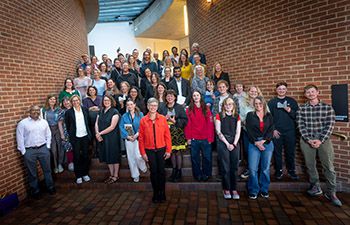
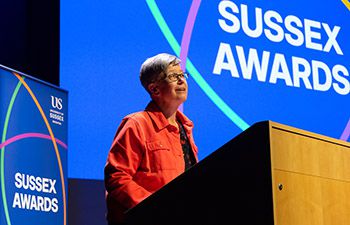

The winners of this year’s Sussex Awards were revealed at a special ceremony at the Attenborough Centre last night, Monday 27 April.
Hosted by Vice-Chancellor Professor Sasha Roseneil and Professor Michael Luck, Deputy Vice-Chancellor and Provost, the ceremony was the culmination of an awards programme designed to recognise the fantastic work of our staff, students and postgraduate researcher (PGR) community across our Faculties and Divisions. The winners were presented with a special trophy (pictured), designed by Product Design student Mabli Vuijk and 3D printed using recycled filament here on campus by Research Fellow Henry Dore.
After the nominations closed in February, several different judging panels made up of staff and, on some panels, students, reviewed over 600 nominations that students, staff and postgraduate researchers submitted this year. Together they chose the shortlist and winners in each of the 17 categories. The winners of this year’s Adam Weiler PGR Impact Awards were also presented with their awards on the night.
At the ceremony, the Vice-Chancellor said: “This is an opportunity to celebrate the huge range of work that is going on, the incredible creativity and energy that our staff invest in their work, their commitment to the University, their commitment to each other, and it’s really an uplifting and inspirational evening for everyone. It is Sussex at its very best.”
Dr Emma Newport (Faculty of Media Arts and Humanities), winner of the Civic and Global Engagement and Public Service award said: "Every innovation to the programme has been driven with the students, I think that's the thing that I value the most. I wouldn't be standing here today receiving this award on behalf of Sussex Writes, if it wasn't for all of their tireless work."
Kasia Barnert from the Housing Team (winners of the Institutional Improvement and Transformation award), said: "For me personally it means a lot because I have been here for over ten years and it is the first award ever that I have won! I have always been working in the Housing environment and it's a very hidden role. I am very very proud of our team."
Read about this year’s winners. You can also see the full shortlist online too.
Inclusive Education
Dr Xiangming (Tommy) Tao (University of Sussex Business School) won this award for his exceptional ability to create a welcoming, equitable classroom environment where students from all backgrounds feel valued and confident. He embeds inclusive principles into every aspect of his work, from curriculum design and accessible teaching methods to mentorship, research on equitable AI, and genuine personal care for his students. Nominators consistently highlighted that inclusion is not a checklist for him, but a natural and sustained part of how he teaches, supervises, and connects with people.
Education for Employability and World Readiness
The SEPnet/DISCnet Team (School of Mathematical and Physical Sciences) - Prof Jacob Dunningham, Dr Kate Shaw, Susanne Bell, and Prof Kathy Romer - won their award for running an exceptionally successful and inclusive industry placement programme that connects around 100 students per year with paid placements across sectors including finance, energy, and aerospace. The scheme stands out for its equity, with participation rates matching the broader student body across gender, ethnicity, and neurodiversity, and for being financially sustainable, with over 70% of placements fully funded by employers. The results speak for themselves, with students gaining career clarity and job offers, and employers reporting outstanding outcomes that directly feed into real products and services.
Education and Student Life: Civic and Global Engagement and Public Service
Dr Emma Newport (Faculty of Media, Arts and Humanities) won her award for founding and leading Sussex Writes, a now decade-old outreach project that uses creative writing to build resilience, raise attainment, and develop life skills among marginalised and disadvantaged young people across schools, youth charities, and community organisations. Her exceptional drive has expanded the project far beyond its origins, from working with 15 local schools to piloting programmes with a 40-school national academy network, partnering with cultural organisations like Glyndebourne, and even working internationally with Kenya's Youth Café during Covid. This work has grown into a major funded research project on youth mental health in the global south, demonstrating how her passion for creative community engagement has translated into genuine, wide-reaching social impact.
Collaborative Learning and Innovation
The Glimmer creative team (various teams). Music students (Shreya Maligeswaran, Jamie Cresswell, Shea Boyle, Aimee Beaumont, Sebastian Truscott-Cooper, Sasha Krieger-Rees, Grace Barber) and staff (Dr Jason Price, Helen McAleer, Hannah Wallace, Emily Huns, Lauren Church, Jane Harvell, Dr Danny Bright, Marc Beatty, Arron Polton-Gower). The creative team behind Glimmer designed a transformative and visually stunning campus event in February this year, where light sculptures, live music, and sound installations combined to foster a profound sense of wellbeing and belonging among all who attended. Through exceptional collaboration between staff, students, and external partners, the team overcame significant challenges to design an experience that proved deeply educational, creatively ambitious, and a remarkable showcase of what cross-departmental partnership can achieve.
Scholarship
The How to Embed Authenticity in Legal Assessments team (School of Law, Politics and Sociology) - Dr Jo Wilson, Dr Verona Ni Drisceoil, and Jeanette Ashton - for authoring a rigorously researched and timely book that addresses one of higher education's most pressing challenges: how to design authentic, fair, and academically robust assessments in the age of generative AI. Drawing on extensive pedagogic research and 20 diverse case studies from legal educators across the UK, the book moves beyond theoretical analysis to offer practical, innovative assessment strategies that enhance standards at Sussex while inspiring educators nationally and internationally.
Research and Innovation Excellence
The ESRC Centre for Digital Futures at Work (Digit) (University of Sussex Business School) – Prof Jackie O'Reilly and Dr Megan McMichael – won their award for producing an exceptional volume of high-impact, interdisciplinary research, including 129 journal articles, 35 major reports, and 11 policy briefs, that has shaped academic debate, informed policymakers, and influenced real-world practices around how digitalisation and AI are transforming work and working lives. Their success in securing £14.7m across two rounds of UKRI ESRC funding, combined with innovative collaborative methodologies, mentorship of early-career researchers, and far-reaching societal impact from the NHS to EU policy and global corporations like Walmart, firmly establishes Digit as a national and international leader in this field.
Open Research
Dr Kate Shaw (School of Mathematical and Physical Sciences) – for founding and leading the ATLAS Open Data project at CERN, which since 2014 has transformed real Large Hadron Collider collision data into a freely accessible global educational resource, reaching tens of thousands of learners from school to postgraduate level, particularly in under-resourced regions of the Global South. Through a decade of sustained leadership, multiple major data releases, and a comprehensive suite of open tools spanning visualisation, coding, and machine learning, she has established an internationally recognised model for open science in education that has fundamentally advanced inclusivity and opportunity in particle physics worldwide.
Research and Innovation Culture
Women's Leadership Academy (various teams) – Dr Elizabeth Rendon-Morales, Prof Erika Mancini, Katy Stoddard, and Vicki Love - for designing and delivering a highly impactful, sustainably funded programme that directly addresses the gender gap in promotion applications among early career researchers, with 91% of participants reporting greater career confidence and all feeling ready to apply for promotion when the time is right. Co-designed with coaching expertise and senior academic input, the programme has already extended its reach through participant-led initiatives.
Research and Innovation Impact
The Centre for the Study of Corruption (School of Law, Politics and Sociology) – Dr Becky Dobson Phillips, Prof Liz David-Barrett, Prof Robert Barrington, Dr Dan Haberly, Dr Tom Shipley, Prof Dan Hough, and Georgia Garrod - for directly shaping the UK Government's 2025 Anti-Corruption Strategy, most notably by drafting the country's first ever official definition of corruption, a conceptual framework now used as an operational tool across government departments in areas ranging from NHS procurement to football regulation. Drawing on nearly five years of research, the CSC's contributions on procurement red flags, illicit financial flows, legal ethics, and anti-corruption evaluation demonstrate an exceptional translation of academic scholarship into real-world national policy impact.
Postgraduate Researcher Support
BSMS PGR Team (Brighton and Sussex Medical School) - Prof Natasha Sigala, Steph Clark, Prof Barbara Philips, and Dr Mei Trueba - for delivering outstanding, holistic support to postgraduate researchers at every stage of their doctoral journey, combining proactive wellbeing and progression monitoring, tailored inductions, dedicated clinical supervision training, and strong feedback mechanisms that have contributed to exceptional completion rates. Their success in securing additional funding and specialist roles, embedding PGR activity within the institution's broader research culture, and extending support to students across NHS Trusts and internationally demonstrates a sustained, strategic commitment to improving the doctoral experience.
Technician Award
Life Sciences Teaching Technical Team (School of Life Sciences) - Kristy Flowers, William Horne, Chris Baker, Eva Wallis, En King, Sarah Roberts, Becki Cook, Anna Farlow, and Marcus Burnell-Spector received multiple nominations for going far beyond routine technical support to create an innovative, inclusive, and accessible laboratory environment. Formed in 2023, the team has also led laboratory refurbishments, championed sustainable practice earning a Silver LEAF Award, managed a growing range of reasonable adjustments, and launched a cross-department work experience programme, demonstrating exceptional dedication to student experience, inclusion, and technical excellence.
Civic Engagement
University of Sanctuary team (various teams) - Prof Mike Collyer, Dr Tahir Zaman, Prof Anke Schwittay, Prof Linda Morrice, Prof Mario Novelli, Dr Judith Townend, Dr Moira Dustin, Prof Nuno Ferreira, Prof Zahid Pranjol, Dan Sumner, Naimatulla Zafary, Shona Luton, Dr Emilie de la Nougerede, Amy Andrews, Jo White, Paul Wiggins, Robert Yates, Rachel Dyson, Antony Groves, Andrew Jackson, and Md Zulkar Nayen. This team were winners for demonstrating exceptional civic engagement through a wide-ranging, collaborative programme of support for refugees and sanctuary-seeking students, spanning scholarships, language programmes, widening participation initiatives, and partnerships with local government, all co-designed with students who have lived experience. From supporting academics and students in Gaza to revitalising a regional Arc of Sanctuary network and providing scholarships for Afghan women, the team exemplifies Sussex's commitment to combining academic research, advocacy, and practical action in service of some of the world's most vulnerable communities.
Global Engagement
Dr Jo Walton (Faculty of Media, Arts and Humanities) for building exceptional international research partnerships that centre African voices in global conversations about AI and climate futures, most notably through commissioning original African speculative fiction, co-developing the participatory climate futures tool Kampala Yénkya, and co-founding the Uganda Youth for Environment network to bring this work into schools across Uganda. This sustained, collaborative approach, spanning partnerships with artists, universities, and communities across East Africa and the UK, has directly challenged the Global North bias in dominant AI and climate narratives while generating significant follow-on funding opportunities and public-facing impact.
Diverse and Inclusive Sussex
Lauren Church (Faculty of Media, Arts and Humanities) for transforming the Festival of Ideas into a genuinely inclusive, wide-reaching platform that amplifies diverse student voices, particularly those of neurodiverse, queer, and disabled students, through deeply personal mentorship, accessibility features like BSL and audio tours as standard, and partnerships that extend student work into the wider Brighton Festival. Beyond her creative and programmatic achievements, she has cultivated a lasting culture of openness, representation, and belonging across Sussex, with her warmth, collaborative spirit, and commitment to inclusion leaving a meaningful impact on colleagues and students alike.
Contribution to Campus Life
Claire Tymoshyshyn (University of Sussex Business School) was a joint winner in this category, having received multiple nominations for her exceptional and wide-ranging contribution to campus life at Sussex, from flawlessly coordinating Welcome Week and Option Fairs to launching a campus-wide Climate Fresk sustainability initiative and a weekly wellbeing quiz that has benefited students across the University. Beyond her professional achievements, her extraordinary kindness makes her a uniquely warm presence in the Sussex community.
Inter-Library Loan team (Library, Culture and Heritage) - Lucy Oakley, Julia Green, and Abbie Hodges - for providing an exceptional, largely invisible service that ensures no member of the Sussex community is left without the academic resources they need, consistently sourcing even the most obscure materials quickly, kindly, and creatively in the face of tightening budgets and changes in academic publishing. Their unwavering commitment to removing barriers for researchers and students across every school and discipline, combined with their adoption of innovative inter-lending technologies, makes them an essential and deeply valued part of Sussex's knowledge infrastructure.
Environmental Sustainability
Dr Katerina Psarikidou (University of Sussex Business School) for making a sustained and exceptional contribution to environmental sustainability through rigorous, justice-centred research, including her role on a UKRI project addressing food poverty in disadvantaged communities, combined with strong leadership in sustainability education. Her work uniquely bridges research, civic engagement, and education, demonstrating how inclusive, co-produced approaches to food systems transformation can generate tangible benefits for communities while advancing the University's alignment with the UN Responsible Management Education principles.
Institutional Improvement and Transformation
The Housing Systems Team (Estates, Facilities and Commercial Services) - Sally Darby, Kasia Barnert, and Eloise Taberman-Pichler – for transforming the student accommodation application process through targeted communications, improved digital systems, and a successful Returners Accommodation Campaign that helped the University reach full capacity. Their work has delivered measurable benefits on all fronts: higher application completion rates, reduced processing times, improved student satisfaction, and greater financial sustainability, demonstrating how thoughtful, collaborative systems improvement can generate lasting institutional impact.