World’s most precise LiquidO radiation detector built at Sussex
By: Justine Charles
Last updated: Tuesday, 27 January 2026
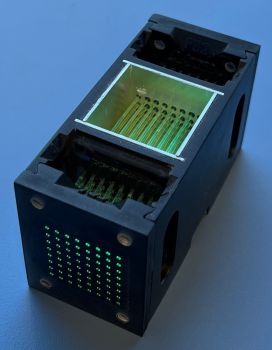
The LiquidO radiation device built by Prof Hartnell and members of the Experimental Particle Physics research group at Sussex.
A new detector built by Prof Jeff Hartnell and members of the Experimental Particle Physics Research Group at Sussex could make radiation monitoring cheaper and far more precise. Early use of the detector is planned to monitor a commercial nuclear reactor in France through the AntiMatter-OTech innovation project.
The team’s LiquidO device, developed over six years, tracks cosmic-ray particles (high-energy particles from space) to better than half a millimetre, making it the most precise detector of its type so far, as reported in the team's paper in the Journal of Instrumention.
This level of detail helps scientists to pinpoint exactly where radiation interacts, trace a particle’s path, and distinguish between different particles based on their behaviour in the detector.
LiquidO is a new kind of radiation detector that works like a camera for subatomic particles (the tiny building blocks of atoms). It uses an opaque scintillator – a material that produces a flash of light when radiation passes through it. Because the material is deliberately cloudy, the light stays close to where it was produced, while a grid of thin optical fibres collects it to map the particle’s path.
Research Fellow Dr Nicolo Tuccori said: “LiquidO could deliver detectors that are 5–10 times more precise for a similar cost – opening up wider uses in radiation monitoring and nuclear safeguards, with longer-term possibilities in medical imaging.”