Impact of WE-SAY research
We look at how the WE-SAY project has impacted the women involved and their wider community.
Young women’s voices matter and they now feel heard by community leaders, family, and institutions. Amara
Girei CRP
Two years after the end of the WE-SAY project, internal funding from the University of Sussex supported a follow-up study to explore how the research may have contributed to change for the young women themselves and within their communities, particularly in relation to family life, education, and work.
The funding enabled Professor Dauda Moses to conduct two focus group discussions with eight co-researcher participants (CRPs) from Girei and Numan, as well as six individual semi-structured interviews with community leaders. Participants included primary and secondary headteachers, religious leaders, youth leaders, and the Permanent Secretary for Women’s Affairs based in Yola.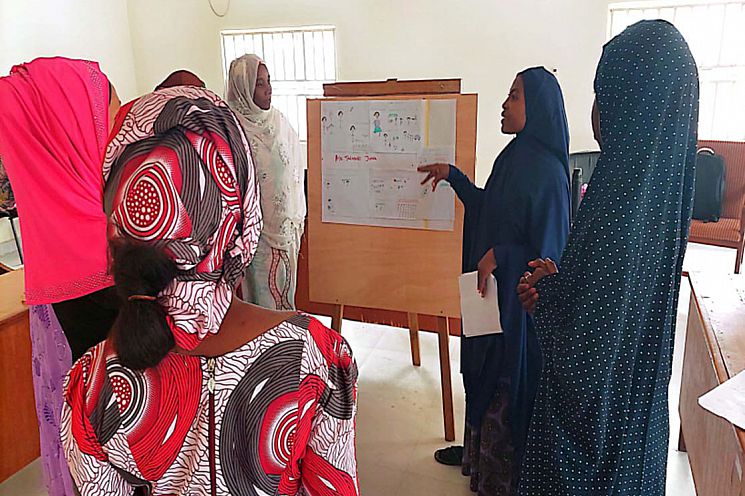
The findings suggest that the research was important in bringing key messages to the community. It supported change at a personal level, enabling CRPs to find a voice both in the home and the wider community. It also contributed to changes in the gendered division of labour in the home, in educational opportunities for themselves and their children, in their professional practices within schools, and in their work situation.
More widely, participants reported changes in how schooling was valued, leading to increased enrolment. There was also evidence of greater reflection on how young women were treated in schools, including reduced use of corporal punishment and increased attention to the needs of married women. Some changes were also reported in relation to women’s work outside the home, with more opportunities for women to undertake work that had previously been reserved for men.
I learnt from the research that young women have a say; we have a say. Before this research, I felt our voice would not be heard but after this research I know that my voice is important and can be heard. Gunoshi
Numan CRP
Several participants highlighted, however, that more work is needed to bring the messages of the research to other communities and villages, where ‘traditional’ beliefs remain firmly entrenched. With this in mind, it would be valuable to examine what ‘tradition’ actually implies, and explore how appeals to tradition are used to resist change.
Overall, there is a clear need for further research into the nexus of education, work, and family in this context. Community leaders themselves highlighted the value of a similar project that included young men. Additional research is also needed to explore how policy changes, such as the adoption of the Child Rights Act in Adamawa State, may affect young people’s lives.
You can read the full WE-SAY study follow up report for more information.
With special thanks to all of our co-researcher participants and everyone who took part in the community dialogues.