From Micro Aggression to Micro Inclusion: A Linguistic Approach to Decolonising the Everyday
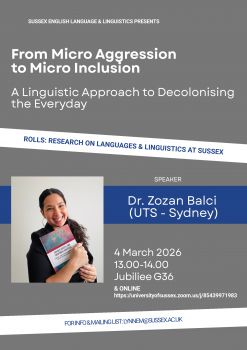
4 March at 13.00
on the University of Sussex campus in Jubilee G36
or on Zoom at https://universityofsussex.zoom.us/s/85439971983
We look forward to seeing you for:
From Micro Aggression to Micro Inclusion: A Linguistic Approach to Decolonising the Everyday
Zozan Balci, University of Technology Sydney
Persistent myths of the homogenous nation continue to dominate contemporary discourse and sit uneasily alongside demographic realities that reveal societies as fundamentally diverse. This seminar engages with these tensions by drawing on the book Erased Voices, Unspoken Heritage, which documents how exclusion operates through both overt macro-aggressions and the subtle, cumulative weight of everyday micro-aggressions.
Emerging from this research is Say Our Names, a project that challenges how we navigate perceived “tricky” or “foreign” names in Anglocentric contexts. The initiative is designed to translate scholarly insight into tangible micro-practices that foster recognition and enact everyday forms of decolonisation. Central to the seminar will be a screening of the short documentary which exemplifies how academic work can be reimagined as accessible, socially impactful output.
Dr Zozan Balci is an academic, sociolinguist, and social justice advocate at the University of Technology Sydney (UTS). Born in Germany to immigrant parents, her lived experience of navigating multiple cultural and linguistic worlds informs much of her scholarly work on language and identity.
Zozan’s academic practice is grounded in the belief that research should generate social impact in and with communities. This commitment underpins her roles with the UTS Centre for Social Justice and Inclusion and the UTS Multicultural Women’s Network, where she works to bridge scholarship and everyday social change.