Collaborative Growth at the Sussex Forest Food Garden
By: Meg Sweeney
Last updated: Tuesday, 24 February 2026
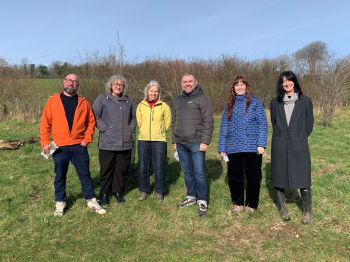
The Global Engagement team recently visited the Sussex Forest Food Garden to meet with Dr Perpetua Kirby and learn more about its developing collaboration with the University of San Diego through the US-UK Fulbright Commission’s Global Challenges Teaching Awards 2025-26. These awards support faculty in co-delivering interdisciplinary virtual exchange and Collaborative Online International Learning (COIL) courses that address pressing global challenges. The visit provided an opportunity to see how international partnership, sustainability and teaching connect in practice.
As Perpetua explained, the Forest Food Garden operates as a working classroom. Offered as an elective module since 2020, it asks students to engage directly with ecological systems rather than approaching sustainability as theory alone. Teaching revolves around a theme of interdependence, within human communities and across animal and plant species, and examines why these relationships matter in the context of climate change and ecological degradation.
Students study the ecological history of the site and explore how food systems can be designed to regenerate soil, strengthen biodiversity and support sustainable supply chains. Working with the seven-layer forest model, they plan, plant and harvest collaboratively. The module operates as a relay: one cohort develops project proposals and the next implements them. This structure builds continuity into the curriculum, encouraging shared responsibility, long-term thinking and practical collaboration. Volunteers from across the University community also contribute, extending participation beyond enrolled students.
Each year, the garden adopts a guiding theme. In 2025-26, the focus is water. In response to mounting global concern around water scarcity, students are collaborating with colleagues from the Sussex School of Life Sciences and the School of Engineering and Informatics to design and build a pond, alongside other sustainable water initiatives. The project integrates water-positive design with habitat creation, functioning both as water storage and a biodiversity resource. The pond will also create a calming space for observation and engagement with the site’s evolving ecosystem.
For the Global Engagement team, the visit reinforced how global challenges can be addressed through locally rooted, interdisciplinary work. The Forest Food Garden demonstrates how teaching, research and international collaboration can converge in a shared space - one that evolves over time through collective effort and care. In our fast-paced global work, it was grounding to slow down, be present and observe the quiet, steady work of nature.