Graduation 2026: Honour for the "visual poet" Black Britain
By: Jacqui Bealing
Last updated: Tuesday, 20 January 2026
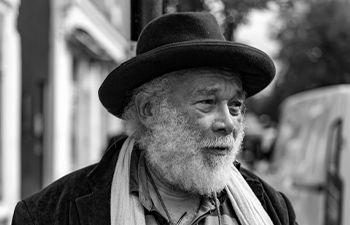
Charlie Phillips
Celebrated photographer Ronald 'Charlie' Phillips will be conferred Honorary Doctor of the University at Winter Graduation 2026.
Ronald Phillips OBE, better known as 'Charlie', is recognised today as among Britain’s most significant—yet for decades under‑recognised—photographic voices.
His remarkable career as a self‑taught photographer spans more than half a century and offers an intimate and historically vital record of Black British communities and urban transformation, as well as capturing shots of cultural and sporting heroes such as Jimi Hendrix and Muhammed Ali.
During the latter part of his career his work has been exhibited in major galleries and exhibitions, including Tate Britain and the National Portrait Gallery, alongside highly celebrated photographers such as Cecil Beaton. In 2022, he received an OBE for his life’s commitment to documenting life through the lens of a camera.
Since 2017, with the help of a grant from the Heritage Lottery Fund, his work has been curated for the Charlie Phillips Heritage Archive. More recently, unpublished photographs he took in Rome during the 1960s of actors and filmmakers are also in the process of being archived. While he welcomes the attention now, he says it is bittersweet.
“I was overlooked for a long time,” he says. “I would try to get my photos published and people didn’t believe I’d taken them, or they’d say they weren’t interested.”
Born in Jamaica in 1944, Phillips migrated to London at the age of eleven, joining his parents in Notting Hill, then an impoverished neighbourhood marked by racism, exploitative landlords, and social tension. He considered himself to be different to his age group. “I liked jazz and classical music and wanted to be an opera singer,” he says. “I got on better with adults."
His interest in photography was sparked when an African-American GI gave his father a camera to look after – and never came back for it. At the same time, the American servicemen would give him US comics and newspapers, and Phillips was inspired by the illustrations of Norman Rockwell on the cover of The Sunday Post that depicted modern life.
He began documenting the daily experiences of his world, initially believing he would return to Jamaica to show his grandmother what his London life was like. He developed his early photographs in the family bathroom late at night, quietly honing his eye for storytelling and composition.
During the late 1950s, he began to find his identity. “I was a beatnik, a hippie. My favourite book was Jack Karouac’s On the Road. I liked being with people who were open and free thinking.” While his parents encouraged him to get a regular job, Phillips had bigger ambitions. He travelled to Paris in 1968 to capture images of the student riots, then journeyed to Rome and discovered actors and extras hanging around the city during the filming of Fellini’s La Dolce Vita.
But he struggled to be taken seriously as a photographer. To supplement his income, he worked as a waiter, restaurateur, and travelled Europe as part of the Merchant Navy. Despite the lack of early success, his images are now celebrated not just for their documentary precision but for their emotional depth. He is particularly proud to have been recognised by the art historian and television presenter Simon Schama, who has described Phillips as “a visual poet: chronicler, champion, witness of a gone world…one of Britain's great photo-portraitists”.
Phillips' long‑running project How Great Thou Art, a fifty‑year documentation of African‑Caribbean funerary traditions in London, is one of his most powerful contributions. This intimate archive of mourning rituals has been exhibited in major institutions, including Tate Britain and the Museum of London.
Recognition has grown steadily in the twenty‑first century. His work has appeared in international publications including Life, Harper’s Bazaar, Stern, and Vogue.
In 2020, together with fellow photographer Eddie Otchere, Charlie became involved in photographing Black alumni from the University of Sussex, creating portraits of the academic Paul Gilroy, the theatre director Lynette Linton and the journalist Clive Myrie that have been exhibited at Sussex.
Today, Charlie Phillips is recognised not only as a pioneering Black photographer but as a foundational voice in British cultural history.