University research driving sustainable and inclusive solutions to Indonesia’s food security challenge
By: Cosmo Rana-Iozzi
Last updated: Monday, 15 December 2025
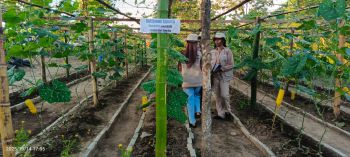
Students managing the Living Lab at Universitas Negeri Gorontalo, Indonesia
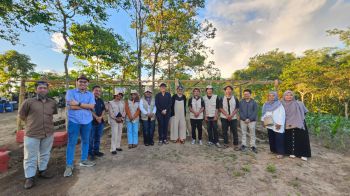
Members of the LEAF Indonesia team and Universitas Negeri Gorontalo students at the Living Lab
How to ensure the food security of one of the largest and most biodiverse countries on the planet? This is the dilemma Indonesia faces as it embarks on ambitious plans to achieve national food self-sufficiency by 2029.
The Business School’s Prof Fiona Marshall leads Land-use, Ecosystems, Agriculture, Food security (LEAF) Indonesia in collaboration with the School of Engineering and Informatics' Prof Novi Quadrianto and Dr Jeremy Reffin. LEAF comprises an interdisciplinary research team from the University and four Indonesian institutions, and is working with government agencies, NGOs and farming communities across the country to get the balance right. As Fiona explains, “land use to ensure national food security goals can pose serious trade-offs with biodiversity, local livelihoods and climate resilience. But by making the system dynamics more visible and bringing local experiential knowledge and innovation together with formal knowledge for integrated decision making, there is enormous potential to build synergies in the form of climate-resilient agriculture”. Indonesia increasingly faces severe climate events, including floods, droughts and forest fires.
To meet the scale of the challenge, LEAF draws on Sussex’s transdisciplinary expertise in engaging with and shaping public policy around the world for sustainably-managed multifunctional landscapes. This includes using the insights of LIMMMA, a dynamic data platform developed by the University’s School of Informatics and the Business School’s Science Policy Research Unit (SPRU). LIMMMA brings together a raft of ecological and socioeconomic data from household to global scale, both qualitative and quantitative. It allows users, such as a policymaker or development planning agency, to map and model the implications of land-use interventions in a given region - exploring trade-offs and synergies for different sustainability goals and interest groups.
The entire LEAF team gathered for a series of workshop exercises in October 2025, bringing together a range of experts from the University of Sussex and Indonesia’s Monash University, State University of Gorontalo, Mulawarman University and State University of Papua, in the eastern Indonesian city of Makassar.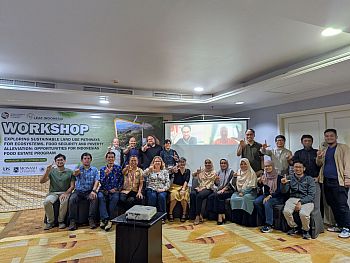
This was followed by a field visit to Gorontalo province, one of three Indonesian provinces where LEAF is focussing its efforts on the ground. Here the emerging research findings and activities have already been a major impetus for the State University of Gorontalo’s Living Lab, an impressive and growing blueprint of climate-resilient integrated farming. The Lab is fostering sustainable agricultural knowledge and practice for the hundreds of students maintaining it, and potentially many more professional farmer groups with which it is building connections. The initiative is also demonstrating progressive new business models and its scalable economic value to communities.
Left: The LEAF Indonesia team at their October 2025 workshop in Makassar, Indonesia.
Further information: https://www.sml-research.org/general-8