Polish Embassy hosts book launch for Sussex Politics Professor
By: Heather Stanley
Last updated: Wednesday, 3 December 2025
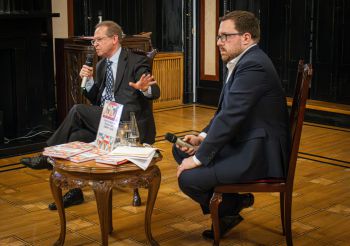
Guardian journalist & 'Europe Live' blogger, Jakub Krupa, moderated discussion at the "in-conversation" style event.
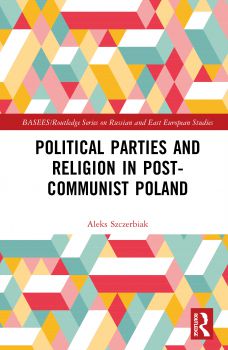
Aleks said: "To make sense of Polish politics, you need to understand the role that religion plays and the importance of the catholic church as a civil society actor."
The Polish Embassy in London was the venue for the hugely successful launch of Aleks Szczerbiak’s, Professor of Politics and Head of the Department of Politics at the University of Sussex, new Routledge published book, ‘Political Parties in Post-Communist Poland’ on 28 November. The 'In conversation' style event had the theme 'Does religion still matter in Polish politics?' and was hosted by Jakub Krupa, editor of The Guardian’s ‘Europe Live’ blog who interviewed Professor Szczerbiak about the principal themes of his book and moderated questions and discussion.
Attendees comprised academics, journalists, policy-makers, think-tankers, government officials, businesses, students and prominent representatives of the UK Polish community. The latter included representatives from the Catholic Bishops Conference of England and Wales, the Federation of Polish Student Societies, the President of the Federation of Poles in Great Britain, and students from the Sussex International Relations Society.
Krupa probed Professor Szczerbiak on why, in spite of rapid recent secularisation of Polish society (especially among younger Poles), the Catholic Church continues to play a key role in public life – and how it has been able to achieve its policy objectives without having to support a single, specific political movement. They also talked about changing attitudes towards the role of the church in the public lives of both current Polish prime minister, Donald Tusk, leader of the ruling liberal-centrist Civic Coalition (KO) party, and the right-wing Law and Justice (PiS) party that governed Poland for eight years up to 2023 and is now the main opposition grouping.
Open discussion covered topics such as the differences in religiosity in party politics in Poland the UK and other European countries; why religiosity is key to understanding how Poles identify themselves as ‘left-wing’ and ‘right-wing’; and the links between religiosity and attitudes towards European integration. Questions were raised about how changing attitudes towards the church in Poland affect the Polish diaspora, and the impact of religion on Poland’s recent presidential election which saw the unexpected triumph of Law and Justice candidate, Karol Nawrocki.
Sharing his thoughts about the event, Professor Szczerbiak said:
“I am extremely grateful to the Polish Embassy for providing me with this wonderful forum to discuss the main ideas set out in my book. To make sense of Polish politics, you need to understand the role that religion plays and the importance of the catholic church as a civil society actor. By acting as a deep and persistent moral-cultural fault line, religion has shaped the structure of political competition and influenced party strategies on both sides of the religious-secular divide.
“My book highlights the great complexity in the relationship, with some parties actively associating themselves with the Church’s moral authority, while at the same time many Poles oppose key elements of the Church’s public policy agenda, and some parties mobilise politically around anticlericalism. Although Poland is clearly something of an outlier - particularly in terms of extraordinarily high residual levels of religiosity, even in the context of ongoing secularisation - it helps us to understand the role that religion has played in contemporary European party politics.”
See this short article in Notes From Poland which sets out the main lines of argument in Professor Szczerbiak’s book.