Advancing science through Nobel-winning discoveries
Explore how Sussex Nobel laureate Sir Harry Kroto sparked new possibilities in chemistry and beyond.
Innovation and education
The late Professor Sir Harry Kroto FRS was awarded a Nobel Prize in Chemistry in 1996 for his discovery of new forms of carbon (the fullerenes) and, in particular, C₆₀ Buckminsterfullerene. Buckminsterfullerene is made up of 60 carbon atoms, and termed C₆₀ or the Buckyball – owing to its composition of pentagons and hexagons, which resembled that of a football and the geodesic dome architecture of Buckminster Fuller.
The discovery was especially remarkable as, up until that point, pure carbon was only known to exist as diamond or graphite, not as a molecule.
The scale of innovation that has come from C₆₀ is huge – from nanotechnology to materials science, diagnostics and even drug delivery, with a diversity of applications in neuroscience, cancer treatment, photonics, spintronics, and even quantum optics. What started as fundamental chemistry now spans so many disciplines.
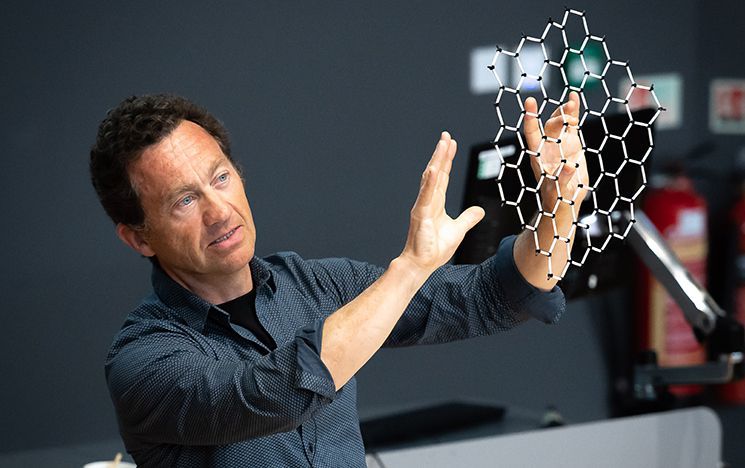
Harry was an inspiration to many, both with his Nobel Prize-winning discovery and his passion for teaching chemistry, evidenced by the fact that many researchers worldwide were students or collaborators of his. Pictured above is Dr Jonathan Hare, science communicator and a former PhD student of Harry’s. Taking part in an outreach day at Sussex, he explains the significance and impact of Harry’s discovery to a new generation of school children.
As Hazel Cox (current Professor of Theoretical and Computational Chemistry at Sussex) recalls: “Harry was passionate about science communication and education. He used his Nobel Prize winnings to set up the Vega Science Trust to make science accessible to everyone. That commitment to inspiring young people is still felt at Sussex today. He has inspired others profoundly in making a change. Sussex has been home to six Nobel laureates – three in chemistry – and we continue to lead in materials science, nanotechnology and quantum innovation.”
Enjoy this celebration of Harry Kroto’s discovery, and learn how Sussex is continuing his legacy.
- Video transcript
Dr Jonathan Hare:
Harry had an exceptionally nice character. He was so inspirational and kind. His office was the most wonderful place. There was just books everywhere. On art, on design, on chemistry, on astronomy. Everything. It was like going into Harry Kroto’s brain.
Professor Hazel Cox:
He was always so supportive of everyone.
Dr Suzanne Carville:
He literally would, like, bounce around when he was teaching.
Dr Amit Sarkar:
People would really queue up to see his lectures. He was really that exciting.
Lady Margaret Kroto:
He was one of those people who always did everything to the best of his ability. If he was going to do it, he was going to do it well.
Professor Hazel Cox:
The University of Sussex's School of Chemistry and Molecular Sciences, known as MOLS, there’s a real hive of activity. People were just following their research with passion.
Professor Sir David Clary:
Harry was making molecules in the lab, doing their spectra, and then trying to get colleagues to see if they could be observed in astronomical environments. And this was really the great project that Harry himself was interested in.
Dr Jonathan Hare:
And then he came across the apparatus that was designed by Rick Smalley in Rice University, which is called the cluster beam apparatus. Harry immediately thought put carbon in there, maybe we could recreate the chemistry going on in space.
He flew over from Sussex University to Texas to work for one week with Rick Smalley and Bob Curl and the students.
One thing he always said was, “if I knew what the result of an experiment would be, why do it?”.
This cluster beam apparatus could take a sample, and you can use a laser to vaporise the sample. So you have a star, perhaps in space that's emitting carbon. It would be very hot. Just like in this machine, you fire the laser beam at it, boil off the atoms. So it was a little snapshot of space in the lab with a fantastic machine that could measure all the results.
They did this amazing experiment. In the process, completely by accident, they discovered an enormous peak for C60. This whole new world of chemistry was just about to appear.
So this is a model of C60 or Buckminsterfullerine. And this was a molecule that was discovered at Rice University in 1985 by Harry Kroto and colleagues.
Lady Margaret Kroto:
It’s described as a beautiful molecule. And I think that's its appeal in a way. It seems to suit Harry because it had the visual appeal as well as the scientific thing.
Professor Hazel Cox:
The most wonderful thing is that it was blue skies research. He never set out to find the third form of carbon and help spark the whole area of nanoscience and nano technology. He was just pursuing his passion to understand carbon in interstellar space.
Professor Sir David Clary:
Calling these set of molecules fullerenes came from Harry. He was very interested in art, very interested in architecture. And he realised that this was, a beautiful symmetrical molecule.
Sir Harrry Kroto:
One image, which was in my mind from way back, was that of Buckminster Fuller's dome in Expo ’67.
Dr Jonathan Hare:
I remember rushing into the office and there was this amazing message on the answer machine.
Carl Jacobson:
I am Carl Jacobson from the Royal Swedish Academy of Sciences, and I have the good news to give you that you just have been awarded the 1996 Nobel Prize in Chemistry, jointly with Professor Robert Curl and Professor Richard Smalley. Of course, for your discovery of fullerenes.
Dr Jonathan Hare:
And then the telephones didn't stop ringing. The TV crews didn't stop coming round. It was just like this incredible energy.
Professor Hazel Cox:
There was just an explosion of joy and happiness. Everyone was just running around, shouting down the corridors, “Harry’s got the Nobel Prize.”
Lady Margaret Kroto:
He was obviously very excited about it, but he was also equally excited about the fact that it was going to be called Buckminster fullerene and he said he would fight for it because he knew that nobody else liked it.
Dr Amit Sarkar:
I opened my son's chemistry GCSE book, went to the section on carbon - graphite, diamond and now the fullerenes, C60. So at that point, I realised the reach of Harry's work was so immense that the textbooks had been rewritten. It's obviously opened up a whole new plethora of science. There's a whole division of chemistry, nanotechnology, material science. It's opened up so many angles.
Professor Hazel Cox:
We've still got that fullerene chemistry going on here at Sussex, following in Harry's footsteps. Astrochemistry, we've got people working on titanium dioxide nanotubes. We've got people using nanotube polymer composites.
Professor Sasha Rosneil:
Winning the Nobel Prize for his discovery of C60 really did make a big difference to Sussex's global reputation. Students still talk about his legacy and they're taught about it at Sussex. He had a real mission to take science out from beyond the walls of the lab and the University and engage children, young people, old people with his passion for science. And that legacy lives on at Sussex today.
Sir Harry Kroto:
For me, science is something to do with fun and solving puzzles where I really don't know what the answer is.