Greater than the sum: why science, technology and innovation studies matter now
By: Serena Mitchell
Last updated: Monday, 29 June 2026
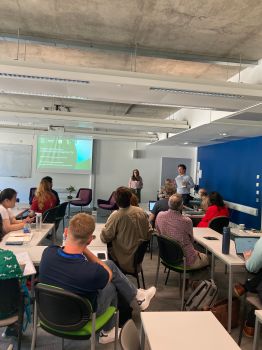
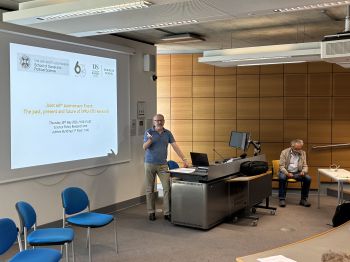
Attendees sit in a classroom-style seminar room while two speakers stand at the front beside a projected slide titled “Greater than the Sum: Collaboration and Impactful STIS.
In a world shaped by climate change, artificial intelligence, public health crises and contested policy choices, the question is no longer simply how innovation happens. It is who innovation serves, whose knowledge counts, and which futures are made possible.
These topics were explored at two interconnected events hosted by the Science Policy Research Unit (SPRU) at the University of Sussex Business School: the AsSIST-UK Early Career Researcher Summer School and the Joint 60th Anniversary Talks with SPRU and Science, Technology and Innovation Studies (STIS), University of Edinburgh. Held as SPRU and STIS (through its forerunner – the Science Studies Unit) celebrate their founding 60 years ago, the events created a timely space to reflect on the past, present and future. AsSIST-UK is the UK’s Association for the Studies in Innovation, Science and Technology that brings together scholars and academic institutions working in the field across the UK.
Across both days, three themes stood out: how to rethink impact beyond narrow success stories; how to support early-career researchers navigating uncertainty; and why long-term partnerships matter for sustaining critical, collaborative research.
Rethinking impact beyond short-term policy success stories
Impact is now central to academic life. However, one of the strongest insights from the conversations was that meaningful impact is rarely simple, immediate or easy to measure.
For science, technology and innovation studies scholars, short-term policy success can be a poor measure of good research. Some of the most important work happens by challenging assumptions, slowing down dominant narratives, or making visible the politics behind supposedly technical decisions.
Professor Adrian Smith offered a useful framework through policy settings, instruments and paradigms, reminding researchers that impact operates across different timescales. Dr Les Levidow highlighted the role of civil society groups in producing critical insights. Professor Kieron Flanagan described impact as a "zombie concept", warning that it can obscure the messy realities of trying to shift policy paradigms.
Professor Jane Calvert suggested researchers should think less about proving "impact" in narrow terms, and more about how their work can make a meaningful intervention, sometimes by challenging accepted ideas or asking questions that make people see a problem differently.
Navigating uncertainty as an early-career researcher
STIS offers intellectual openness and strong communities but exists within a university system shaped by funding pressures, job insecurity and uneven access to opportunity.
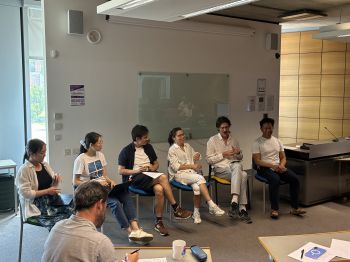
Dr Valeria Ramirez, Dr Alex Ghionis, Anna Dorwick and Dr Josh Moon spoke about the pressure to say "yes" too often. Their advice was simple, slow down and practise the 24-hour rule before committing. They also reflected on the importance of maintaining resilient networks. Academic careers are sustained through relationships and people who help one another keep moving.
Dr Ghionis summed up the core challenge: constant uncertainty, and a field that does not always fit neatly into existing job titles or career paths. Dr Ramirez advised researchers to identify what is distinctive in their work, their concepts, methods and ways of seeing, and learn to sustain and mobilise that distinctiveness.
Mentoring, confidence and intellectual community
Research training is not just about methods or funding. It is also about confidence, a sense of belonging to a community and honest conversation about career uncertainty.
Kanika Balani, approaching the end of her PhD at SPRU, described the ‘Surviving the Viva’ roundtable with Professor Robin Williams as "extremely valuable and timely". His reframing of the viva not as something to fear, but as "a rare opportunity to engage in a deep intellectual discussion with two experts who have read your work closely" was, she said, "both reassuring and empowering".
Dominic Watters, a SPRU first-year PhD researcher, reflected on the shared STIS commitment to "theoretical frameworks and analytical approaches that challenge assumptions and open up possibilities within innovation", noting the tension researchers face when trying to demonstrate impact within a system that may prioritise narrower measures of value.
The power of long-term partnerships
SPRU’s 60th anniversary year is also a chance to celebrate and renew long-standing partnerships, particularly with the Science Studies Unit at the University of Edinburgh. Both were founded in 1966, and both have helped shape the development of science, technology and innovation studies in the UK and internationally.
At their joint event, acting Head of SPRU Professor Andy Davies highlighted the uniqueness of both centres, including their interdisciplinarity and policy and business relevance. Professor Robin Williams, University of Edinburgh, argued that innovation studies and STS have diverged in recent decades and called for renewed collaboration between these parts of the field. Professor Robin Mansell, former SPRU researcher and Emerita Professor at LSE, recalled her experience working in the PICT (Programme on Information and Communication Technologies) and reflected on SPRU’s early work on digital communications through the PICT programme, in collaboration with Edinburgh and other centres.
These histories show that STIS has always been built through collaboration between disciplines, institutions, generations and forms of expertise. Partnerships between SPRU, STIS, AsSIST-UK and wider research networks create the conditions for critical research to flourish.
Asking better questions about innovation
As SPRU marks 60 years, the celebration not only marks institutional history but considers what comes next, supporting early-career researchers, renewing partnerships, and continuing to ask difficult questions about science, technology and innovation in a changing world.
STIS does not take innovation for granted but ask what innovation is for, who gets to shape it, and how research can help facilitate more responsible, inclusive and democratic futures.
With thanks to Katerina Psarikidou, Isaac Lemo, Pablo Ayala-Villalobos, Stephen Scholte and Carla Douglas Gonzalez for leading the organisation of the AsSIST-UK ECR Summer School, and to Adrian Ely, Andy Davies, Robin Williams and Katerina Psarikidou for coordinating the SPRU/STIS anniversary discussions. The events were supported by AsSIST-UK and SPRU's Science Politics and Decision-Making Research Mobilisation Group.