Building a fairer food future
At Sussex, researchers are working with communities and city partners to create healthier, fairer and more sustainable food systems.
A city-wide food challenge
Food is part of everyday life. It shapes our health, our communities, our environment and our sense of belonging. But access to affordable, healthy and culturally appropriate food is not equal.
For many people, choices about what to eat are shaped not only by personal preference, but by income, access, advertising and the wider systems that influence what food is available, affordable and visible in everyday life.
In Brighton and Hove, more than 6,000 people rely on weekly food support, while the city continues to face challenges around food inequality, food waste and access to healthy, sustainable food.
At the University of Sussex, researchers are exploring how these systems can be changed so that the people most affected by food inequality have a greater say in the decisions that shape their everyday lives.
Shaping policy with communities
Dr Katerina Psarikidou, Assistant Professor at the Science Policy Research Unit (SPRU) at the University of Sussex Business School, is helping to lead this work through FoodSEqual, a major £6 million UK Research and Innovation-funded project.
As Policy Lead and Co-Investigator, Dr Psarikidou has been working with communities, local authorities, community organisations and industry partners to explore how food policy ideas and recommendations can be co-produced with the people they are intended to support.
Working with communities in Brighton and Hove, and in Reading, FoodSEqual focuses on co-developing new products, policy frameworks and supply chains that are healthy, affordable, sustainable and culturally appropriate.
Rather than treating public engagement as something that happens after research is complete, the project builds community involvement into the process from the start, using policy workshops, interactive consultations, co-produced policy briefs and creative public engagement tools.
From research to real-world change
In Brighton and Hove, FoodSEqual has worked closely with Brighton & Hove Food Partnership and Brighton & Hove City Council, contributing to local conversations about how the city can support a fairer and healthier food future.
One tangible outcome has been the project’s contribution to work around Healthy Start vouchers and junk food advertising. Community policy recommendations helped inform a city-wide campaign using 50 digital bus stop adverts to promote access to healthy food schemes.
The campaign has since helped inspire a wider Brighton & Hove City Council policy banning fast food advertising on bus stops across the city, marking an important public health milestone.
For Dr Psarikidou, this kind of collaboration is essential because food policy affects everyday life. “Policy shapes our everyday experiences around food – we all have a say and should be involved in shaping it,” she says.
Playing with policy
Alongside policy reports and community workshops, FoodSEqual has developed creative ways to bring research findings to wider audiences.
One of these is Foodtopia, a video game that turns policy-making into an interactive experience. Players are invited to weigh up the kinds of choices councils, communities and food businesses face when trying to create healthier, fairer food systems, from limiting takeaway licences near schools and youth centres to subsidising supermarket offers on fruit and vegetables.
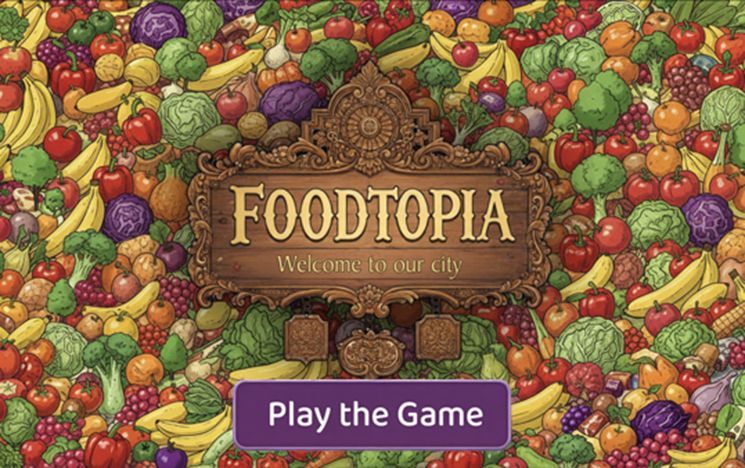
What would you prioritise? Play Foodtopia and make your own food policy decisions.
The project has also produced the FoodSEqual Policy Film, a documentary-style film capturing community voices and the journey of co-producing food policy. Together, these tools help share the project’s findings with communities, policymakers and wider audiences.
Who gets to shape food policy?
- Video transcript
Note: This accessible transcript includes spoken dialogue, key on-screen text, music cues, and concise descriptions of meaningful visual content.
[Uplifting piano music plays. On-screen text: “FoodSEqual Policy Research: Co-producing policies to bring food equality to the UK’s food system.” Opening shots show people selecting fruit and vegetables in a supermarket, an egg frying in a pan, and people preparing and serving a salad in a kitchen.]
Dr Katerina Psarikidou: FoodSEqual is a UKRI-funded, five-year project that aims to transform the UK food system in more sustainable and healthy directions for all.
[Dr Katerina Psarikidou speaks to camera. On-screen text identifies her as Policy Lead, FoodSEqual, and Assistant Professor, Science Policy Research Unit (SPRU), University of Sussex. Shots show children eating breakfast at a table and people selecting vegetables in a supermarket.]Dr Katerina Psarikidou: We argue that co-producing policies for and with communities experiencing food inequalities is key for transforming the food system. Policies, most of the time, are developed in silos, without really engaging with communities or directly speaking to community needs.
[Shots show supermarket scenes, with people of different ages selecting fruit and vegetables.]Dr Katerina Psarikidou: At FoodSEqual we work closely with our community partners and our community researchers in order to bring communities at the heart of the conversations.
[Inspiring piano music plays. Aerial footage shows Brighton and Hove, panning across the seafront towards the i360 and West Pier. On-screen text: “FoodSEqual Policy in Brighton & Hove.”]Shelley Taylor: Brighton itself is a city of inequality.
[Shots show a busy street scene in Brighton’s North Laine, with people walking around market stalls, browsing and shopping. Shelley Taylor then speaks to camera. On-screen text identifies her as Research and Policy Coordinator, Brighton & Hove Food Partnership.]Shelley Taylor: If you walk into Brighton you see lovely shops, lovely delis, lots of people having a lovely time, but it is quite different what is available just a mile up the road onto the outskirts.
[Footage filmed from a car shows residential streets on the outskirts of Brighton, with houses and occasional shops or places to eat.]Shelley Taylor: The food environment there is very different and doing this food policy research with the community gave an amazing example about how important it is to consult people.
[A photo shows a community group taking part in an activity inside a community hall. Dr Katerina Psarikidou leads the group as they arrange post-it notes, papers and photos on a large table.]Shelley Taylor: How people that these decisions affect are most likely to have the answers that are going to work and create impact.
[A photo shows a wall in the community hall with a large sheet of flipchart paper headed “Changes”, displaying written post-it notes, photos and completed prompts from the community workshop.]Shelley Taylor: It affects our health, our economy, our wellbeing, the environment, and people really are conscious of that and are really trying to do the best that they can.
[Ali Ghamini speaks to camera. On-screen text identifies her as Head of Partnerships and Programmes, Brighton & Hove Food Partnership.]Ali Ghamini: Essentially what they said is that they wanted to have better access to food that was healthy. For example, they wanted to eat more fresh vegetables, ideally organic, or that have not got chemicals on them. They wanted to eat more fish.
[A FoodSEqual policy brief is shown on screen. The film cuts between the policy brief, Ali Ghamini speaking to camera and community workshop materials.]Ali Ghamini: They felt very strongly about giving farmers and food producers a fair price for what they do. They realise the influence of the supermarkets in pushing those prices down and squeezing the margins for the farmers. They thought that was wrong. They wanted better food education in schools, and also the community wanted to come together to eat, to share food, to learn cooking skills together.
[A photo shows a wall in the community hall with a large sheet of flipchart paper headed “Future”, displaying written post-it notes, photos and completed prompts from the community workshop.]Ali Ghamini: They realise it is not just about eating good food, it is about connection, it is about reducing isolation and strengthening communities.
Ali Ghamini: So I lead on the city’s food strategy, and I took some of the research from the FoodSEqual policy, like what people wanted to change, and I put that into our food strategy document.
[A digital bus stop advert shows a large KFC double burger with text “Double Down, Double Down”]Angela Blair: We had learnt through the community researchers’ work, and the policy brief, that really there was a desire to have less junk food advertising, and also on the positive side trying to have more healthy sustainable foods advertising, and our colleagues in transport offered a space on the digital adverts in the city bus stops which was incredible.
[Angela Blair speaks to camera. On-screen text identifies her as Food Policy Coordinator, Brighton & Hove City Council. Shots show digital bus stop adverts around the city promoting the Healthy Start scheme.]
[A digital bus stop advert asks: “Could you get help to buy healthy food and milk?” The advert includes a QR code and Healthy Start branding.]
Angela Blair: The space was worth tens of thousands of pounds. In fact we felt incredibly lucky to use that and my colleague in public health contacted the Healthy Start team and they actually made a bus stop advert ready for us, so we were ready to go.
[A report cover appears on screen, showing an assessment of the impact of bus stop adverts for Healthy Start schemes and vouchers in Brighton and Hove. The film returns to bus stop footage.]Angela Blair: Really it was the support and the confidence through the FoodSEqual programme and knowing that they were up for evaluating this properly that we could all move forward together.
[Pablo Ayala Villalobos speaks to camera. On-screen text identifies him as Research Fellow, Science Policy Research Unit (SPRU), University of Sussex. More footage shows the Healthy Start advert in city streets.]
Pablo Ayala Villalobos: The survey finds that people are tired of junk food adverts. People are aware as well of how much noise there is in the city. They talk about how the space could be used for something of public good. If you’re talking about food, why don’t you give me food recipes instead. Why don’t you get involved with the needs of the community instead of just bringing noise into the environment.
[Dr Katerina Psarikidou speaks to camera. The film then moves to aerial footage of Reading while inspirational piano music plays. On-screen text: “FoodSEqual Policy in Reading.”]Dr Katerina Psarikidou: So, in FoodSEqual we have worked very closely with Brighton & Hove Food Partnership, and Brighton & Hove City Council, but also with organisations in Reading, like Whitley Community Development Association, and Reading Borough Council.
[Jane Bradbeer speaks to camera. On-screen text identifies her as Project Manager, FoodSEqual, University of Reading. Shots show a community centre, an outdoor food market and a FoodSEqual policy brief.]Jane Bradbeer: Reading Borough Council doesn’t currently have a specific food coordinator as Brighton has. We’ve taken information and ideas from the local community within Whitley in Reading, and informed the council by saying this is what is strong on their minds and on their agendas, and then work with the council to actually make that happen and bring about some change.
[Photos transition on screen, showing South Reading Community Hub, an outdoor community food market, and a policy brief titled “Accessing healthy food in Whitley, Reading: The Voice of the Community.”]
[Jo Anderson speaks to camera. She is sitting at a table beside a window in a bright room with a large palm plant and a bowl of fruit. On-screen text identifies her as FoodSEqual Community Food and Health Champion, University of Reading.]Jo Anderson: I’m hopeful that some of the conversations about the policy work that we did, that importance of keeping their community centres kind of vibrant and a place where people feel safe and want to go to, so I think we’ve got the evidence to prove that actually if you invest in these spaces then you’ll get the best out of your communities.
[Trisha Bennett speaks to camera in the same bright room, seated at a table beside a window. On-screen text identifies her as Community Development Coordinator, Whitley Community Development Association.]Trisha Bennett: So we start with a community cafe, and that’s a really good way to engage people. But for me none of it’s in isolation, like policy’s not in isolation. Policy’s about neighbourhoods, it’s about connectedness, it’s about licensing laws, it’s about health, it’s about housing, transport, everything.
[The Foodtopia video game title screen appears, with an illustrated town surrounded by fruit and vegetables. The game screen shows a welcome message and policy scenarios.]Dr Katerina Psarikidou: We know that policy conversations can be very daunting, so developing a policy video game sounded like a great idea. It’s something that can engage communities in conversations about food in more creative and playful ways.
[Foodtopia gameplay continues. Animated scenes show a supermarket and a school classroom, with policy choices appearing on screen.]Dr Katerina Psarikidou: What is really unique about the game and very interesting is that all the different policy options and challenges that the player is introduced through this game are things that people have been telling us about food and the types of changes they want to see, in their own places, in different UK cities.
[Gareth Griffiths speaks to camera. On-screen text identifies him as Game Design Collaborator and Director of Untether. Gameplay scenes continue to show illustrated characters and policy choices.]Gareth Griffiths: By sharing the game in this way, and opening the research up for audiences that wouldn’t normally be able to access it or wouldn’t have the patience or the skills to read these documents, it may make people more activist, or become more aware, that these kind of conversations are going on.
[Dan Stevenson speaks to camera. On-screen text identifies him as Head of Sustainable Farming, LEAF (Linking Environment and Farming). Foodtopia gameplay shows a character saying the future of Foodtopia is in the player’s hands, followed by policy options about fairer contracts and working conditions for farmers.]Dan Stevenson: What I really think it does to all players, is it reinforced the intricacies and relationships between these policy decisions at very grassroots level, all the way through to central government.
[The film cuts between Dan Stevenson speaking and gameplay showing street scenes and community characters.]Dan Stevenson: One of my real takeaways from this project has been, do we speak to the consumer and the community side of things enough? So certainly we would spend a lot of time maybe talking to farmers and retailers and processors, and assuming we know what consumers want based on their purchasing decisions, but what this project has told me is that those purchasing decisions are impacted by an awful lot of things that don’t necessarily reflect their visions and their values and so unless we’re talking to them, and then linking up what we doing on this side of things with retailers, with government policy with producers, then we’re not going to bring those two things together.
[Aerial footage shows market stalls filled with fruit and vegetables while optimistic piano music plays. Carol Wagstaff speaks to camera. On-screen text identifies her as FoodSEqual Principal Investigator and Professor of Food and Nutritional Sciences, University of Reading.]Carol Wagstaff: If you give people the means, the motivation, the capability, and some of that is finance, some of it is time, availability, access, all these things, actually there’s a huge number of people who will make the changes, that actually the policy makers would really like to see, but you need to listen to people and you need to not prejudge, and you actually find that in most cases the solution’s there.
[Final Foodtopia gameplay screen shows an illustrated town with a rainbow overhead. On-screen text says: “Under your direction Foodtopia turned a corner and is seeing a much brighter and healthier future.”]
[Final screen shows the FoodSEqual logo, partner logos, funder logos and four QR codes for project resources, including the FoodSEqual policy research film and Foodtopia.]
Food futures for all
As debates around food systems, public health and sustainability continue, FoodSEqual shows how universities can help create spaces where communities are listened to and research supports practical action.
From community workshops and policy recommendations to films, video games and city-wide campaigns, the project demonstrates that building a better food future is not only about what we eat. It is also about who gets to shape the systems that feed us.