About us
We focus on the relationship between regional migration, internal migration and poverty in Africa and Asia.
About Migrating out of Poverty
Migrating out of Poverty Research Programme Consortium is funded by the UK’s Department for International Development (DFID).
The goal of Migrating out of Poverty is to maximise the poverty-reducing and developmental impacts of migration and minimise the costs and risks of migration for the poor. This includes generating new knowledge related to migration and poverty; creating new datasets and publications; engaging policymakers with key research outcomes on migration and poverty linkages.
Migrating out of Poverty (from 2010-2017) worked in partnership with research institutions in Bangladesh, Ghana, Kenya, Singapore and South Africa. Since 2017, we have been shifting focus to Africa primarily. We continue to work with Ghana and South Africa and are forging new partnerships in Ethiopia and Senegal. Watch this space for updates.
Day-to-day coordination of the Migrating out of Poverty partners and research themes is undertaken by the Secretariat with an Executive Board that offers advice and commentary on steps within the research design and dissemination.
Migrating out of Poverty was built on the work of the former Development Research Centre on Migration, Globalisation and Poverty.
Our partners
- The Organisaion for Social Science Research in Eastern and Southern Africa (OSSREA)
- The Centre for Migration Studies (CMS)
- L'Université Assane Seck de Ziguinchor
- The African Centre for Migration & Society (ACMS)
- Centre for Applied Social Sciences (CASS)
- The Refugee and Migratory Movements Research Unit
- The African Migration & Development Policy Centre (AMADPOC)
- Asia Research Institute (ARI).
Conferences
Find out more about the conferences we’ve hosted.
- From evidence to policy
This conference was held from Tuesday 28 March-Wednesday 29 March 2017 at the School for Oriental and African Studies (SOAS) in London
The Migrating out of Poverty Research Programme Consortium held its ‘From Evidence to Policy’ conference at the School for Oriental and Asian Studies (SOAS) in London from 28-29 March 2017.
We published our conference report, which breaks down each session and describes the detail, in terms of topic, region and argument introduced within the presentations. The report contains references to specific papers and photographs from the two days.
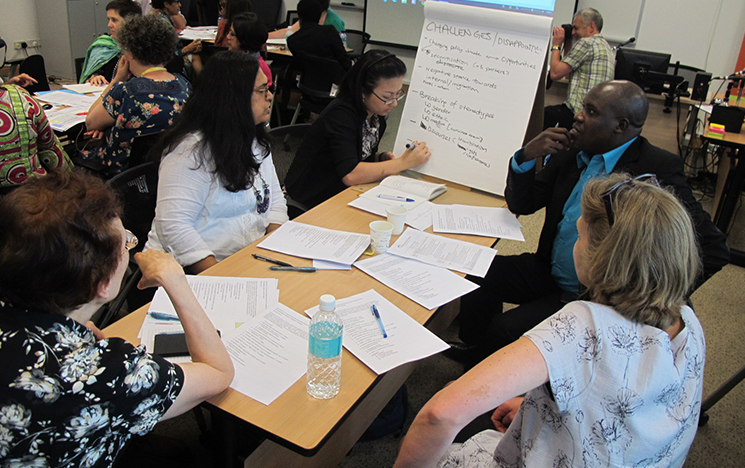
In keeping with our research, there was a strong focus on the intersection of gender and migration. Bringing researchers and practitioners together, this conference links evidence and policy from a number of the major themes of our research, including:
- migration brokerage
- intra-household dynamics
- youth aspirations
- the making of migration policy
- remittances
- migration and poverty
- migrants’ journeys.
Our keynote speakers were Michael Clemens and Julia O'Connell Davidson.
New patterns of mobility are continuously shaping and being shaped by macro processes of globalisation on the one hand and local processes embedded in culture, class, ethnicity and race on the other hand. New transnational alliances, actors and institutions are shaping the “power geometry” of migration by determining who migrates, why, where and under what circumstances. Gendered and ethnic identities have pushed men and women into certain types of migrant labour and created specific niches and segmented labour markets where some forms of work are feminised and ascribed a lower market value.
This international conference invited decision makers, funders, scholars and practitioners to explore these new configurations of mobility, particularly those of poorer social groups. Our aim is to inform migration policy based on contextualised and intersectional understandings of migration. The conference was structured around two keynote speeches; four plenaries providing critical insights into cutting-edge research and the translation of research into evidence for policy and four parallel sessions with three streams of panels. It is hosted by the Migrating out of Poverty Research Programme Consortium, which is funded by the UK’s Department for International Development (DFID).
Taking as our point of departure the ongoing research within the consortium, we invited papers and multimedia contributions addressing the themes described below. All submissions took gender differences into consideration and focused on both men and women. The conference highlighted how emerging evidence on migration and poverty can promote more effective policy interventions to ensure the benefits of migration and reduce its costs and risks for poor people.
Themes
Conference themes included:
- migration brokerage, debt and precarious employment
- differentiated niches in migrant labour markets
- policy processes and politics in migration
- remittances, remittance behaviour and poverty outcomes
- youth and migration
- return and reintegration, gender identities and livelihoods
- migration and social networks
- social policy for migrants
- migration, urbanisation and climate change
- the migration crisis
- migrant journeys
- migrant organisations and activism.
- Gendered dimensions of migration
This conference was an opportunity to understand how gender roles and expectations influence the factors leading to migration, male and female migrants’ different experiences of migration and its impact on migrants, their families and home communities. Key insights from research shed light on how migration affects economic wellbeing and relationships – not only between women and men, but also between parents and their sons and daughters.
Together, we shared findings from 20 carefully selected and diverse research projects, exploring how notions of gender and age appropriate activities and behaviour shape migration. It was a lively discussion, with presentations, films and exhibitions. A policy roundtable enabled researchers and civil society representatives to engage with their counterparts in international policy-making organisations. It was a rare chance for dialogue on an under-explored issue.