Cover Cropping: A Nature-Based Solution for Healthier Soils and Resilient Farms
Posted on behalf of: Dr Cynthia Olumba, Cranfield University - Work Package 1 - REAL NbS Project
Last updated: Friday, 17 April 2026
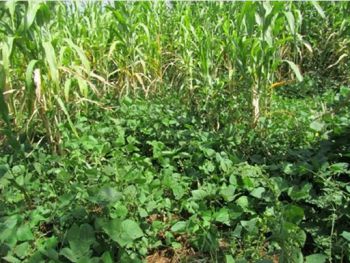
A main crop (maize) intercropped with a cover crop (lablab)
Across East Africa, many smallholder farmers face growing challenges from soil erosion, declining soil fertility, and unreliable rainfall. Bare soil is highly vulnerable to washout during heavy rains, and the loss of nutrient-rich topsoil directly reduces crop yields. At the same time, prolonged dry periods can stress crops and limit productivity. One promising approach to address these challenges is cover cropping, a nature-based solution that leverages living plants to protect and restore soil.
What Is Cover Cropping?
Cover cropping refers to the practice of growing specific plants (or a combination of plants), primarily to protect, enrich, and improve the soil, rather than being grown for direct harvest for household consumption or as a cash crop. These cover crops are planted either during fallow periods or alongside main crops to protect the soil surface and enhance soil conditions. Their dense foliage shields the bare soil from raindrop impact, while their roots anchor the soil, improve soil structure, and add organic matter upon decomposition. Some cover crops (such as leguminous species) can ‘fix’ atmospheric nitrogen to enhance soil nutrient content.
Cover Cropping as a Nature-based Solution
Nature-based solutions (NbS) harness natural processes to address environmental challenges sustainably. Cover cropping is one example, using living plants to restore soil health, suppress weeds, and cycle nutrients, without synthetic fertilizers or heavy machinery. Cover crops bring plant diversity to agricultural lands, increasing farm resilience in the face of environmental stresses such as soil erosion.
In the REAL NbS project, cover cropping was co-selected by farmers and other stakeholders during the inception workshop held in Arusha, Tanzania, in autumn 2024. With project support, some farmers are now planting a locally sourced cover crop, known as ‘lablab’, on experimental plots, monitoring its impact on controlling land degradation and increasing main crop yields.
Why implement Cover Cropping?
Bare soil between cropping seasons is prone to soil and water losses, compaction, and nutrient leaching. Cover crops counteract this by:
- Reducing Soil Erosion: The plant canopy intercepts raindrops, and the plant stems slow runoff, preventing topsoil loss on farmers’ fields.
- Boosting Soil Fertility: Legumes like lablab fix atmospheric nitrogen and add organic matter to the soil, enhancing microbial activity and nutrient availability.
- Improving Water Retention: Extensive root systems create soil pores, increasing rainfall infiltration and moisture-holding capacity, which are critical during dry spells.
- Enhancing Crop Yields: Healthier soil supports better establishment and growth of the main crop, often leading to significant yield gains in subsequent seasons.
- Suppressing Weeds and Pests: Dense growth of the cover crop outcompetes weeds naturally, reducing herbicide needs.
- Cover crops can diversify farm production. Depending on the species, cover crops can provide an additional food source for the household, as well as fodder and bedding for livestock. Some cover crops can be harvested for their seeds and grains.
Challenges and Considerations
Although cover cropping offers many benefits, farmers may face some challenges when adopting the practice:
- Competition with main crops: If not well managed, cover crops may compete with the main crop for water, nutrients, or sunlight.
- Seed availability: Access to suitable cover crop seeds may be limited in some areas.
- Knowledge and training: Farmers may require guidance on selecting appropriate species and managing cover crops effectively.
Despite these challenges, cover cropping presents significant opportunities to improve soil health and build more resilient farming systems. With adequate guidance and support, these challenges can be managed, making cover cropping a practical and scalable solution.
Conclusion
Cover cropping is a practical and sustainable nature-based solution that can help address some of the key challenges facing agriculture in many parts of East Africa. By keeping the soil covered with living plants, farmers can reduce soil erosion, improve soil fertility, and enhance water retention.
Through the REAL NbS project, some farmers in Arusha are testing how cover crops such as lablab can help address land degradation challenges. These field experiments are generating valuable insights into how nature‑based approaches can protect farmland, improve productivity, and strengthen the resilience of smallholder farming systems.
This work is supported by UK Research and Innovation Building a Green Future strategic theme, Building a Secure and Resilient World strategic theme, Natural Environment Research Council, and the Foreign Commonwealth and Development Office (grant number NE/Z503447/1).