The power of women’s enterprise and everyday generosity
By: Serena Mitchell
Last updated: Monday, 5 October 2026
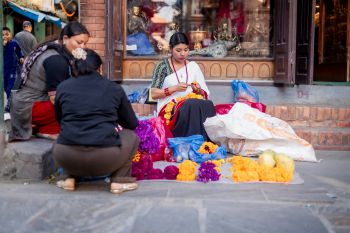
Photo by Sushanta Rokka on Unsplash Newari woman crafting globe amaranth garlands, Patan Durbar Square, Lalitpur, Nepal
International Women’s Day, 8 March 2026, invites us to reflect on the idea that when people share knowledge, time, resources and support, the benefits multiply. Research by our faculty members, Professor Mirela Xheneti and Professor Ödül Bozkurt shows how this principle already shapes the everyday realities of women entrepreneurs around the world.
Enterprise built on trust, reciprocity and care
A study by Prof. Xheneti and Dr. Adrian Madden (University of York), published in Human Relations, explores the experiences of 90 women entrepreneurs working in Nepal’s informal economy. The research reveals that these businesses are sustained not through financial exchange alone, but through relationships of trust, reciprocity and mutual support.
Women often extend credit to customers who cannot pay immediately, rely on neighbours and family for help with childcare or supplies, and build long-term relationships with suppliers and clients. These exchanges are rarely just about profit. They reflect a moral economy in which business decisions are shaped by responsibilities to family, community and place.
At the centre of these practices is care.
Many of the businesses operate from or close to women’s homes. This allows women to earn an income while also managing childcare, household work and wider community responsibilities. But it also requires considerable effort. Women frequently work long hours, absorb financial risks and prioritise the well-being of others in order to maintain these networks of support.
Through these everyday actions, women create what the researchers describe as relational infrastructures — informal systems of cooperation that help families and neighbourhoods function. These networks often remain invisible in traditional discussions of entrepreneurship and economic development, yet they are essential to how local economies survive and adapt.
From survival to solidarity
Importantly, these relationships can also become sources of solidarity and strength. Informal savings groups, training programmes and local women’s networks often evolve into spaces where women share experiences, support one another through financial challenges and build confidence to operate in spaces traditionally dominated by men.
In this sense, entrepreneurship is not only about individual ambition. It is about the collective ties that allow communities to move forward together.
Entrepreneurship and the circular economy
A second study by Prof. Bozkurt and Prof. Xheneti, published in Work, Employment and Society, shows how these relational dynamics also shape efforts to build more sustainable economies. The research follows a small business owner creating a circular fashion enterprise using regenerated fishing nets.
The study shows that driving sustainable change requires several kinds of work at once: running a business, redefining professional identity and actively advocating for new ways of producing and consuming fashion. Just as importantly, this work is deeply collaborative.
Rather than reflecting the image of a lone entrepreneur, the business connects designers, customers, community groups and other women entrepreneurs across the world. Profits are reinvested into microloans that support women’s businesses in developing economies. In this way, the circular economy becomes not just an environmental solution but a social project built through shared purpose and mutual support.
Small acts, collective impact
Together, these studies remind us that economic change often begins with small acts of generosity — offering credit, sharing knowledge, mentoring others, building partnerships and supporting community networks.
These are everyday examples of Give To Gain in action.
When women extend support to others, they strengthen the networks that sustain families, businesses and communities. When entrepreneurs collaborate across industries and borders, they create new possibilities for sustainable development.
International Women’s Day encourages us to think about what we can all contribute to gender equality. Because when generosity, collaboration and trust are placed at the centre of economic life, the gains are shared by everyone.
Inspired by the power of women’s enterprise?
At the Business School, we support students who want to build businesses that make a difference. Explore our courses in entrepreneurship, innovation management and sustainable business and start shaping the future of inclusive economies.