Graduation 2026: How Gus made Glyndebourne modern, sustainable and inclusive
By: Jacqui Bealing
Last updated: Tuesday, 20 January 2026
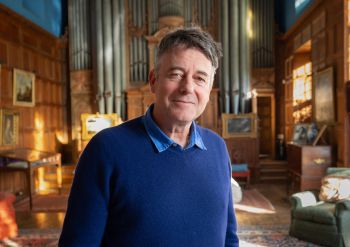
Gus Christie
Gus Christie, who will be conferred Honorary Doctor of Music at Winter Graduation 2026, talks about his 25 years at the helm of his family’s world-famous opera house and festival in East Sussex.
When Gus Christie’s father chose him as the successor for the family business, he admits he was “very daunted”.
The business was Glyndebourne, the world-famous opera house and festival created by his grandparents in the heart of the Sussex countryside in the 1930s. Gus’s father, George, had been running it for nearly 40 years, and had developed what had once been an intimate 300-seater theatre into a state-of-the-art auditorium for 1200.
Gus knew from the age of 19 that his father had singled him out from his three other siblings for the job. But it was not until he was 36, having already established a successful career in wildlife filmmaking, that he stepped into the role.
“Dad didn’t force me, or anything. He just said he just thought I would be quite good at it,” Gus reflects. “I was in two minds. I was with a film crew in the Serengeti – making a documentary about leopards - and I spent a long time in the bush contemplating whether to do it. I had a job I loved that had taken me all over the world and I was very daunted by the whole prospect of taking over a national institution. But I'm glad I did.”
We are chatting in Gus’s office, which overlooks the beautifully manicured lawns and gardens of Glyndebourne - a far cry from the plains of Africa. He has been at the helm here since January 2000. Initially it was ‘in name only’ while George Christie gradually stepped away before fully retiring in 2005.
Although Gus had returned to his childhood home, where he had grown up surrounded by the shining figures of the opera world, he found running the business was something else entirely. “People who had worked here a long time probably thought, who is this upstart? I had to earn their trust and know when to listen.”
Under his leadership, the organisation, which now has around180 permanent staff and stages some120 performances a year, has continued to thrive as an extraordinary cultural experience.
The summer programme still features much-loved operas attended by devotees who dress up for the occasion and picnic in the grounds during the 90-minute intervals. Among the productions lined up for May-August 2026 are Britten’s Billy Budd and Puccini’s Tosca.
But there is also a distinctly 21st century vibe going on at Glyndebourne, with sustainability, community, diversity, and digital innovation all given high priority. And this is largely down to Gus.
He says one of his proudest achievements was installing a 220 ft high wind turbine, which now supplies more than 100% of Glyndebourne’s electricity needs.
It was no easy venture. Despite receiving planning permission in 2008, there was so much opposition from local people and heritage groups that it led to a week-long public inquiry in Lewes.
“Honestly, you could write an opera about it,” laughs Gus. “There were all these horror stories about what it was going to look like and the creeping industrialization of the South Downs.
“But we had Sir David Attenborough as a witness, and he wrote a simple, two-page statement saying the South Downs was already a manmade environment, with loss of woodland and the introduction of sheep, and this was part of the ongoing dynamism of the landscape. He said Glyndebourne should be applauded for attempting to reduce their carbon emissions in this way.”
In 2012 the turbine finally began turning. “Personally, I feel it's an object of beauty because of what it what it's doing,” adds Gus.
Other sustainability initiatives include having a new on-site props and costume-making hub focused on recycling wherever possible, and even a workshop creating clothes dyes made from plants grown in the grounds.
Fortunately, Gus has more than recovered good will among the local residents. In addition to its professional programme, Glyndebourne creates a community opera every three years and does an impressive amount of outreach work.
Last year’s community opera, Uprising, was inspired by climate activist Greta Thunberg and written by Jonathan Dove. It involved more than 140 local people performing in the chorus and the orchestra pit alongside seasoned professionals.
Glyndebourne also has an autumn season of performances, for which half the seats are priced at an affordable level, while their learning and engagement programme involves bringing the joy of singing and music to local care homes and working with dementia groups.
In addition, they run Glyndebourne Academy, a talent-seeking initiative that enables young people from all over the UK to audition for free. If selected, they come to Glyndebourne to learn their art.
“It’s great because we’re enabling those from lesser privileged backgrounds to be coached and we’re seeing many of them progressing to performing on the main stage,” Gus points out.
Gus has made opera accessible in other ways too. In 2007 Glyndebourne became the first opera house in the world to broadcast live digitally across the world.
And during the Covid-19 pandemic in 2020, while other indoor venues were forced to remain dark, he saw the opportunity to create outdoor socially distanced events.
“We set up two stages - one by the lake and one by the courtyard - and had a fantastic programme of music, and then an Offenbach operetta with my wife [opera singer Danielle de Niese] singing the lead while she was six months’ pregnant. It was completely bonkers, really, but it was unique. The staff were thrilled to be doing it, and the audiences were over the moon they had something to go to!”
Now in his early sixties, Gus, realises he will need to hand his baton on one day too. He has four sons from his first marriage, and two children with Danielle, but has yet to single out a successor.
“I’ll know more in five years,” he says. “They’re all doing their own thing at the moment. But I think my five-year-old might be taking after her mother…she really likes to sing.”
Bottom of Form