Engineering and Design news
University of Sussex showcases innovation and technology at EVOLVE 2026
By: Jessica Gowers
Last updated: Monday, 6 July 2026
Held at the Brighton Centre, EVOLVE26 brought together innovators, leaders and creators across technology, business, and education to build meaningful connections and drive real progress towards a better digital future.
Organised around the theme of shaping a sustainable digital future, the event provided a platform for students, academics, professionals, and businesses to explore how technology can deliver a real-world impact and contribute to a more sustainable future.
Based in ‘Innovation Frontiers’, the Innovation and Business Partnerships team worked with academics and students to showcase technology and facilitate potential partnerships with businesses attending the event. The team offered guidance on available funding opportunities (including UKRI and KTP), on routes to collaboration, such as consultancy, directly commissioned research, and licensing, and on matters of intellectual property and consortium development.
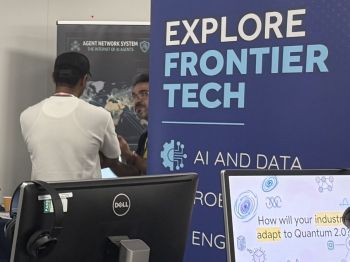
Sussex Innovation presented its “Explore Frontier Tech” showcase structured around four research themes: AI and Data, Robotics and Engineering, Quantum, and Climate. The stands featured a series of live, interactive demonstrations of the University’s research in action.
MetaSonixx showcased its acoustic technology for creating quieter hybrid offices, accompanied by an on-screen demonstration of how sound is controlled across the workspace.
The event was also an opportunity to demonstrate some of the University’s standout assets, including the Quantum Centre of Excellence, opportunities for student engagement, and the Sussex MBA which is currently being offered to local residents with a 50% fee discount.
Kate Thorpe (Head of Innovation and Business Partnerships) hosted the Frontiers in Practice stage during the afternoon alongside a number of other University speakers contributing to the event.
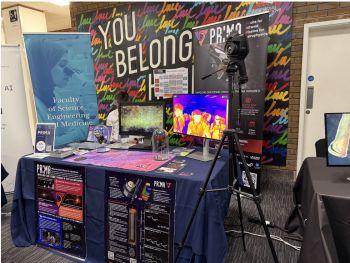
The School of Mathematical and Physical Sciences were represented by Prof Seb Oliver and colleagues. Prof Oliver leads the UK’s effort on PRIMA “The PRobe far-Infrared Mission for Astrophysics”. PRIMA is a new space observatory and if selected, it will become a $1B NASA mission, planned for launch in the 2030s. The UK contributions to PRIMA include highly specialised filters operating at far-infrared wavelengths, precise calibration sources, and critical advanced data-processing algorithms. The stall featured live thermal camera imaging to demonstrate the underlying science.