Why Public Control of Fossil Fuel Resources is Necessary for a Managed Decline of Fossil Fuel Use
Posted on behalf of: J. Mijin Cha and Emily Grubert
Last updated: Monday, 26 October 2026
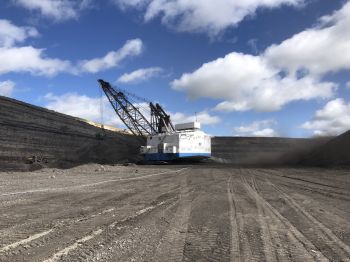
Mining at the Powder River Basin
Reaching and maintaining zero greenhouse gas (GHG) emissions globally is essential for limiting climate change, and doing so requires global fossil fuel phase-out. While necessary for climate considerations, fossil fuel phase-out will be economically and socially disruptive, especially if it is unplanned and pursued haphazardly. A managed decline where energy system transition is planned over several years to coordinate exiting industries with emerging industries presents the best way of limiting disruption.
A managed decline requires long-term and proactive planning to ensure maximum stability. Both of these requirements, however, tend to be counter to private sector demands for profit accumulation. Firms are beholden to investor and shareholder returns, which can lead to an emphasis on short-term gain and less on policies and practices focused on long-term impacts. Firms exiting declining industries are incentivized to extract resources until they are no longer profitable, which may not align with whether or not they are essential, and does not align with the need to coordinate with end-users. The long-term planning and financial support needed to ensure a less disruptive transition are fundamentally incompatible with profit requirements and anti-trust laws.
Supply-side energy policies and incentives have successfully increased renewable energy production both in the U.S. and globally. Yet despite record renewable energy production, there is continued expansion of fossil fuel extraction around the world. There is no substitute for eliminating greenhouse gas emissions and no pathway to addressing the climate crisis that does not effectively eliminate fossil fuel production and use. And, supply side policies alone can not force fossil fuel drawdown.
In a recent paper in Energy Research and Social Science, we argue that an alternative path for managed decline is publicly owning and controlling fossil fuel resources. The United States is an outlier amongst OECD countries because most ownership of these societally embedded assets is private, which poses significant challenges for managing decline in the public interest. Our paper advances the work on public ownership and control by estimating the cost of acquiring fossil fuel assets with a specific focus on coal resources in the Powder River Basin (PRB) in Wyoming. We chose the PRB because the land is federally owned and coal mining is declining in the region, with no supporting transition policies. In short, the cost of acquiring the assets is far outweighed by cost saving of the avoided emissions and potential reclamation costs.
Estimating the cost of publicly acquiring fossil fuel assets
Estimating the value of coal producing assets like those of the PRB is not straightforward. The small number of mines aren't frequently bought and sold, so we don't have many direct market signals of the value of the mine. Stock prices are another common market signal, but many PRB assets are not controlled by publicly traded companies, and those that are are usually lumped together with other kinds of assets. Even more complex is the fact that the future of coal sales is highly dependent on assumptions about the future: how much coal will be mined and sold? How might policy change this? Will mine profit margins change, and what are they right now? These uncertainties challenge our ability to confidently project revenues and profits. One thing we do know, though, is how much states believe reclamation will cost.
Our approach, therefore, is to use multiple strategies to generate estimates for what the mines might be worth. We claim that if we get similar overall estimates using different kinds of data, they're likely robust enough to inform a decision. As we're interested in a publicly managed transition, we also care about other costs society might incur, such as the costs of workforce dislocation and climate change itself.
Overall, we estimated 1) the market value of the coal, generating 36 cases with a combination of empirical data (e.g., actual sales) and modeling assumptions (e.g., how much coal would be produced absent transition); 2) how much workers might have been paid in wages absent transition; and 3) the notional social cost of carbon that might have been emitted absent transition (Figure 1). Our numbers are fundamentally uncertain, but illustrative, and we believe they address some of the most important considerations for what a public takeover of the PRB might cost. Our full paper and its supplementary data include extensive details about the nature of our input data and assumptions, and why we chose to use these specific values.
Figure 1. Approach to estimating financial value of Powder River Basin coal operations (adapted from Fig 1, Cha and Grubert 2026)

Fossil fuel buyout is cost effective and saves public money
PRB assets are collectively worth close to $0 given the significant liabilities and declining asset value of coal, even without considering the trillion-dollar risk posed by business as usual (BAU) operations given climate pollution and impacts. Any costs that would be associated with acquisition, such as clean up or worker transition policies, would ultimately accrue to the public in the case of bankruptcy-driven closures in any case, but without the benefits of managed decline, including control of the creation of additional externalities and public retention of any remaining revenues. In general, recognizing that even from a market perspective, some fossil fuel assets have very low financial value should inform a public approach to acquisition.
Although the US does not have a state-owned coal mining enterprise and relevant operational capacity, many of the considerations related to designing managed decline for phase-out likely apply even in contexts where resources and mining are already publicly controlled. Public ownership is critical, but not sufficient, to drive fossil fuel phase-outs. Demonstrations of managed decline across a set of fossil assets can provide precedents and foster confidence. There is substantial precedent for creating state industrial capacity through a process of returning assets to public control, though 20th century activities were not designed for phase-out. Successful examples of public takeover of resources or services show that it can result in better outcomes for the public, as well as better governance of resources or services.
Managed decline must be a normative goal that informs decision making: without this, public governance is less powerful as a climate action tool. Yet, historical evidence and asset-level incentives suggest that managed decline as a normative goal without public control of decisions about which assets operate or not is unlikely to succeed in a manner that promotes an effective, just transition.
-